Letters to a Friend, Written to Mrs. Ezra S. Carr, 1866-1879
John Muir
THE CLASSIC COLLECTION · 1913
"Irritability: A Physiological Analysis of the General Effect of Stimuli" by Max Verworn is a scientific publication written in the early 20th century. The text appears to focus on the concept of irritability as it pertains to living substances, exploring how different stimuli can affect physiological reactions and the laws governing these responses. The author discusses the historical perspectives on irritability and aims to unite experiments conducted over decades to form a systematic understanding of this fundamental physiological concept. The opening of the work introduces the reader to the historical context surrounding the study of irritability, outlining significant thinkers such as Francis Glisson and Albrecht von Haller, and their contributions to the understanding of living substances' responses to stimuli. Verworn sets the stage for a comprehensive exploration by discussing the philosophical and scientific evolutions that have shaped the field. He emphasizes the importance of studying irritability as a gateway to better understanding life's processes. The author also signals his intention to methodically investigate the effects of stimulation across various biological systems, laying a foundation for the detailed analysis that will follow in the subsequent chapters.
Introduction adapted from the source catalogue; source summaries may be automatically generated.
Free to read · English · 85,158 words · No account needed
MAKE TIME FOR A GOOD BOOK
On by default. Untick to stop anonymous reading totals. Each page counts after 10 seconds in view. How this works.
Anonymous counting is on unless you have switched it off.
Contents: Necessity of cellular physiological analysis of toxic depressions by pharmacology. Apparent variety of processes of depression. Depression of oxydative disintegration as the most extended principle in the processes of depression. Asphyxiation, fatigue, heat depression, as a consequence of restriction of oxydative disintegration. Narcosis. Theories of narcosis. The alteration of specific irritability and conductivity in narcosis. Depression of oxydative processes in narcosis. Asphyxiation of living substance when oxygen is present during narcosis. Persistence of anoxydative disintegration in narcosis. Increase of the same by stimuli. Depression by narcosis as a form of acute asphyxiation. Hypothesis on the mechanism of depression of oxygen exchange by narcotics. Possibility of combining the facts with the observations of Meyer and Overton.
The processes of excitation of all the effects of stimulation are those which have invariably claimed place in the interest of physiologists. The study of the processes of depression, on the other hand, has remained more or less in the background. This is readily understood when it is considered how much more apparent the processes of excitation are than those of depression. Nevertheless, these latter possess no less importance for the course of vital phenomena than those of excitation. Without depression no excitation can take place in the vital activity of the organism, for, as we have seen, every excitation is secondarily followed by a refractory period. To this must be added the great number of primary depressions, directly brought about by the most varied stimuli, such as cold, want of oxygen, poisons, etc., without the presence of a preceding excitation. Thus it is essential that the processes of depression should be studied with no less interest than those of excitation, and it is much to be desired that the former should receive a more detailed analysis than has up to now been the case. Even as it is, extensive material has been obtained for the analysis of this group of reactions. With the closer study of the process of excitation the facts in connection with the refractory period and fatigue make it necessary that the processes of depression be taken into consideration. Toxicology and pharmacology likewise furnish innumerable effects of depression produced by poisons and drugs. Unfortunately the investigation of these reactions has been in the main purely superficial. This arises from the recency of the development of these sciences. Even later than physiology they are only now beginning to extend their investigations, directed up to the present to the grosser organic reactions, to the cellular analysis of the effects of poisons. How rarely we find instances in which the effect of some drug is studied at the point of attack and systematically followed to the specific cell form, and its primary excitating or depressing effect on this or that constituent process of the metabolic activities ascertained. And how great, on the other hand, is the number of “medicines” making their appearance each year in pharmacology of which nothing further is known than a few secondary effects on the action of the heart, the blood pressure, the secretion and excretion and on some other outwardly perceptible organic actions! This deplorable condition of present-day pharmacology must be ascribed to the regrettable circumstances that pharmacological research is only in a very small degree the result of careful investigations, carried out by biologically and chemically trained pharmacologists, but is for the most part undertaken at the instigation of chemical manufacturers. This eager haste to obtain superficially practical results has lessened in great degree the interest in the close and painstaking theoretical analysis of reaction to poisons. Thus it happens that, in spite of the numberless examples of the depressing effects of poisons discovered by pharmacologists, it is only in rare instances that the physical nature of these processes is more closely studied. Therefore, investigation in pharmacology and toxicology in so far as they are carried out in a purely scientific spirit and not influenced by the desire for merely superficial results, may find here a wide field of research work, rich in future promise. It is from such investigation that we may expect an abundance of material for the closer analysis of the processes of depression. For the present, however, we must restrict ourselves to the consideration of some individual cases which have been studied somewhat more in detail by physiologists.
Your reading position is saved on this browser. Take it to another device with a library code. Reading pages adapt to text, rather than matching a printed edition.
BEHIND THE BOOK
This eBook is for the use of anyone anywhere in the United States and most other parts of the world at no cost and with almost no restrictions whatsoever. You may copy it, give it away or re-use it under the terms of the Project Gutenberg License included with this eBook or online at www.gutenberg.org. If you are not located in the United States, you will have to check the laws of the country where you are located before using this eBook. Read the source licence.
The original source file, including credits and licence, is retained by this library. Request an original-format copy at no charge. Please include the book title and Project Gutenberg identifier #66767.
KEEP YOUR CURIOSITY GOING
John Muir
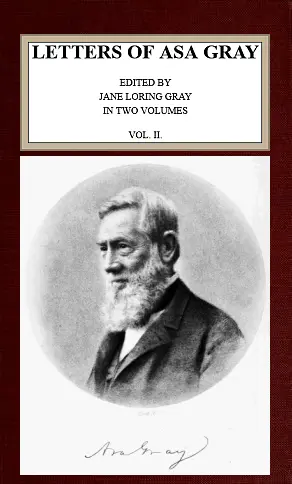
Asa Gray
Asa Gray
Florence Nightingale
Elizabeth Robins Pennell
Denison Olmsted