Letters to a Friend, Written to Mrs. Ezra S. Carr, 1866-1879
John Muir
THE CLASSIC COLLECTION · 1913
"Irritability: A Physiological Analysis of the General Effect of Stimuli" by Max Verworn is a scientific publication written in the early 20th century. The text appears to focus on the concept of irritability as it pertains to living substances, exploring how different stimuli can affect physiological reactions and the laws governing these responses. The author discusses the historical perspectives on irritability and aims to unite experiments conducted over decades to form a systematic understanding of this fundamental physiological concept. The opening of the work introduces the reader to the historical context surrounding the study of irritability, outlining significant thinkers such as Francis Glisson and Albrecht von Haller, and their contributions to the understanding of living substances' responses to stimuli. Verworn sets the stage for a comprehensive exploration by discussing the philosophical and scientific evolutions that have shaped the field. He emphasizes the importance of studying irritability as a gateway to better understanding life's processes. The author also signals his intention to methodically investigate the effects of stimulation across various biological systems, laying a foundation for the detailed analysis that will follow in the subsequent chapters.
Introduction adapted from the source catalogue; source summaries may be automatically generated.
Free to read · English · 85,158 words · No account needed
MAKE TIME FOR A GOOD BOOK
On by default. Untick to stop anonymous reading totals. Each page counts after 10 seconds in view. How this works.
Anonymous counting is on unless you have switched it off.
As the functional constituent members of metabolism involve a disintegration of the nitrogen-free atom groups, the functional self-regulation must necessarily furnish in sufficient quantity and in proper form the carbon, hydrogen and oxygen atoms, which have been removed in the production of carbon dioxide and water. This is accomplished, as is well known, by the food and the intake of oxygen. It is of importance to the maintenance of living substance that after every functional activity it is as soon as possible again capable of reaction. Therefore, it is absolutely necessary that this material is in the proper place, where building up is essential, and is at the same time constantly in proper form. Indeed, the restitution of the original state follows under favorable conditions with lightning rapidity, although varying in different forms of living substance. This occurs in the nerve in an extremely short time. From this it might be supposed that the living system by accumulating a store of the necessary compensation substances in suitable form, had made itself independent to a certain degree of the frequently varying supply of material obtained from the medium.
This may be held as the proper view, first with regard to compensation substances. The fact that living organisms can under some conditions remain for a lengthened period in a state of starvation, without losing their capability of activity, can only be explained by the presence of a great quantity of reserve supplies of compensation substances. In the course of work in the laboratory every physiologist has become acquainted with the fact that frogs which have been kept without food for a year, although much reduced in weight, are still capable of some muscular activity.
Organs and tissue, which are cut off from all food supply through the blood and lymph, may remain active for many hours. H. v. Baeyer[64] has shown that the ganglion cells in the frog, in which saline solution was transfused at room temperature and containing no trace of organic substances and where irritability has been increased to the maximal by means of strychnine, were capable of strenuous work for nine or ten hours before losing responsivity. The nerves and muscles of the animal retain their excitability for even a longer period under the same conditions. Indeed, we have histological evidence of the existence of organic reserve material in the various cells in the form of embedded bodies in the protoplasm. As for instance the disappearance of the Nissl granules in the ganglion cells following great activity,[65] (Figure 12), or that of the granules in infusoria cells during starvation.[66] (Figure 13.) We assume that a certain amount of organic foodstuffs in a state properly prepared is present in the cell. As the amount of these prepared substances is consumed, new quantities of stores, having undergone various preparatory processes, among which the enzymic actions may be considered to play a chief rôle, are brought into that form in which they appear suited to fill the gap produced by disintegration. Plant physiologists in particular have here again furnished us with some essential data for the assumption of the existence of such processes which regulate the transformation of reserve substances as well as its extent. Pfeffer[67] has found in several fungi and bacteria that there exists a compensation between the diastatic breaking down of the carbohydrates stored as reserve material and the quantity of dextrose introduced. He further found that the more the reserve substance is split up into dextrose the less of the latter is introduced from without and vice versa. De Bary[68] some time ago also observed in the bacillus amylobacter an analogous relation between the enzymatic cellular digestion and the quantity of dextrose introduced with the food. An equilibrium, therefore, exists between the required amount of dextrose and the extent of enzymic splitting up processes of the reserve material. A great number of similar processes have been observed. Even though the details of the whole preparatory assimilative processes are beyond our knowledge we can still say with certainty that, on the one hand, everywhere great quantities of organic reserve substances are always present in the cell, and on the other, that these substances are subjected to a transformation into suitable material for building-up processes, the extent of which is controlled according to need, by the processes of self-regulation.
Your reading position is saved on this browser. Take it to another device with a library code. Reading pages adapt to text, rather than matching a printed edition.
BEHIND THE BOOK
This eBook is for the use of anyone anywhere in the United States and most other parts of the world at no cost and with almost no restrictions whatsoever. You may copy it, give it away or re-use it under the terms of the Project Gutenberg License included with this eBook or online at www.gutenberg.org. If you are not located in the United States, you will have to check the laws of the country where you are located before using this eBook. Read the source licence.
The original source file, including credits and licence, is retained by this library. Request an original-format copy at no charge. Please include the book title and Project Gutenberg identifier #66767.
KEEP YOUR CURIOSITY GOING
John Muir
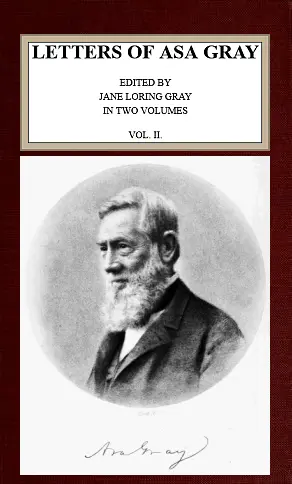
Asa Gray
Asa Gray
Florence Nightingale
Elizabeth Robins Pennell
Denison Olmsted