
The Writing of News A Handbook with Chapters on Newspaper Correspondence and Copy Reading
Charles G. (Charles Griffith) Ross
THE CLASSIC COLLECTION · 1901
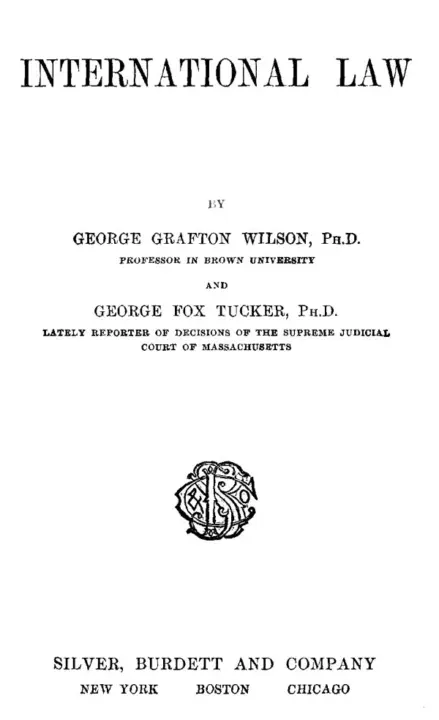
"International Law" by George Grafton Wilson and George Fox Tucker is a scientific publication written in the early 20th century. This work serves as a comprehensive introduction to the principles and practices of international law, emphasizing its growing significance due to increased global interaction and diplomacy. It covers a wide range of topics, from the historical roots and definitions of international law to the rights and obligations of states. The opening of the book begins with a preface explaining the authors' goal to provide a concise introduction to international law, which they believe has become more crucial in light of expanding international negotiations. They note that the text relies on established cases and codes to illustrate key principles, while also preparing appendices for easy reference to supporting materials. The initial chapters introduce foundational concepts, such as the definition of international law, its divisions into public and private law, and its historical development, outlining how these elements interplay within the context of states' relationships and interactions.
Introduction adapted from the source catalogue; source summaries may be automatically generated.
Free to read · English · 111,322 words · No account needed
MAKE TIME FOR A GOOD BOOK
On by default. Untick to stop anonymous reading totals. Each page counts after 10 seconds in view. How this works.
Anonymous counting is on unless you have switched it off.
[54] The internal acts of a de facto state are valid, whatever the attitude of the international circle. As an example, in 1777, during the Revolutionary War, the British governor of Florida made a grant of land in what is now the southern part of the United States. Fifty years later a descendant of the grantee laid claim to the land, but the Supreme Court of the United States declared, "It has never been admitted by the United States that they acquired anything by way of cession from Great Britain by that treaty [of Peace, 1783]. It has been viewed only as a recognition of preëxisting rights, and on that principle the soil and the sovereignty, within their acknowledged limits, were as much theirs at the Declaration of Independence as at this hour. By reference to the treaty, it will be found that it amounts to a simple recognition of the independence and limits of the United States, without any language purporting a cession or relinquishment of the right, on the part of Great Britain ... grants of soil made flagrante bello by the party that fails, can only derive validity from treaty stipulations." Harcourt v. Gaillard, 12 Wheat., 523, 527. See also M'Ilvaine v. Coxe's Lessee, 4 Cr., 209, 212.
[55] Suarez, "De Legibus," 6.
[56] Wheat., D., 41 n.
[57] United States of Central America, Nov. 1, 1898, from Republics of Nicaragua, Salvador, and Honduras.
[58] Japan has been generally recognized since 1894, and her foreign relations have been in course of readjustment.
[59] 1 Whart., § 70.
[60] I. Rivier, §§ 44, 125.
[61] See on this subject 1 Whart., § 70.
[62] 13 Pet., 415. See also Jones v. United States, 137 U. S. 202; Foster v. Neilson, 2 Pet., 253.
[63] State of Mississippi v. Johnson, President, 4 Wall., 475, 500. For late review of the question, see 32 Amer. Law Rev., 390, W. L. Penfield.
[64] I. Rivier, Droit des gens, §§ 3, 11.
[65] Hall, § 26*, note 1, p. 93.
[66] Hall, § 27, p. 100.
[67] Lawrence, § 51, p. 75.
[68] "Political Annuals," since 1887 rich in discussion of
neutralization.
[69] Statesman's Year Book 1901, p. 591.
[70] Ibid., pp. 657, 1237.
[71] 6 American Cycl., 376.
[72] Lawrence, p. 82, § 54.
[73] Wheat., D., note 15, p. 37.
[74] For full discussion see Wilson, "Insurgency" lectures U. S.
Naval College, 1900.
[75] Hall, § 5, p. 31, ff.
[76] 3 Whart., § 381; United States v. "Ambrose Light," 25 Fed. Rep. 408. Snow, 206, "Montezuma."
[77] President Cleveland's Message, Dec. 2, 1885. U. S. For. Rel.
1885, pp. 254, 273.
[78] Parl. Papers, 1887, 1 Peru, 18.
[79] 3 Whart., § 381, "Huascar."
[80] 33 Albany Law Jour., 125.
[81] Lawrence, § 162.
[82] 1885, For. Rel. U. S. 252, 264.
[83] 1885, For. Rel. U. S. 254, 273.
[84] See 3 Whart., § 381; Bluntschli, § 512; Hall, § 5, p. 34; U. S. For. Rel. (1885), 252, 254, 264, 273.
[85] See numerous references in 51 Br. and Fr. St. Papers; also
Hall, § 5, p. 39.
[86] Hall, § 5, p. 35.
[87] Wheat., D., note 15, p. 34.
[88] 1 Whart., §§ 69, 71.
[89] Story, "Santissima Trinidad," 7 Wheat. 354.
[90] Hall, § 83, p. 281.
[91] "Caroline," 1 Whart., § 50 c; 2 ibid., § 224. See Appendix,
p. 434.
[92] 3 Whart., § 327, p. 147. Snow's Cases, § 179.
[93] § 87, p. 291.
[94] Hall, § 87, p. 294.
[95] Von Gentz, "Fragments upon the Balance of Power in Europe,"
1806.
[96] Hume, "Essays," VII.
[97] Nys, "Origines," pp. 165 ff.
[98] Bernard Lectures on "Diplomacy," 98.
[99] Tucker, "Monroe Doctrine," 4.
[100] "The Monroe Doctrine," VI.
[101] See Tucker, "Monroe Doctrine."
Your reading position is saved on this browser. Take it to another device with a library code. Reading pages adapt to text, rather than matching a printed edition.
BEHIND THE BOOK
This eBook is for the use of anyone anywhere in the United States and most other parts of the world at no cost and with almost no restrictions whatsoever. You may copy it, give it away or re-use it under the terms of the Project Gutenberg License included with this eBook or online at www.gutenberg.org. If you are not located in the United States, you will have to check the laws of the country where you are located before using this eBook. Read the source licence.
The original source file, including credits and licence, is retained by this library. Request an original-format copy at no charge. Please include the book title and Project Gutenberg identifier #41759.
KEEP YOUR CURIOSITY GOING
Charles G. (Charles Griffith) Ross
Hannah Webster Foster

Emily Lawless
Edwin Hamlin Carr

Charles De Lano Hine
Andrew Ure