
The Writing of News A Handbook with Chapters on Newspaper Correspondence and Copy Reading
Charles G. (Charles Griffith) Ross
THE CLASSIC COLLECTION · 1901
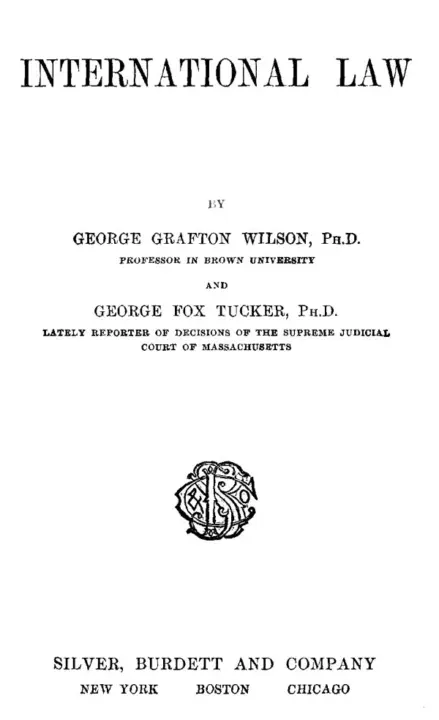
"International Law" by George Grafton Wilson and George Fox Tucker is a scientific publication written in the early 20th century. This work serves as a comprehensive introduction to the principles and practices of international law, emphasizing its growing significance due to increased global interaction and diplomacy. It covers a wide range of topics, from the historical roots and definitions of international law to the rights and obligations of states. The opening of the book begins with a preface explaining the authors' goal to provide a concise introduction to international law, which they believe has become more crucial in light of expanding international negotiations. They note that the text relies on established cases and codes to illustrate key principles, while also preparing appendices for easy reference to supporting materials. The initial chapters introduce foundational concepts, such as the definition of international law, its divisions into public and private law, and its historical development, outlining how these elements interplay within the context of states' relationships and interactions.
Introduction adapted from the source catalogue; source summaries may be automatically generated.
Free to read · English · 111,322 words · No account needed
MAKE TIME FOR A GOOD BOOK
On by default. Untick to stop anonymous reading totals. Each page counts after 10 seconds in view. How this works.
Anonymous counting is on unless you have switched it off.
(a) To use arms, projectiles, or substances calculated to inflict superfluous suffering, or to aggravate wounds, particularly projectiles which, being explosible, or charged with fulminating or inflammable substances, weigh less than four hundred grams. (Declaration of St. Petersburg.)[497]
(b) To mutilate or kill an enemy who has surrendered at discretion, or is disabled, and to declare that quarter will not be given, even if the force making such declaration does not claim quarter for itself.
(c) Of wounded, sick, and the hospital staff
The wounded, the sick, and the hospital staff are exempted from unnecessary severities, which might otherwise touch them, by the following rules (Arts. 10 to 18), drawn from the Convention of Geneva.
10. Wounded and sick soldiers must be brought in and cared for, to
whatever nation they belong.
11. When circumstances permit, officers commanding in chief, immediately after a combat, may send in enemy soldiers wounded during it to the advanced posts of the enemy, with the consent of the latter.
12. The operation of moving sick and wounded is a neutral act, and the staff engaged in it is neutral.
13. The staff of the hospitals and ambulances--namely, surgeons, clerks, hospital orderlies, and other persons employed in the sanitary, administrative, and transport departments, as well as chaplains, and members and agents of societies duly authorized to assist the official hospital staff--is considered to be neutral while exercising its functions, and so long as there are wounded to remove or succor.
14. The staff specified in the preceding Article must continue after occupation by an enemy has taken place to give its attention to the sick and wounded, to such extent as may be needful, in the ambulance or hospital which it serves.
15. When such staff applies for leave to retire, it falls to the officer commanding the occupying troops to fix the date of departure. After request, however, has been made, the departure of the staff can only be postponed for a short time, and for reasons of military necessity.
16. Measures must, if possible, be taken to secure to the neutralized staff fitting maintenance and allowance when it falls into the hands of the enemy.
17. The neutralized hospital staff must wear a white armlet with a red cross on it. The armlet can be issued only by the military authorities.
18. It is the duty of the generals of the belligerent Powers to appeal to the humanity of the inhabitants of the country in which they are operating, for the purpose of inducing them to succor the wounded, pointing out to them at the same time the advantages which result to themselves therefrom (Arts. 36 and 59). Those who respond to any such appeal are entitled to special protection.
(d) Of the dead
Your reading position is saved on this browser. Take it to another device with a library code. Reading pages adapt to text, rather than matching a printed edition.
BEHIND THE BOOK
This eBook is for the use of anyone anywhere in the United States and most other parts of the world at no cost and with almost no restrictions whatsoever. You may copy it, give it away or re-use it under the terms of the Project Gutenberg License included with this eBook or online at www.gutenberg.org. If you are not located in the United States, you will have to check the laws of the country where you are located before using this eBook. Read the source licence.
The original source file, including credits and licence, is retained by this library. Request an original-format copy at no charge. Please include the book title and Project Gutenberg identifier #41759.
KEEP YOUR CURIOSITY GOING
Charles G. (Charles Griffith) Ross
Hannah Webster Foster

Emily Lawless
Edwin Hamlin Carr

Charles De Lano Hine
Andrew Ure