
The Writing of News A Handbook with Chapters on Newspaper Correspondence and Copy Reading
Charles G. (Charles Griffith) Ross
THE CLASSIC COLLECTION · 1901
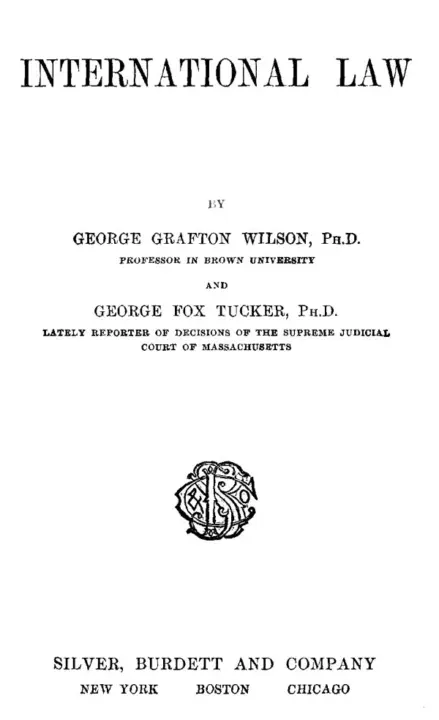
"International Law" by George Grafton Wilson and George Fox Tucker is a scientific publication written in the early 20th century. This work serves as a comprehensive introduction to the principles and practices of international law, emphasizing its growing significance due to increased global interaction and diplomacy. It covers a wide range of topics, from the historical roots and definitions of international law to the rights and obligations of states. The opening of the book begins with a preface explaining the authors' goal to provide a concise introduction to international law, which they believe has become more crucial in light of expanding international negotiations. They note that the text relies on established cases and codes to illustrate key principles, while also preparing appendices for easy reference to supporting materials. The initial chapters introduce foundational concepts, such as the definition of international law, its divisions into public and private law, and its historical development, outlining how these elements interplay within the context of states' relationships and interactions.
Introduction adapted from the source catalogue; source summaries may be automatically generated.
Free to read · English · 111,322 words · No account needed
MAKE TIME FOR A GOOD BOOK
On by default. Untick to stop anonymous reading totals. Each page counts after 10 seconds in view. How this works.
Anonymous counting is on unless you have switched it off.
[21] The Amphyetionic League recognized some principles of interstate right and comity, as well as preserved Grecian institutions and religious traditions. This is shown in the oath of the members, "We will not destroy any Amphyctionic town nor cut it off from running water, in war or peace; if any one shall do this, we will march against him and destroy his city. If any one shall plunder the property of the god, or shall be cognizant thereof, or shall take treacherous counsel against the things in his temple at Delphi, we will punish him with foot and hand and voice, and by every means in our power." They also agreed to make and observe humane rules of warfare. See also Bluntschli, "Völkerrecht," Introduction.
[22] Maine, "Ancient Law," Ch. III. The idea as to what jus gentium was, of course varied with times. Under the Empire it lost its old meaning. See Cicero, "De Officiis," III., 17; Livy, VI., 17; IX., 11; I., 14; V., 36; Sallust, "Bell. Jug.," XXII.; Tacitus, "Ann.," 1, 42; "Quintus Curtius," IV., 11, 17.
[23] Bryce, "Holy Roman Empire," Ch. VII.
[24] Bryce, "Holy Roman Empire," Chs. VII, and XV. The "Truce of God" introduced by the clergy (1034) left only about eighty days in a year for fighting and settling feuds.
[25] On effects of Crusades, see Milman, "Latin Christianity," VII., 6; Hallam, "Middle Ages," Ch. III., Pt. I.; Bryce, "Holy Roman Empire," Chs. XI., XIII.
[26] Hall, § 268, p. 740.
[27] Laws of Wisby contain early reference to marine insurance, §
66.
[28] Expanded in 1614.
[29] De Valroger, "Droit Maritime," I., § 1.
[30] The Marine Ordinance of Louis XIV, 1681, became the basis of
sea law.
[31] With the decline of the influence of the "Holy Roman Empire," the use of Latin in diplomacy became less general.
[32] Abbé Saint-Pierre, in three volumes, 1729, "Abrégé du Projet de Paix perpétuelle," outlines a plan for peace by fixed system of balance of power.
[33] "Institutes," II., 1, 21, 22.
[34] Declaration of Russia, Feb. 28, 1780.
[35] The works of Moser (1701-1786) and his immediate followers attempt to make practical the principles of International Law.
[36] I. Hertslet, 317.
[37] I. Hertslet, 573.
[38] Ibid., 658.
[39] Hall, § 88, p. 297.
[40] Walker, "Hist. Law of Nations," pp. 283, 336.
[41] See p. xix for list of authors and works.
[42] Jenks, "Law and Politics in the Middle Ages," p. 30.
[43] The Santa Cruz, 1 C. Rob., 49, 61.
[44] Act of Congress, March 3, 1891. 26 U. S. Sts. at Large, 826.
[45] Lawrence, § 64.
[46] Bolton v. Gladstone, 5 East, 155, 160.
[47] United States v. Rauscher, 1886, 119 U. S., 407.
[48] United States Constitution, Art. III., § 2. For English view, see Walker, p. 46, who quotes 3 Burr, 1480.
[49] Declarations, protocols, conventions, proclamations, notes,
etc.
[50] III. Hertslet, 1904.
[51] Holtzendorff, "Introduction droit public," 44.
[52] Hall, § 1 p. 18; I., Rivier, § 3, 9, I.
[53] Hall, § 1, p. 20.
Your reading position is saved on this browser. Take it to another device with a library code. Reading pages adapt to text, rather than matching a printed edition.
BEHIND THE BOOK
This eBook is for the use of anyone anywhere in the United States and most other parts of the world at no cost and with almost no restrictions whatsoever. You may copy it, give it away or re-use it under the terms of the Project Gutenberg License included with this eBook or online at www.gutenberg.org. If you are not located in the United States, you will have to check the laws of the country where you are located before using this eBook. Read the source licence.
The original source file, including credits and licence, is retained by this library. Request an original-format copy at no charge. Please include the book title and Project Gutenberg identifier #41759.
KEEP YOUR CURIOSITY GOING
Charles G. (Charles Griffith) Ross
Hannah Webster Foster

Emily Lawless
Edwin Hamlin Carr

Charles De Lano Hine
Andrew Ure