
The Writing of News A Handbook with Chapters on Newspaper Correspondence and Copy Reading
Charles G. (Charles Griffith) Ross
THE CLASSIC COLLECTION · 1901
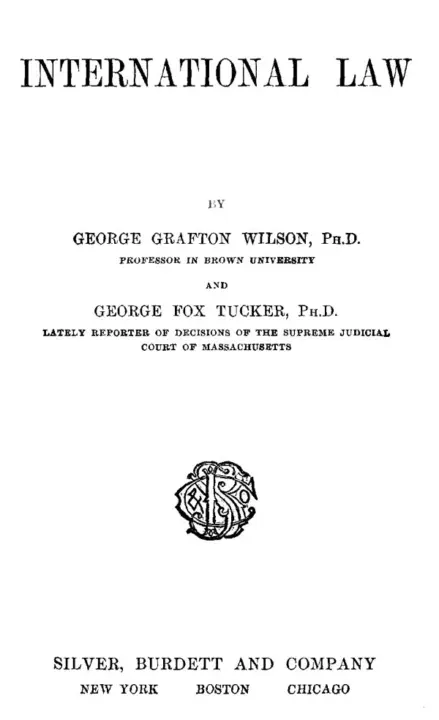
"International Law" by George Grafton Wilson and George Fox Tucker is a scientific publication written in the early 20th century. This work serves as a comprehensive introduction to the principles and practices of international law, emphasizing its growing significance due to increased global interaction and diplomacy. It covers a wide range of topics, from the historical roots and definitions of international law to the rights and obligations of states. The opening of the book begins with a preface explaining the authors' goal to provide a concise introduction to international law, which they believe has become more crucial in light of expanding international negotiations. They note that the text relies on established cases and codes to illustrate key principles, while also preparing appendices for easy reference to supporting materials. The initial chapters introduce foundational concepts, such as the definition of international law, its divisions into public and private law, and its historical development, outlining how these elements interplay within the context of states' relationships and interactions.
Introduction adapted from the source catalogue; source summaries may be automatically generated.
Free to read · English · 111,322 words · No account needed
MAKE TIME FOR A GOOD BOOK
On by default. Untick to stop anonymous reading totals. Each page counts after 10 seconds in view. How this works.
Anonymous counting is on unless you have switched it off.
Formerly the public property of the enemy, whatever its nature, was regarded as hostile, and liable to seizure. Practice of modern times has gradually become less extreme, and the attitude of the powers in restoring the works of art which Napoleon had brought to Paris shows the sentiment early in the nineteenth century. The practice in regard to public property of the enemy has now become fairly defined.
The public property of one belligerent state within the territory of the other at the outbreak of war, if real property, may be administered during the war for the benefit of the local state; if movable, it is liable to confiscation. Works of art, scientific and educational property, and the like are, however, exempt.[309] The Treaty of Aug. 20, 1890, between Great Britain and France, exempts public vessels employed in the postal service.
In case one belligerent by military occupation acquires authority over territory formerly within the jurisdiction of the other, the rules of the Hague Conference of 1899 provide as follows:--
"+Art. 53.+ An army of occupation can only take possession of the cash, funds, and property liable to requisition belonging strictly to the State, depots of arms, means of transport, stores and supplies, and generally, all movable property of the State which may be used for military operations.
"Railway plant, land telegraphs, telephones, steamers, and other ships, apart from cases governed by maritime law, as well as depots of arms and, generally, all kinds of war material, even though belonging to Companies or to private persons, are likewise material which may serve for military operations, but they must be restored at the conclusion of peace, and indemnities paid for them."
"+Art. 55.+ The occupying state shall only be regarded as administrator and usufructuary of public buildings, real property, forests, and agricultural works belonging to the hostile State, and situated in the occupied country. It must protect the capital of these properties, and administer it according to the rules of trusteeship.
"+Art. 56.+ The property of municipalities, that of religious, charitable, and educational institutions, and those of arts and science, even when State property, shall be treated as private property.
"All seizure, destruction of, or intentional damage done to such institutions, to historical monuments, works of art or science, is prohibited, and should he made the subject of civil and criminal proceedings."[310]
§ 103. Real Property of Enemy Subjects
The real property of the subject of one belligerent situated within the territory of the other belligerent was in early times appropriated by the state, later practice administered it during the war, for the benefit of the state; but at present it is treated as the real property of any non-hostile foreigner.
Your reading position is saved on this browser. Take it to another device with a library code. Reading pages adapt to text, rather than matching a printed edition.
BEHIND THE BOOK
This eBook is for the use of anyone anywhere in the United States and most other parts of the world at no cost and with almost no restrictions whatsoever. You may copy it, give it away or re-use it under the terms of the Project Gutenberg License included with this eBook or online at www.gutenberg.org. If you are not located in the United States, you will have to check the laws of the country where you are located before using this eBook. Read the source licence.
The original source file, including credits and licence, is retained by this library. Request an original-format copy at no charge. Please include the book title and Project Gutenberg identifier #41759.
KEEP YOUR CURIOSITY GOING
Charles G. (Charles Griffith) Ross
Hannah Webster Foster

Emily Lawless
Edwin Hamlin Carr

Charles De Lano Hine
Andrew Ure