
The Writing of News A Handbook with Chapters on Newspaper Correspondence and Copy Reading
Charles G. (Charles Griffith) Ross
THE CLASSIC COLLECTION · 1901
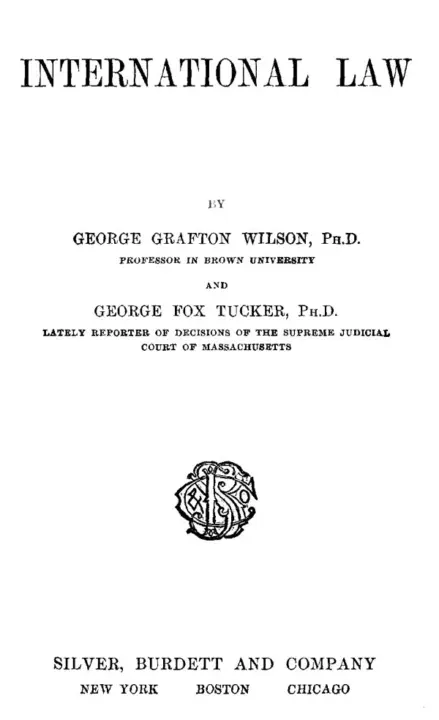
"International Law" by George Grafton Wilson and George Fox Tucker is a scientific publication written in the early 20th century. This work serves as a comprehensive introduction to the principles and practices of international law, emphasizing its growing significance due to increased global interaction and diplomacy. It covers a wide range of topics, from the historical roots and definitions of international law to the rights and obligations of states. The opening of the book begins with a preface explaining the authors' goal to provide a concise introduction to international law, which they believe has become more crucial in light of expanding international negotiations. They note that the text relies on established cases and codes to illustrate key principles, while also preparing appendices for easy reference to supporting materials. The initial chapters introduce foundational concepts, such as the definition of international law, its divisions into public and private law, and its historical development, outlining how these elements interplay within the context of states' relationships and interactions.
Introduction adapted from the source catalogue; source summaries may be automatically generated.
Free to read · English · 111,322 words · No account needed
MAKE TIME FOR A GOOD BOOK
On by default. Untick to stop anonymous reading totals. Each page counts after 10 seconds in view. How this works.
Anonymous counting is on unless you have switched it off.
Netherlands, sale of territory by, to Great Britain, 101; convention of, as to Suez Canal, 111.
Neutral goods, capture of, 247, 299 et seq.
Neutrality, proclamation of, 60;
of goods, 247;
submarine telegraphic cables, 248;
definition and history of, 275-284;
laws of United States as to, 283, 296;
of nations during war between Spain and the United States, 283;
as to departure of hostile vessels from neutral ports, 291;
British regulations as to, 291 n.;
as to direct assistance, 293-295;
obligations of state, 295-297;
ordinary commerce in case of, 299-303;
contraband in ease of, 303-307;
unneutral service in case of, 308-310;
visit and search in case of, 310-313;
convoy in care of, 313, 314;
blockade, 314-319;
violation of blockade, 319, 320;
continuous voyages, 320-324;
prize and prize courts, 324-328.
Neutrality statutes of United States, 283, 417-420.
Neutralization of states, 51, 52;
forms of, 277-280.
Non-combatants, who are, 237, 238.
Non-hostile redress, what is, 220.
North Sea fisheries, convention as to, 114.
Notes, what they are, 171, 200, 212.
Notification of blockade, 316, 317.
Nuncios, rules as to, 156 et seq.
See Ambassadors, Diplomatic Agents.
Occupation, a method of acquiring territory, 98, 99;
belligerent, 250, 252.
Officers of merchant vessels, status of, 236.
Oleron, laws of. See Sea Laws.
Oriental states, exemption of subjects of Western states in, 139-141.
Oxford Manual, provisions of, 368, 381.
Pacific Blockade, what it is, 223-225.
Paris, treaty of, 206.
Parole, release on, 263.
Passengers, capture of, 258.
Passport, form of, 133;
of diplomatic agent, 163, 171;
given in time of war, 266.
Peace of Westphalia, relation of, to the balance of power, 75;
recognition of diplomacy by, 154, 155;
preceded by armistice, 272.
Perfidy. See Deceit.
Personal property, status of, in war, 241-244.
Persons, jurisdiction over, 121;
status of, in war, 235, et seq.
Philippines, sale of, to the United States, 101.
Pillage, prohibition of, 142.
Poison, use of, forbidden in war, 253.
Poland, partition of, 22, 76, 101.
Political refugees. See Right of Asylum.
Ports, neutrality of, 287.
Portugal, partition of Africa by, 103;
jurisdiction of, as to foreign-born subjects, 123;
relations of, to Terceira affair, 288.
Postal communication, cartels as to, 265.
Postliminium, what it is, 260.
Prescription, acquisition of territory by, 101, 102.
Prestation. See Angary.
Prisoners of war, treatment of, 262-264;
exchange of, 265;
when must be restored, 268;
treaties as to, 273.
Privateering, history of, 254;
action of, M. Gênet as to, 282.
Private international law, of what it treats, 4, 122, 146.
Private property of enemy, capture of, at sea, 247, 300 et seq.; inviolability of, on land, 252.
Private vessels, liability of, to capture, 245;
exemption of, 246.
Prize, courts of, 30;
disposition of, 258, 259;
salvage in case of, 260, 261;
taking of, into neutral waters, 293;
attitude of Japan as to, 313, 314;
law of, 324-328;
procedure as to, in court, 421-429.
Prize courts. See Prize.
Prize law of Japan, 246.
Procès-verbaux. See Protocol.
Proclamation of the United States as to the Declaration of Paris, 33;
of Queen Victoria as to belligerency, 60;
of treaties, 209;
of the United States as to war with Spain, 222;
of blockade, 230, 231.
Your reading position is saved on this browser. Take it to another device with a library code. Reading pages adapt to text, rather than matching a printed edition.
BEHIND THE BOOK
This eBook is for the use of anyone anywhere in the United States and most other parts of the world at no cost and with almost no restrictions whatsoever. You may copy it, give it away or re-use it under the terms of the Project Gutenberg License included with this eBook or online at www.gutenberg.org. If you are not located in the United States, you will have to check the laws of the country where you are located before using this eBook. Read the source licence.
The original source file, including credits and licence, is retained by this library. Request an original-format copy at no charge. Please include the book title and Project Gutenberg identifier #41759.
KEEP YOUR CURIOSITY GOING
Charles G. (Charles Griffith) Ross
Hannah Webster Foster

Emily Lawless
Edwin Hamlin Carr

Charles De Lano Hine
Andrew Ure