
The Writing of News A Handbook with Chapters on Newspaper Correspondence and Copy Reading
Charles G. (Charles Griffith) Ross
THE CLASSIC COLLECTION · 1901
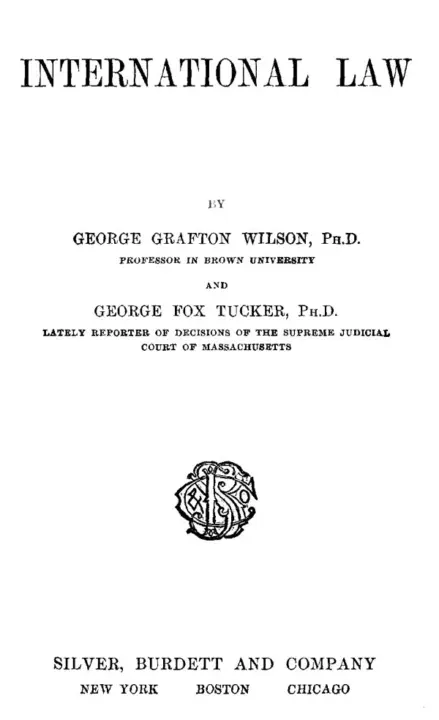
"International Law" by George Grafton Wilson and George Fox Tucker is a scientific publication written in the early 20th century. This work serves as a comprehensive introduction to the principles and practices of international law, emphasizing its growing significance due to increased global interaction and diplomacy. It covers a wide range of topics, from the historical roots and definitions of international law to the rights and obligations of states. The opening of the book begins with a preface explaining the authors' goal to provide a concise introduction to international law, which they believe has become more crucial in light of expanding international negotiations. They note that the text relies on established cases and codes to illustrate key principles, while also preparing appendices for easy reference to supporting materials. The initial chapters introduce foundational concepts, such as the definition of international law, its divisions into public and private law, and its historical development, outlining how these elements interplay within the context of states' relationships and interactions.
Introduction adapted from the source catalogue; source summaries may be automatically generated.
Free to read · English · 111,322 words · No account needed
MAKE TIME FOR A GOOD BOOK
On by default. Untick to stop anonymous reading totals. Each page counts after 10 seconds in view. How this works.
Anonymous counting is on unless you have switched it off.
Internment of belligerent troops, 286, 290.
Interpretation of treaties, 212-214.
Intervention in affairs of other nations, 77-87.
Ionian Islands, protectorate of, 23, 214.
Islands, title to, when formed in rivers, 102.
Italy, one of the Great Powers, 90;
relation of, to the Triple Alliance, 92;
partition of Africa by, 103;
convention of, as to the Suez Canal, 111.
Jackson, President, attitude of, as to the Falkland Islands, 46.
Japan, recognition of, 43, 44;
jurisdiction of, over aliens, 131, 132;
freedom of Emperor of, from suit, 136;
treaty of United States with, as to consular functions, 193;
termination of treaty of, with China, 215;
prize law of, 246, 313;
treaty of peace of, with China, 272;
attitude of, as to convoy, 314.
Jettison of cargo, 13.
Jurisdiction of states, 69, 94 et seq.;
of diplomatic agents, 175-182;
consuls, 193-196;
over non-combatants, 237;
neutral territorial, 286-289;
in case of blockade, 314-324;
as to prize courts, 325. See International Law.
Jus belli, early international law, 13.
Jus fetiale, defined, 7, 13.
Jus gentium, defined, 7, 14.
Jus inter gentes, defined, 7, 14.
Jus naturale, defined, 6.
Koszta, case of, 129, 130.
Lakes, change in, as affecting territory, 102.
Language used in treaties, 205, 206;
in diplomacy, 170 n. 3.
Law of nations, term long used, 8.
Laws of Antwerp. See Sea Laws.
Laws of Oleron. See Sea Laws.
Laws of the Rhodians, fragment of, 13.
See Sea Laws.
Legates, rules as to, 156, et seq.
See Ambassadors, Diplomatic Agents.
Letter of credence, form of, 164.
Letters, in diplomatic relations, 200, 201.
Letters of marque. See Privateering.
Levies en masse, as combatants, 236, 262.
Liberia, recognition of, 44.
Licenses to trade, 266, 267.
Lien, right of state to enforce, 98.
Lincoln, President, proclamation of, as to blockade, 231, 317 n.
Loans of money, by neutral to belligerent state, 295;
by citizens of a neutral state, 295.
Luxemburg, neutralization of, 52, 278.
Madagascar, protectorate of, 53.
Mails and mail steamers, under neutral flag, 309.
Marcy, Secretary, as to naturalization, 128.
Mare Clausum, rule of, as to Bering Sea, 116.
Marine League. See Three-mile limit.
Maritime ceremonials, in salutes, 89.
Maritime war. See Neutrality.
Marriage, as affecting nationality, 125;
performed by diplomatic agent, 172.
McKinley, President, message of, as to Cuba, 85;
proclamation of as to blockade, 317 n.
Mediation. See Good Offices.
Memoranda, what they are, 171, 200.
Messages, transmission of, 310.
Milan decree of Napoleon, 315.
Military assistance not to be furnished by neutral to belligerent, 293.
Ministers, jurisdiction of Supreme Court as to, 31.
See Ambassadors, Diplomatic Agents.
Money, as contraband of war, 305.
Monroe Doctrine, history of 77;
position of United States as to, 93.
Monroe, President, author of Monroe Doctrine, 77.
Montenegro, recognition of, 44.
"Most favored nation," what it means in treaties, 213, 214.
Munitions of war, sales of, by neutral, 294.
See Supplies of war.
Napoleon Bonaparte, relation of, to Monroe Doctrine, 77;
sale of Louisiana by, 101;
Berlin decrees of, 222, 315;
Milan decrees of, 315.
Natural-born subjects, jurisdiction over, 122.
Naturalization, law as to, 125-130.
Naval war code of the United States, 222, 400-416.
Navigation of rivers, 106-108.
Navy, exemption of, from local jurisdiction, 138.
Your reading position is saved on this browser. Take it to another device with a library code. Reading pages adapt to text, rather than matching a printed edition.
BEHIND THE BOOK
This eBook is for the use of anyone anywhere in the United States and most other parts of the world at no cost and with almost no restrictions whatsoever. You may copy it, give it away or re-use it under the terms of the Project Gutenberg License included with this eBook or online at www.gutenberg.org. If you are not located in the United States, you will have to check the laws of the country where you are located before using this eBook. Read the source licence.
The original source file, including credits and licence, is retained by this library. Request an original-format copy at no charge. Please include the book title and Project Gutenberg identifier #41759.
KEEP YOUR CURIOSITY GOING
Charles G. (Charles Griffith) Ross
Hannah Webster Foster

Emily Lawless
Edwin Hamlin Carr

Charles De Lano Hine
Andrew Ure