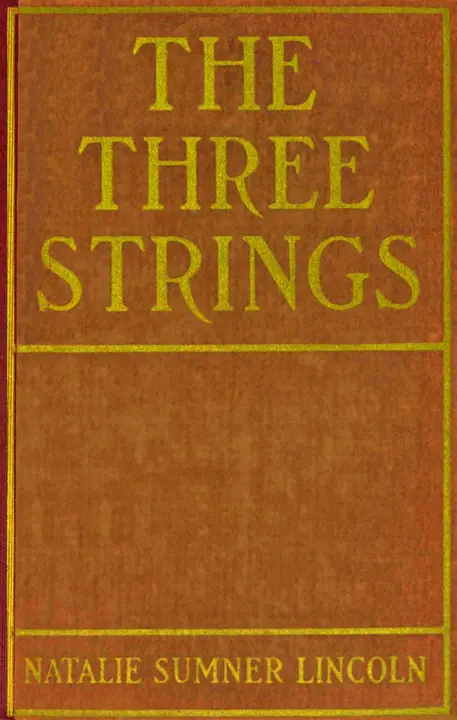
The three strings
Natalie Sumner Lincoln
THE CLASSIC COLLECTION · 1916
"I Spy" by Natalie Sumner Lincoln is a novel written during the early 20th century, around the time of World War I. The story unfolds against the backdrop of war, espionage, and the emotional struggles of its characters, particularly highlighting familial and romantic tensions amidst the chaos of the time. The narrative introduces John Hargraves, a young officer about to leave for the front, and explores his relationships with his uncle, Sir Percival Hargraves, and the women in his life, including Kathleen, an American girl who plays a significant role in his emotional journey. The opening of "I Spy" establishes a tense atmosphere, set in November 1914, where John and his uncle discuss the war and the undercurrents of espionage affecting England. Their conversation reveals deep concerns over the German Secret Service's influence within England, illustrating the pervasive anxiety of the time. Shortly after, John departs for Victoria Station, where he encounters a mysterious man associated with the German spy network. The chapter skillfully sets the stage for the unfolding drama, hinting at elements of intrigue, danger, and romance while introducing key characters whose lives are intricately connected to the war. As the story progresses, it promises to delve into themes of loyalty, love, and the impact of war on personal lives.
Introduction adapted from the source catalogue; source summaries may be automatically generated.
Free to read · English · 61,719 words · No account needed
MAKE TIME FOR A GOOD BOOK
On by default. Untick to stop anonymous reading totals. Each page counts after 10 seconds in view. How this works.
Anonymous counting is on unless you have switched it off.
"Did he ever show deep interest in it?"
"Only questioned me about it now and then," replied Whitney casually, and Charles Miller alone noted the nervous twitching of his eyelids.
"Was the electric light turned on in Mr. Spencer's room when you left him
for the night?"
"Y-yes." Whitney reflected for a moment, then added, "I believe the bulb by the bureau was burning, but I can't swear to it."
"Did Mr. Spencer give you any inkling Tuesday night that he intended to be an early riser on Wednesday morning?"
"No, he never mentioned the subject."
"Was it his custom on previous visits, to walk about your house before
the servants were up?"
"Not that I am aware of," Whitney hesitated. "Possibly his intoxicated condition made him desire the fresh air."
"That is possible," admitted the coroner. "But witnesses testify that Mr. Spencer had on no shoes."
"Which confirms my statement of his condition," replied Whitney quietly. "No man in his sober senses seeks the street in his stockings."
The coroner, making no comment, held up the knife with the black bone handle. "Have you ever seen this knife before?"
Whitney turned a shade whiter. "I may have; there is nothing distinctive
about the knife."
"Is it not used for modeling in clay?"
"I believe so."
"Who made the clay models in your studio, Mr. Whitney?"
"I did."
"Unassisted?"
The question remained unanswered, and after a brief pause the coroner pushed back his chair and rose. "That is all, thank you, Mr. Whitney; kindly wait in the adjoining room to the left; you will find a chair there."
With a stiff bow Whitney stepped down from the platform and made his way through the silent crowd to the room indicated.
As the door closed behind him, Penfield called the deputy coroner to the stand. Laying down his pen, Dr. North took his seat in the witness chair, and after being sworn, turned to face the jurors, chart in hand.
"You made the autopsy upon Mr. Sinclair Spencer?" questioned Penfield.
"I did, Doctor, in the presence of the morgue master."
"Please state to the jury the result of that autopsy."
The deputy coroner glanced at the notes on the back of the chart, then reversed it, holding it aloft so that all in the room could see the anatomical drawing of a human figure.
"The knife penetrated this section of the neck, just missing the carotid artery," he began, using his pencil to indicate the spot marked on the chart. "While the wound bled profusely it was superficial and did not cause death."
Your reading position is saved on this browser. Take it to another device with a library code. Reading pages adapt to text, rather than matching a printed edition.
Natalie Sumner Lincoln
Natalie Sumner Lincoln
Natalie Sumner Lincoln
Natalie Sumner Lincoln
BEHIND THE BOOK
This eBook is for the use of anyone anywhere in the United States and most other parts of the world at no cost and with almost no restrictions whatsoever. You may copy it, give it away or re-use it under the terms of the Project Gutenberg License included with this eBook or online at www.gutenberg.org. If you are not located in the United States, you will have to check the laws of the country where you are located before using this eBook. Read the source licence.
The original source file, including credits and licence, is retained by this library. Request an original-format copy at no charge. Please include the book title and Project Gutenberg identifier #9812.
KEEP YOUR CURIOSITY GOING
Coulson Kernahan

Maurice Baring
Frances Wright
Cécile Tormay

Frederic Jesup Stimson

W. H. P. (William Henry Pope) Jarvis