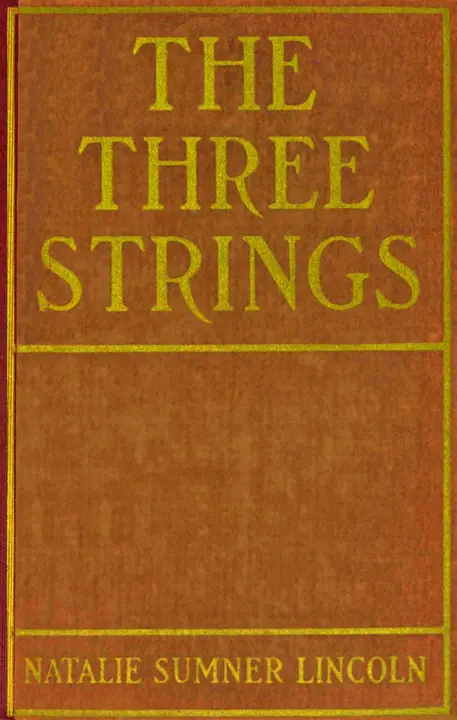
The three strings
Natalie Sumner Lincoln
THE CLASSIC COLLECTION · 1916
"I Spy" by Natalie Sumner Lincoln is a novel written during the early 20th century, around the time of World War I. The story unfolds against the backdrop of war, espionage, and the emotional struggles of its characters, particularly highlighting familial and romantic tensions amidst the chaos of the time. The narrative introduces John Hargraves, a young officer about to leave for the front, and explores his relationships with his uncle, Sir Percival Hargraves, and the women in his life, including Kathleen, an American girl who plays a significant role in his emotional journey. The opening of "I Spy" establishes a tense atmosphere, set in November 1914, where John and his uncle discuss the war and the undercurrents of espionage affecting England. Their conversation reveals deep concerns over the German Secret Service's influence within England, illustrating the pervasive anxiety of the time. Shortly after, John departs for Victoria Station, where he encounters a mysterious man associated with the German spy network. The chapter skillfully sets the stage for the unfolding drama, hinting at elements of intrigue, danger, and romance while introducing key characters whose lives are intricately connected to the war. As the story progresses, it promises to delve into themes of loyalty, love, and the impact of war on personal lives.
Introduction adapted from the source catalogue; source summaries may be automatically generated.
Free to read · English · 61,719 words · No account needed
MAKE TIME FOR A GOOD BOOK
On by default. Untick to stop anonymous reading totals. Each page counts after 10 seconds in view. How this works.
Anonymous counting is on unless you have switched it off.
Charles Miller, completing a hurried toilet, paused at the sound of a sharp rap on his bedroom door.
"Come in," he called. "Ah, Henry, good morning," as the chauffeur stepped briskly over the threshold. The latter's white face and agitated manner indicated that he was the bearer of portentous news. Miller made a hasty step in his direction.
"Kathleen--is she ill?" he asked.
The chauffeur looked to see that the bedroom door was securely fastened
before he answered.
"It isn't Miss Kathleen," he answered cautiously. "Mr. Whitney has had
a stroke."
"What?" Miller recoiled. "When?"
"Some time last night."
"Will he recover?"
"Dr. McLane says that he cannot tell yet, Herr Captain. He was alive but still unconscious when I left the house to come here."
"What"--Miller looked anxiously at the chauffeur--"what brought on the stroke? Mr. Whitney appeared to be in robust health when I saw him last."
"The Doctor seemed to think it was caused by sudden shock, Herr Captain." Henry stepped closer. "Miss Kiametia Grey found Mr. Whitney in his studio lying on the floor unconscious."
"Miss Grey found him!" Miller's eyes opened wide in astonishment.
"Yes, Herr Captain; at four o'clock in the morning," with significant emphasis, and the two men looked at each other.
"And what was Miss Grey doing in the attic at that hour of the morning?"
"She said she had gone upstairs to see Rosa, the cook, who was suffering from a bilious attack early in the evening."
"But," perplexedly, "if I remember correctly, Rosa testified at the inquest that the servants' bedrooms are not in the attic but on the floor beneath."
"They are, Herr Captain. On answering the bell from Mr. Whitney's studio I found Miss Grey there trying to revive him."
"You answered the bell at four in the morning?" in surprise. "I understood you did not sleep at the Whitneys'."
"Nor do I, Herr Captain; but last night I took Vincent's place and occupied his bedroom. When I reached the studio, I at first thought Mr. Whitney dead," continued the chauffeur, after a slight pause, "and rushed to summon a physician. On his arrival I assisted him to carry Mr. Whitney to his bedroom."
"Did you see Miss Kathleen?"
"Not after giving her the special delivery letter"--Henry's sidelong glance escaped Miller's attention--"when you were with her in the drawing-room; but I did hear her talking to Mrs. Whitney and the nurse in her father's bedroom just before I left the house to come here."
"Keep me informed of what transpires at the Whitneys'," directed Miller,
picking up his coat.
Your reading position is saved on this browser. Take it to another device with a library code. Reading pages adapt to text, rather than matching a printed edition.
Natalie Sumner Lincoln
Natalie Sumner Lincoln
Natalie Sumner Lincoln
Natalie Sumner Lincoln
BEHIND THE BOOK
This eBook is for the use of anyone anywhere in the United States and most other parts of the world at no cost and with almost no restrictions whatsoever. You may copy it, give it away or re-use it under the terms of the Project Gutenberg License included with this eBook or online at www.gutenberg.org. If you are not located in the United States, you will have to check the laws of the country where you are located before using this eBook. Read the source licence.
The original source file, including credits and licence, is retained by this library. Request an original-format copy at no charge. Please include the book title and Project Gutenberg identifier #9812.
KEEP YOUR CURIOSITY GOING
Coulson Kernahan

Maurice Baring
Frances Wright
Cécile Tormay

Frederic Jesup Stimson

W. H. P. (William Henry Pope) Jarvis