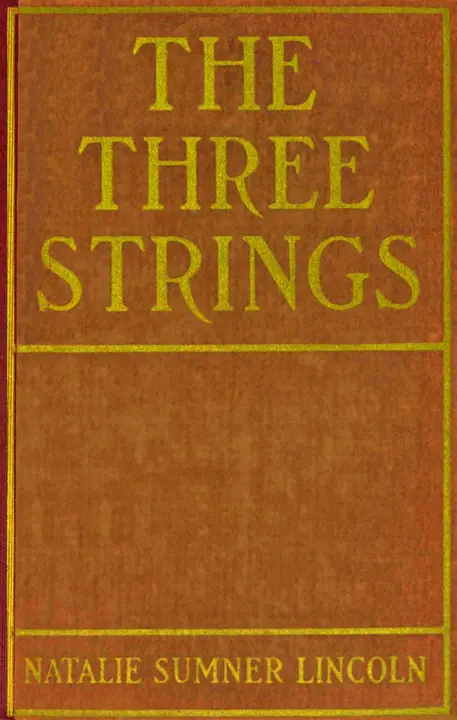
The three strings
Natalie Sumner Lincoln
THE CLASSIC COLLECTION · 1916
"I Spy" by Natalie Sumner Lincoln is a novel written during the early 20th century, around the time of World War I. The story unfolds against the backdrop of war, espionage, and the emotional struggles of its characters, particularly highlighting familial and romantic tensions amidst the chaos of the time. The narrative introduces John Hargraves, a young officer about to leave for the front, and explores his relationships with his uncle, Sir Percival Hargraves, and the women in his life, including Kathleen, an American girl who plays a significant role in his emotional journey. The opening of "I Spy" establishes a tense atmosphere, set in November 1914, where John and his uncle discuss the war and the undercurrents of espionage affecting England. Their conversation reveals deep concerns over the German Secret Service's influence within England, illustrating the pervasive anxiety of the time. Shortly after, John departs for Victoria Station, where he encounters a mysterious man associated with the German spy network. The chapter skillfully sets the stage for the unfolding drama, hinting at elements of intrigue, danger, and romance while introducing key characters whose lives are intricately connected to the war. As the story progresses, it promises to delve into themes of loyalty, love, and the impact of war on personal lives.
Introduction adapted from the source catalogue; source summaries may be automatically generated.
Free to read · English · 61,719 words · No account needed
MAKE TIME FOR A GOOD BOOK
On by default. Untick to stop anonymous reading totals. Each page counts after 10 seconds in view. How this works.
Anonymous counting is on unless you have switched it off.
"Were you then upstairs, Mr. Whitney?"
"Yes, in my wife's boudoir on the first bedroom floor."
"When did you last see Mr. Spencer alive?"
"When I showed him into his bedroom and loaned him a pair of pajamas."
"Did you help him undress?"
"No, as he assured me, with drunken gravity, that he could manage
it himself."
"Did you inform your wife and daughter that Mr. Spencer was spending the
night in your house?"
"No. My wife was downstairs entertaining her guests, and my daughter was asleep in her room. I did not see either of them until the next morning."
"Where did you go after leaving Mr. Spencer in his bedroom?"
"To my studio in the attic. I remained there all night absorbed in my
work."
"Did you hear any unusual sounds during the night?"
"No; my studio, or workshop, is sound-proof. And it is the same throughout the house," he added. "The walls, besides being of unusual width, were all deadened by my grandfather's direction. He had a horror of noise."
"When did you leave your studio?"
"About seven o'clock Wednesday morning."
"Did you use the elevator then?"
"No, I seldom use it." Whitney twisted about in his chair. "I had the elevator installed for the convenience of my wife and daughter."
Penfield made an entry in his notebook, then faced Whitney directly.
"Have you in connection with your workshop a photographic outfit and
darkroom?" he asked.
"I have."
"I am told that you are working on a sort of camera which, used in an aeroplane, makes a map of the country over which the machine passes. Is that correct, Mr. Whitney?"
"Yes," acknowledged Whitney. "A patent is pending."
"Had it gotten about among your servants that you were working upon an
important invention?"
"It's very possible," Whitney conceded.
"Did Julie, your wife's maid, ever evince undue curiosity in your work?"
Whitney wrinkled his brow in thought. "No," he said. "I can't say that I am aware she did. When I go to my studio, as we usually call my workshop, it is an understood thing that I am not to be disturbed by anyone. It is a rule I enforce by dismissal if broken, and the servants have learned by experience to obey."
"Has your household access to your studio when you are not there?"
"No, I securely lock the door whenever I leave the room."
"Are you ever joined while in your studio by your wife and daughter and
their friends?"
"Occasionally they bring Miss Grey and Senator Foster in to see my
models."
"Did you confide the particulars of your latest invention to Mr.
Spencer?"
"I did not."
Your reading position is saved on this browser. Take it to another device with a library code. Reading pages adapt to text, rather than matching a printed edition.
Natalie Sumner Lincoln
Natalie Sumner Lincoln
Natalie Sumner Lincoln
Natalie Sumner Lincoln
BEHIND THE BOOK
This eBook is for the use of anyone anywhere in the United States and most other parts of the world at no cost and with almost no restrictions whatsoever. You may copy it, give it away or re-use it under the terms of the Project Gutenberg License included with this eBook or online at www.gutenberg.org. If you are not located in the United States, you will have to check the laws of the country where you are located before using this eBook. Read the source licence.
The original source file, including credits and licence, is retained by this library. Request an original-format copy at no charge. Please include the book title and Project Gutenberg identifier #9812.
KEEP YOUR CURIOSITY GOING
Coulson Kernahan

Maurice Baring
Frances Wright
Cécile Tormay

Frederic Jesup Stimson

W. H. P. (William Henry Pope) Jarvis