
Last letters from the living dead man
David Patterson (Spirit) Hatch
THE CLASSIC COLLECTION · 1917
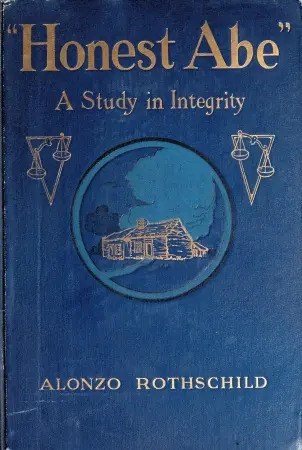
"Honest Abe: A Study in Integrity Based on the Early Life of Abraham Lincoln" by Alonzo Rothschild is a historical account written in the early 20th century. This work explores the formative years of Abraham Lincoln, focusing on his character, integrity, and the influence of his family background. It aims to shed light on how his early experiences shaped him into the emblematic figure of honesty and moral fortitude that he is celebrated as today. The opening of the book sets the foundation for a detailed exploration of Lincoln’s life, particularly emphasizing his inherent honesty and the hardships faced by his family during his upbringing. It describes the poverty Lincoln endured in his childhood and how the moral values instilled by his parents, especially his mother, played a crucial role in shaping his character. The narrative recounts anecdotes that highlight his early understanding of right and wrong and his unwavering commitment to truth, such as his willful efforts to settle debts and his conscientiousness in dealings with others. Throughout this introductory segment, Rothschild firmly establishes Lincoln's reputation as "Honest Abe," illustrating how his integrity was evident from a young age.
Introduction adapted from the source catalogue; source summaries may be automatically generated.
Free to read · English · 102,593 words · No account needed
MAKE TIME FOR A GOOD BOOK
On by default. Untick to stop anonymous reading totals. Each page counts after 10 seconds in view. How this works.
Anonymous counting is on unless you have switched it off.
=Drummond, Judge Thomas=, on Lincoln’s honesty, 64.
=Duncan, Gov. Joseph=, calls special session of assembly, 231.
=Dungee, Jack=, sues Spencer for slander, 152-155.
=Dungee Slander Suit=, Lincoln’s fee, 154.
=Duperron, Cardinal=, and Henry III, 59.
=Edwards, Benjamin S.=, retained by Gov. Matteson, 55.
=Edwards, Ninian W.=, opposing advocate to Lincoln, 159;
one of the “Long Nine,” 211;
on Lincoln’s appearance, 179, 352.
=Elizabethtown, Ky.=, home of Thomas Lincoln, 4;
home of Mrs. Johnston, 7.
=Ellis, James=, befriended by Lincoln, 24.
=Emerson, Ralph=, on Lincoln and the law, 116.
=Ewing, William Lee D.=, Lincoln’s opponent for speaker of Illinois House, 357.
=Ferguson, Benjamin=, eulogized by Lincoln, 331.
=Fisher, Archibald=, wrongly reported murdered, 138.
=Fletcher, Job, Sr.=, one of the “Long Nine,” 211.
=Floyd, George P.=, part of fee returned to him by Lincoln, 159-160, 349.
=Forquer, George=, publicly reproached by Lincoln, 242-244.
=Fox, Charles James=, his “political slaughter” of opponents, 354.
=Franklin, Benjamin=, trials with his partner, 328.
=Gentry, Allen=, makes trading voyage with Lincoln, 14.
=Gentry, James=, sends Lincoln on trading voyage to New Orleans, 14;
commends Lincoln, 15.
=Gentryville=, home of Lincolns, 18.
=Gibson, Justice John B.=, dictum on legal fees, 356.
=Gillespie, Judge Joseph=, anecdote on Lincoln, 69;
on Lincoln’s simplicity, 177-178, 352;
colleague of Lincoln in the House, 236-237;
letter to Herndon, 340.
=Globe Tavern=, first home of Lincoln and his wife, 175.
=Goodrich, Grant=, endorses Lincoln’s charge against the Illinois Central R.R., 168; offers Lincoln partnership, 192.
=Goodwin, Thomas=, describes Thomas Lincoln, 323.
=Graham, Mentor=, helps Lincoln study surveying, 26.
=Green, Squire Bowling=, complains of Lincoln’s interference as peacemaker, 34.
=Green, J. Parker=, bantered by Lincoln in cross-examination, 16.
=Greene, William G.=, buys Radford’s store, 22;
sells store to Lincoln and Berry, 22, 327;
Lincoln’s debt to, 24;
on Lincoln’s sportsmanlike conduct, 31, 330.
=Gridley, Asahel=, opposing counsel in Hoblit vs. Farmer, 70-71; exit through church window with Lincoln, 237.
=Gulliver, Rev. John P.=, on Lincoln’s search for facts, 339.
=Hale, Sir Matthew=, dictum on receiving fees, 144.
=Hamlin, Hannibal=, his struggle with debt similar to Lincoln’s, 328; attitude to fees similar to Lincoln’s, 335.
=Hammond, Judge Abram=, hoodwinked by Lincoln, 263-265.
=Hanks, Dennis=, father of Mrs. Dowling, 3;
on Thomas Lincoln’s frequent removals, 4;
on Lincoln’s habit of asking questions, 60;
on Thomas Lincoln’s “way with women,” 325;
on Lincoln’s business ability, 328.
=Hanks Family=, considered “smart,” 3.
=Hanks, John=, Lincoln’s cousin, accompanies him on trading voyage, 17.
=Hanks, Nancy=, mother of Abraham Lincoln, sweetness and firmness of character, 3; Abraham’s earliest recollections of, 6, 7; hardships and death, 7, 324; influence on Abraham’s character, 7.
=Hardin, Gen. John J.=, Lincoln’s opponent for congressional nomination, 267, 273;
“making a slate,” 274;
turns against Lincoln, 276;
fails to catch Lincoln in his trap, 360.
=Harding, Jacob=, refuses Lincoln space in his editorial columns, 254.
=Harriott, James=, presiding justice in Armstrong case, 109.
Your reading position is saved on this browser. Take it to another device with a library code. Reading pages adapt to text, rather than matching a printed edition.
BEHIND THE BOOK
This eBook is for the use of anyone anywhere in the United States and most other parts of the world at no cost and with almost no restrictions whatsoever. You may copy it, give it away or re-use it under the terms of the Project Gutenberg License included with this eBook or online at www.gutenberg.org. If you are not located in the United States, you will have to check the laws of the country where you are located before using this eBook. Read the source licence.
The original source file, including credits and licence, is retained by this library. Request an original-format copy at no charge. Please include the book title and Project Gutenberg identifier #49679.
KEEP YOUR CURIOSITY GOING
David Patterson (Spirit) Hatch
Cécile Tormay

Moritz Busch
Coulson Kernahan
John L. Ransom

Ralph Waldo Emerson