
Last letters from the living dead man
David Patterson (Spirit) Hatch
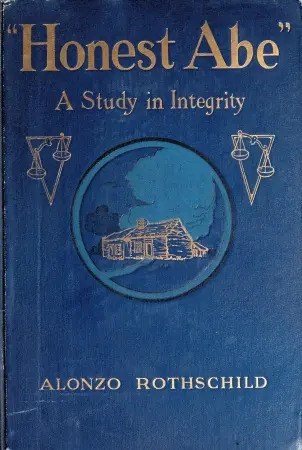
THE CLASSIC COLLECTION · 1917
"Honest Abe: A Study in Integrity Based on the Early Life of Abraham Lincoln" by Alonzo Rothschild is a historical account written in the early 20th century. This work explores the formative years of Abraham Lincoln, focusing on his character, integrity, and the influence of his family background. It aims to shed light on how his early experiences shaped him into the emblematic figure of honesty and moral fortitude that he is celebrated as today. The opening of the book sets the foundation for a detailed exploration of Lincoln’s life, particularly emphasizing his inherent honesty and the hardships faced by his family during his upbringing. It describes the poverty Lincoln endured in his childhood and how the moral values instilled by his parents, especially his mother, played a crucial role in shaping his character. The narrative recounts anecdotes that highlight his early understanding of right and wrong and his unwavering commitment to truth, such as his willful efforts to settle debts and his conscientiousness in dealings with others. Throughout this introductory segment, Rothschild firmly establishes Lincoln's reputation as "Honest Abe," illustrating how his integrity was evident from a young age.
Introduction adapted from the source catalogue; source summaries may be automatically generated.
Free to read · English · 102,593 words · No account needed
MAKE TIME FOR A GOOD BOOK
On by default. Untick to stop anonymous reading totals. Each page counts after 10 seconds in view. How this works.
Anonymous counting is on unless you have switched it off.
=Blackwell, Robert S.=, endorses Lincoln’s charge against Illinois Central R.R., 168.
=Bloomington, Ill.=, 82.
=Booker, William F.=, on character of Mordecai and Josiah Lincoln, 323.
=Boyle, Benjamin=, shot by Gen. Linder’s son, 141.
=Breese, Judge Sidney=, on Lincoln’s honesty, 86.
=Brewer, Justice David J.=, anecdote on Lincoln and law, 103; 343.
=Brockman, James M.=, receives letter from Lincoln on how to study law, 333.
=Brokaw, Abraham=, anecdote of Lincoln and money, 148.
=Brougham, Henry Peter, Baron=, on legal fees, 349.
=Browning, Orville H.=, endorses Lincoln’s charge against Illinois Central R.R., 168.
=Bunn, John W.=, anecdote on Lincoln’s moderate charges, 150;
on Lincoln and politics, 258.
=Bush, Sally=, see =Mrs. Johnston.=
=Butler, William=, tenders Lincoln hospitality, 42.
=Calhoun, John=, surveyor of Sangamon County, appoints Lincoln Deputy Surveyor, 25, 28, 204.
=Carter, Robert Nicholas=, turns over practice to Patrick Henry, 71.
=Cartwright, Dr. Peter=, Methodist circuit-rider, 105; Lincoln’s opponent for Congress, 278, 279.
=Caton, Judge John D.=, on Lincoln’s honesty, 64;
on Lincoln and law, 103-104.
=Chaddon, L. D.=, 90.
=Chew, Henry=, recipient of generosity from Lincoln, 184; fails to pay bill guaranteed by Lincoln, 185.
=Chiniquy, Father Charles=, sued for slander, 155;
retains Lincoln, 156;
overwhelmed by Lincoln’s generosity, 158.
=Chiniquy Slander Case=, 155-158.
“=Clary’s Grove Boys=,” wreck Radford’s store, 22.
=Cicero, Marcus Tullius=, eulogy of Servius Sulpicius, 336.
=Clay, Henry=, Lincoln’s admiration for, 200;
political programme, 201.
=Clinton, De Witt=, Lincoln’s emulation of, 218.
=Cogdal, Isaac=, generously treated by Lincoln, 137.
=Conant, Alban J.=, on Lincoln’s study of Blackstone’s Commentaries, 331.
=Constable, Charles H.=, disloyalty to his party, 244-245.
=Counterfeit money=, in common circulation, 15; Lincoln’s experience with, 15-16; Lincoln secures acquittal of man charged with passing it, 16.
=Crafton, Greek=, killed by Quinn Harrison, 105.
=Crawford, Josiah=, makes Lincoln work for damaged book, 11;
lampooned by Lincoln, 12.
=Cullom, Shelby M.=, associated with Lincoln in Harrison case, 106; on Lincoln’s methods of meeting personal attacks, 344; on Lincoln as an advocate, 337.
=Davis, David=, on Lincoln’s honesty, 63-64;
appoints Lincoln to sit as judge for him, 89, 90;
on Lincoln and the law, 123-124;
rebukes Lincoln for undercharging, 161;
presides at mock-trial, 162;
his “Midas touch,” 172;
delegates his judicial functions to others, 341.
=Davis, J. McCan=, on authenticity of almanac in Armstrong case, 345.
=Dawson, John=, one of the “Long Nine,” 211.
=Democratic Party=, under Andrew Jackson, 198;
in power when Lincoln enters politics, 199;
lashed by Lincoln, 241-242.
=Deskins, Dr. John=, sheriff sent in pursuit of Lincoln, 70.
=Dick, James A.=, sheriff in “Duff” Armstrong case, 110.
=Dickson, Judge William M.=, describes Lincoln’s humor as advocate, 346.
=Disraeli, Benjamin=, his similarities to Lincoln, 240.
=Douglas, Stephen A.=, dunned by Lincoln, 148-149;
elected Register of Land Office, 223.
=Douglass, Frederick=, tells of first money he earned, 347.
=Dowling, Mrs. John=, daughter of Dennis Hanks, praises Thomas Lincoln, 2, 3.
=Dresser, Rev. Charles=, officiates at Lincoln’s wedding, 174.
=Driscoll, Mrs. Katherine Lord=, anecdote on Lincoln’s refusal of bad cases, 338.
Your reading position is saved on this browser. Take it to another device with a library code. Reading pages adapt to text, rather than matching a printed edition.
BEHIND THE BOOK
This eBook is for the use of anyone anywhere in the United States and most other parts of the world at no cost and with almost no restrictions whatsoever. You may copy it, give it away or re-use it under the terms of the Project Gutenberg License included with this eBook or online at www.gutenberg.org. If you are not located in the United States, you will have to check the laws of the country where you are located before using this eBook. Read the source licence.
The original source file, including credits and licence, is retained by this library. Request an original-format copy at no charge. Please include the book title and Project Gutenberg identifier #49679.
KEEP YOUR CURIOSITY GOING
David Patterson (Spirit) Hatch
Cécile Tormay

Moritz Busch
Coulson Kernahan
John L. Ransom

Ralph Waldo Emerson