
Last letters from the living dead man
David Patterson (Spirit) Hatch
THE CLASSIC COLLECTION · 1917
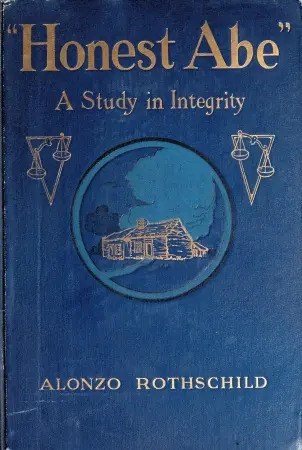
"Honest Abe: A Study in Integrity Based on the Early Life of Abraham Lincoln" by Alonzo Rothschild is a historical account written in the early 20th century. This work explores the formative years of Abraham Lincoln, focusing on his character, integrity, and the influence of his family background. It aims to shed light on how his early experiences shaped him into the emblematic figure of honesty and moral fortitude that he is celebrated as today. The opening of the book sets the foundation for a detailed exploration of Lincoln’s life, particularly emphasizing his inherent honesty and the hardships faced by his family during his upbringing. It describes the poverty Lincoln endured in his childhood and how the moral values instilled by his parents, especially his mother, played a crucial role in shaping his character. The narrative recounts anecdotes that highlight his early understanding of right and wrong and his unwavering commitment to truth, such as his willful efforts to settle debts and his conscientiousness in dealings with others. Throughout this introductory segment, Rothschild firmly establishes Lincoln's reputation as "Honest Abe," illustrating how his integrity was evident from a young age.
Introduction adapted from the source catalogue; source summaries may be automatically generated.
Free to read · English · 102,593 words · No account needed
MAKE TIME FOR A GOOD BOOK
On by default. Untick to stop anonymous reading totals. Each page counts after 10 seconds in view. How this works.
Anonymous counting is on unless you have switched it off.
[iv-16] Tarbell, i, 267-68; Curtis’s Lincoln, 74-75; Thomas Lewis, in Leslie’s Weekly, February 16, 1899.
[iv-17] Browne, 224.
[iv-18] G. W. Nance, in Oldroyd, 557.
[iv-19] Charles W. Moores, in American Law Review, January-February,
1911, p. 92.
[iv-20] Henry Rickel, in Cedar Rapids Gazette, February 6, 1909, p.
1.
[iv-21] Ward, 242-46; Jennings, 93-98.
[iv-22] Father Chiniquy reproduces in his book an engraved facsimile of the due-bill, dated May 23, 1856. It is undeniably in Lincoln’s handwriting, but no explanation has been offered to reconcile the date with the priest’s statement that the paper was written in October, at the time of the second trial. The author based his narrative of this affair upon Chiniquy, 566, 620-67; Whitney, 53-55, 136-37; and a brief of the Circuit Court records at Urbana, Illinois, made for the writer by Judge Joseph O. Cunningham.
[iv-23] George P. Floyd, in McClure’s Magazine, January, 1908, p.
303.
[iv-24] Lamon’s Recollections, 17-19; see, also, Browne’s Lincoln and Men, i, 348-51. There are a few other examples, in legal history, of high-minded lawyers rejecting what they regarded as excessive fees. One notable English instance is thus related by Lord Brougham concerning Topping:--
“A general retainer of a thousand guineas was brought to him to cover the Baltic cases then in progress. His answer was, that this indicated either a doubt of his doing his duty on the ordinary terms known in the profession (one guinea particular, and five guineas general retainer)--or an expectation that he should, on being thus retained, do something beyond the line of his duty; and therefore he must decline it. His clerk then accepted of the usual sum of five guineas, and he led on those important cases, for the defendants.”
So also Charles O’Conor, leader for many years of the New York bar, subordinated money-making to a sense of professional propriety. His friend, William H. Winters, Librarian of the Law Institute, relates that a client once urged the famous pleader, with some insistence, to accept a very much larger fee than the lawyer had charged. O’Conor, becoming indignant, manifested in his own forcible way how this annoyed him. He denied the right of any one to dictate what his pay for legal services should be, and dismissed the presumptuous client without ceremony.
Your reading position is saved on this browser. Take it to another device with a library code. Reading pages adapt to text, rather than matching a printed edition.
BEHIND THE BOOK
This eBook is for the use of anyone anywhere in the United States and most other parts of the world at no cost and with almost no restrictions whatsoever. You may copy it, give it away or re-use it under the terms of the Project Gutenberg License included with this eBook or online at www.gutenberg.org. If you are not located in the United States, you will have to check the laws of the country where you are located before using this eBook. Read the source licence.
The original source file, including credits and licence, is retained by this library. Request an original-format copy at no charge. Please include the book title and Project Gutenberg identifier #49679.
KEEP YOUR CURIOSITY GOING
David Patterson (Spirit) Hatch
Cécile Tormay

Moritz Busch
Coulson Kernahan
John L. Ransom

Ralph Waldo Emerson