
Last letters from the living dead man
David Patterson (Spirit) Hatch
THE CLASSIC COLLECTION · 1917
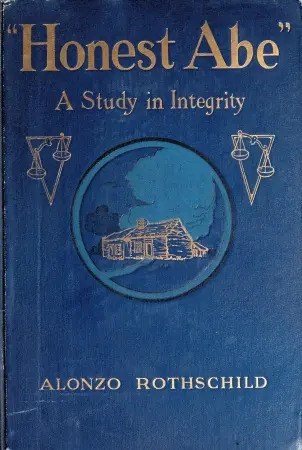
"Honest Abe: A Study in Integrity Based on the Early Life of Abraham Lincoln" by Alonzo Rothschild is a historical account written in the early 20th century. This work explores the formative years of Abraham Lincoln, focusing on his character, integrity, and the influence of his family background. It aims to shed light on how his early experiences shaped him into the emblematic figure of honesty and moral fortitude that he is celebrated as today. The opening of the book sets the foundation for a detailed exploration of Lincoln’s life, particularly emphasizing his inherent honesty and the hardships faced by his family during his upbringing. It describes the poverty Lincoln endured in his childhood and how the moral values instilled by his parents, especially his mother, played a crucial role in shaping his character. The narrative recounts anecdotes that highlight his early understanding of right and wrong and his unwavering commitment to truth, such as his willful efforts to settle debts and his conscientiousness in dealings with others. Throughout this introductory segment, Rothschild firmly establishes Lincoln's reputation as "Honest Abe," illustrating how his integrity was evident from a young age.
Introduction adapted from the source catalogue; source summaries may be automatically generated.
Free to read · English · 102,593 words · No account needed
MAKE TIME FOR A GOOD BOOK
On by default. Untick to stop anonymous reading totals. Each page counts after 10 seconds in view. How this works.
Anonymous counting is on unless you have switched it off.
[iii-18] Admissions that seemed to be of a more damaging nature than those which were made in this case have at times been known to assist, rather than interfere with, the winning of a verdict. How far counsel may go, along such lines, was illustrated in the practice of Daniel Webster. A more brilliant, though less scrupulous, advocate than Lincoln, he went the limit.
Once in Boston, defending a man who had been indicted for forgery, his first act--at the very beginning of the trial, before a witness had been called--was to arise and say: “May it please the Court, we admit the forgery, so that evidence on this point will be unnecessary. We deny that the note was uttered in this county.”
The astonishment of those present gave way to comprehension, when it became evident that the prosecution could easily have made out a case of forgery against the prisoner; but that it could not so readily have proven, what was of equal importance, the issuing of the forged instrument in Suffolk County. For want of sufficient proof, on this very point, the defendant was acquitted. He might have fared differently if both the questions of forgery and utterance had been presented to the jury. It is not unlikely that had they listened to evidence on the crime itself, those facts would have so overshadowed other considerations in their minds as to bring about a conviction. Webster’s avowal prevented this, and saved his unworthy client.
[iii-19] Herndon, ii, 3; Whitney, 251.
[iii-20] Lincoln to Linder, February 20, 1848, Works, ii, 3.
[iii-21] Herndon, ii, 7.
[iii-22] Arnold, 84. See, also, Whitney’s Life, i, 173; Oldroyd, 37; Nicolay and Hay, i, 307.
[iii-23] Herndon, ii, 7.
[iii-24] Gibson W. Harris, quoted in Browne, 220.
[iii-25] Letter of Justice David J. Brewer to the author; and an article by him in the Atlantic Monthly, November, 1906, p. 591.
[iii-26] Caton, 13; Illinois Reports, xxxvii, 13.
[iii-27] A statement made by Judge David Davis.
[iii-28] Hill, 211-12.
[iii-29] Letter of Hon. Shelby M. Cullom to the author; Bateman, 13-15. See, also, Hill, 236-37; and T. W. S. Kidd, the crier of the court, in Tarbell, i, 273-75.
[iii-30] Judge Lawrence Weldon, quoted in Hill, 212-15.
Your reading position is saved on this browser. Take it to another device with a library code. Reading pages adapt to text, rather than matching a printed edition.
BEHIND THE BOOK
This eBook is for the use of anyone anywhere in the United States and most other parts of the world at no cost and with almost no restrictions whatsoever. You may copy it, give it away or re-use it under the terms of the Project Gutenberg License included with this eBook or online at www.gutenberg.org. If you are not located in the United States, you will have to check the laws of the country where you are located before using this eBook. Read the source licence.
The original source file, including credits and licence, is retained by this library. Request an original-format copy at no charge. Please include the book title and Project Gutenberg identifier #49679.
KEEP YOUR CURIOSITY GOING
David Patterson (Spirit) Hatch
Cécile Tormay

Moritz Busch
Coulson Kernahan
John L. Ransom

Ralph Waldo Emerson