
Last letters from the living dead man
David Patterson (Spirit) Hatch
THE CLASSIC COLLECTION · 1917
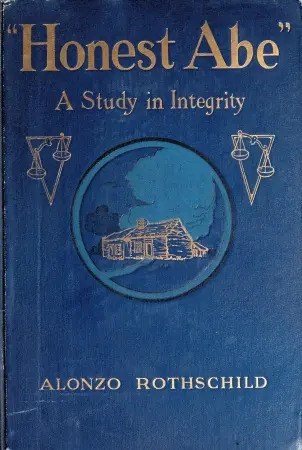
"Honest Abe: A Study in Integrity Based on the Early Life of Abraham Lincoln" by Alonzo Rothschild is a historical account written in the early 20th century. This work explores the formative years of Abraham Lincoln, focusing on his character, integrity, and the influence of his family background. It aims to shed light on how his early experiences shaped him into the emblematic figure of honesty and moral fortitude that he is celebrated as today. The opening of the book sets the foundation for a detailed exploration of Lincoln’s life, particularly emphasizing his inherent honesty and the hardships faced by his family during his upbringing. It describes the poverty Lincoln endured in his childhood and how the moral values instilled by his parents, especially his mother, played a crucial role in shaping his character. The narrative recounts anecdotes that highlight his early understanding of right and wrong and his unwavering commitment to truth, such as his willful efforts to settle debts and his conscientiousness in dealings with others. Throughout this introductory segment, Rothschild firmly establishes Lincoln's reputation as "Honest Abe," illustrating how his integrity was evident from a young age.
Introduction adapted from the source catalogue; source summaries may be automatically generated.
Free to read · English · 102,593 words · No account needed
MAKE TIME FOR A GOOD BOOK
On by default. Untick to stop anonymous reading totals. Each page counts after 10 seconds in view. How this works.
Anonymous counting is on unless you have switched it off.
“‘I’ll give you all dish monies if you’ll make Hans do justice mit de
pridge.’
“‘How much will it cost to repair this bridge?’ asked the attorney.
“‘Well, den, not more ash five tollars.’
“‘Very well,’ said the legal gentleman, pocketing one of the notes and giving the Dutchman the other, ‘take this and go and get the bridge repaired. It’s the best course you can take.’
“‘Yaas,’ responded the client slowly, ‘y-a-a-s, dat ish more better as to quarrel mit Hans.’
“But as he went home, he shook his head frequently, as if unable, after all, quite clearly to see how he had gained anything by going to the lawyer.”
[ii-15] This narrative is based on two interviews, secured for the author from Henry Rice, in the autumn of 1907 and in the spring of 1908, respectively. See, also, Markens, 24.
[ii-16] Lincoln’s refusal to take what he considered a bad case is in harmony, as far as civil actions go, with the practice of every high-minded lawyer. David Hoffman, of the Baltimore bar, drawing up, early in the nineteenth century, a code of ethics for the guidance of his students throughout their professional careers, prescribed as the eleventh of fifty resolutions: “If, after duly examining a case, I am persuaded that my client’s claim or defense (as the case may be) cannot, or rather ought not to be sustained, I will promptly advise him to abandon it. To press it further in such a case, with the hope of gleaning some advantage by an extorted compromise, would be lending myself to a dishonorable use of legal means in order to gain a portion of that, the whole of which I have reason to believe would be denied to him both by law and justice.”
[ii-17] Holland, 126; Browne, 162. But see Lamon, 317, for McHenry’s account of a somewhat similar interview that had a different termination.
[ii-18] “Never stir up litigation. A worse man can scarcely be found than one who does this.” (Notes for Law Lecture, in Works, ii, 142.)
[ii-19] Tarbell, i, 248; McClure’s Yarns, 359-60.
[ii-20] Lamon, 325.
[ii-21] It should, perhaps, be noted that in refusing Matteson’s case Lincoln turned his back on one of his own influential clients, whom he had represented in the Supreme Court but a short time before this happened. See the appeal of Constant vs. Matteson et al., argued at the January term of 1859, in the Second Grand Division. (Illinois Reports, xxii, 546-62.)
[ii-22] James Judson Lord to William H. Herndon, in Herndon, ii, 14-15, note; Letter of Mrs. Katherine Lord Driscoll to the author.
Your reading position is saved on this browser. Take it to another device with a library code. Reading pages adapt to text, rather than matching a printed edition.
BEHIND THE BOOK
This eBook is for the use of anyone anywhere in the United States and most other parts of the world at no cost and with almost no restrictions whatsoever. You may copy it, give it away or re-use it under the terms of the Project Gutenberg License included with this eBook or online at www.gutenberg.org. If you are not located in the United States, you will have to check the laws of the country where you are located before using this eBook. Read the source licence.
The original source file, including credits and licence, is retained by this library. Request an original-format copy at no charge. Please include the book title and Project Gutenberg identifier #49679.
KEEP YOUR CURIOSITY GOING
David Patterson (Spirit) Hatch
Cécile Tormay

Moritz Busch
Coulson Kernahan
John L. Ransom

Ralph Waldo Emerson