
Last letters from the living dead man
David Patterson (Spirit) Hatch
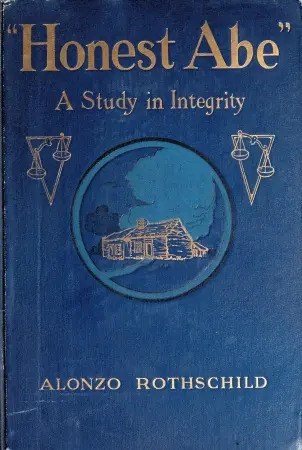
THE CLASSIC COLLECTION · 1917
"Honest Abe: A Study in Integrity Based on the Early Life of Abraham Lincoln" by Alonzo Rothschild is a historical account written in the early 20th century. This work explores the formative years of Abraham Lincoln, focusing on his character, integrity, and the influence of his family background. It aims to shed light on how his early experiences shaped him into the emblematic figure of honesty and moral fortitude that he is celebrated as today. The opening of the book sets the foundation for a detailed exploration of Lincoln’s life, particularly emphasizing his inherent honesty and the hardships faced by his family during his upbringing. It describes the poverty Lincoln endured in his childhood and how the moral values instilled by his parents, especially his mother, played a crucial role in shaping his character. The narrative recounts anecdotes that highlight his early understanding of right and wrong and his unwavering commitment to truth, such as his willful efforts to settle debts and his conscientiousness in dealings with others. Throughout this introductory segment, Rothschild firmly establishes Lincoln's reputation as "Honest Abe," illustrating how his integrity was evident from a young age.
Introduction adapted from the source catalogue; source summaries may be automatically generated.
Free to read · English · 102,593 words · No account needed
MAKE TIME FOR A GOOD BOOK
On by default. Untick to stop anonymous reading totals. Each page counts after 10 seconds in view. How this works.
Anonymous counting is on unless you have switched it off.
[ii-8] This principle was recognized as early as Cicero’s time. In his Ninth Philippic, eulogizing Servius Sulpicius, that most profound of Roman advocates, the orator said, according to Forsyth’s version: “He did not consider himself a lawyer rather than a servant of justice, and his constant endeavor was to temper the severity of law, by reference to principles of equity. He had less pleasure in advising that actions should be brought, than in removing all cause for litigation.”
[ii-9] Works, ii, 142. Lincoln’s comment--“the nominal winner is often a real loser”--suggests the similarity between his advice and that of Professor Porson, as expressed in that learned humorist’s mock examination questions for students:--
“What happens if you win your cause?”
“You are nearly ruined.”
“What happens if you lose your cause?”
“You are quite ruined.”
[ii-10] Browne’s Lincoln and Men, i, 338; Browne, 220.
[ii-11] For a few of these stories the reader is referred to Onstot, 20; Stringer, i, 218; McClure’s Yarns, 380; Gallaher, 46-47; Lincolnics, 30-31; MacChesney, 299-300; Depew’s Speech, February 12, 1909, pp. 6-7; Dr. George M. Angell, in Bloomington (Ill.) Pantagraph, February 12, 1909.
Lincoln was not the only great lawyer concerning whom such anecdotes might be told. The eminent New England advocate, Jeremiah Mason, is said to have been equally successful in bringing about compromises. “Mr. Mason,” writes one who knew him well, “magnified his position by exerting all his influence to prevent litigation, or the commencement of suits upon mere quibbles, or for the purpose of procrastination, or to gratify personal vindictiveness, or retaliation. He was eminently a peacemaker, and was instrumental in healing many a wound, and in preventing the useless expenditure of money, by a set of litigants, who were in the habit of annoying (employing?) lawyers to aid them in schemes of malice or revenge.” (John P. Lord, quoted in Hillard’s Memoir and Correspondence of Jeremiah Mason, 46.)
[ii-12] Browne’s Lincoln and Men, i, 339.
[ii-13] Herndon, ii, 14.
[ii-14] Browne, 218-19. Lincoln’s expedient for preventing trivial litigation was similar in its essence to that of the New York attorney concerning whom Edwards, in his Pleasantries about Courts and Lawyers, tells this anecdote:--
“In a certain part of our State, two Dutchmen, who built and used in common, a small bridge over a little stream which ran through their farms, had a dispute concerning certain repairs which it required. One of them declined to bear any portion of the expense necessary to the purchase of two or three planks. The aggrieved party went to a neighboring attorney and placing ten dollars, in two notes of five dollars each, in his hand, said--
Your reading position is saved on this browser. Take it to another device with a library code. Reading pages adapt to text, rather than matching a printed edition.
BEHIND THE BOOK
This eBook is for the use of anyone anywhere in the United States and most other parts of the world at no cost and with almost no restrictions whatsoever. You may copy it, give it away or re-use it under the terms of the Project Gutenberg License included with this eBook or online at www.gutenberg.org. If you are not located in the United States, you will have to check the laws of the country where you are located before using this eBook. Read the source licence.
The original source file, including credits and licence, is retained by this library. Request an original-format copy at no charge. Please include the book title and Project Gutenberg identifier #49679.
KEEP YOUR CURIOSITY GOING
David Patterson (Spirit) Hatch
Cécile Tormay

Moritz Busch
Coulson Kernahan
John L. Ransom

Ralph Waldo Emerson