
Last letters from the living dead man
David Patterson (Spirit) Hatch
THE CLASSIC COLLECTION · 1917
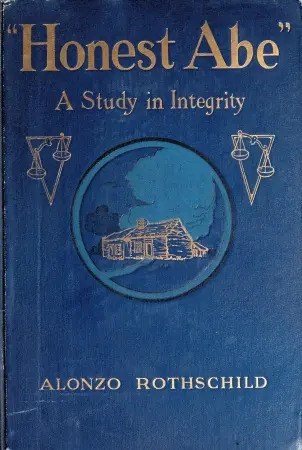
"Honest Abe: A Study in Integrity Based on the Early Life of Abraham Lincoln" by Alonzo Rothschild is a historical account written in the early 20th century. This work explores the formative years of Abraham Lincoln, focusing on his character, integrity, and the influence of his family background. It aims to shed light on how his early experiences shaped him into the emblematic figure of honesty and moral fortitude that he is celebrated as today. The opening of the book sets the foundation for a detailed exploration of Lincoln’s life, particularly emphasizing his inherent honesty and the hardships faced by his family during his upbringing. It describes the poverty Lincoln endured in his childhood and how the moral values instilled by his parents, especially his mother, played a crucial role in shaping his character. The narrative recounts anecdotes that highlight his early understanding of right and wrong and his unwavering commitment to truth, such as his willful efforts to settle debts and his conscientiousness in dealings with others. Throughout this introductory segment, Rothschild firmly establishes Lincoln's reputation as "Honest Abe," illustrating how his integrity was evident from a young age.
Introduction adapted from the source catalogue; source summaries may be automatically generated.
Free to read · English · 102,593 words · No account needed
MAKE TIME FOR A GOOD BOOK
On by default. Untick to stop anonymous reading totals. Each page counts after 10 seconds in view. How this works.
Anonymous counting is on unless you have switched it off.
[i-26] For a severe, though manifestly biased comment on the bad money episode, so far as it concerned Lincoln, see Edmonds, 47-48.
[i-27] Wilson’s Washington, 11-12.
[i-28] Hill, 219-20.
[i-29] New Salem, Illinois, when Lincoln took up his residence there in the summer of 1831, was a busy little village of recent origin, near the west bank of the Sangamon River, in the county of that name. Its site--for the place has long since fallen into decay--is within the present limits of Menard County, about twenty miles northwest of Springfield.
[i-30] The anecdote is from Parkinson’s Tour in America, ii, 436-37 (London, 1805). Whether or not it had come under Lincoln’s notice we have no means of knowing.
[i-31] William McNeely, in Oldroyd, 393-94; Browne, 104.
[i-32] John Rowan Herndon, in Herndon, i, 98.
[i-33] William G. Greene, in Browne, 116-17; and in Onstot, 81-83. A more circumstantial account, based on correspondence with Greene, may be found in Coffin, 73-76. See, also, Nicolay and Hay, i, 110-11; Herndon, i, 98-99; Lamon, 136-37; Tarbell, i, 92; Tarbell’s Early Life, 160; Holland, 54; Brooks, 66.
[i-34] Lincoln’s experience with Berry reminds one of Benjamin Franklin’s trials with his partner Hugh Meredith, who was “often seen drunk in the streets, and playing at low games in the ale houses.” It is an interesting coincidence, moreover, that both Franklin and Lincoln were aided, at these critical junctures, by generous friends.
[i-35] Dennis Hanks, in Atkinson, 50.
[i-36] Leonard Swett, in Rice, 465-66.
[i-37] At about the time Abraham Lincoln thus spoke to his creditors in Illinois, a young man in far-away Maine named Hannibal Hamlin, destined to share his electoral honors, used somewhat similar language under corresponding circumstances. He had gone on the bond of a certain deputy sheriff for four thousand dollars. That officer became a defaulter, and the people who had claims against him looked to his bondsmen. Hamlin, having called the creditors together, said: “My friends, I have lived among you only a few years, but I think you know that I keep my word. I am poor, young, and struggling for an honest support for myself. This struggle will continue right among you, my neighbors. I am unable now to meet this just debt; but if you will give me time, and God will give me strength, I will pay off every dollar I owe you, even if it takes me a lifetime to do it.”
He redeemed his promise to the last cent; but at what cost may be inferred from his exclamation, many years later, in telling the story: “Heavens! how long it kept my nose on the grindstone.”
Your reading position is saved on this browser. Take it to another device with a library code. Reading pages adapt to text, rather than matching a printed edition.
BEHIND THE BOOK
This eBook is for the use of anyone anywhere in the United States and most other parts of the world at no cost and with almost no restrictions whatsoever. You may copy it, give it away or re-use it under the terms of the Project Gutenberg License included with this eBook or online at www.gutenberg.org. If you are not located in the United States, you will have to check the laws of the country where you are located before using this eBook. Read the source licence.
The original source file, including credits and licence, is retained by this library. Request an original-format copy at no charge. Please include the book title and Project Gutenberg identifier #49679.
KEEP YOUR CURIOSITY GOING
David Patterson (Spirit) Hatch
Cécile Tormay

Moritz Busch
Coulson Kernahan
John L. Ransom

Ralph Waldo Emerson