
Last letters from the living dead man
David Patterson (Spirit) Hatch
THE CLASSIC COLLECTION · 1917
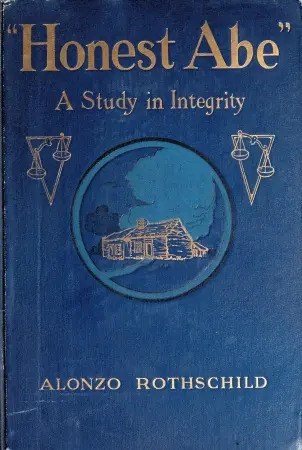
"Honest Abe: A Study in Integrity Based on the Early Life of Abraham Lincoln" by Alonzo Rothschild is a historical account written in the early 20th century. This work explores the formative years of Abraham Lincoln, focusing on his character, integrity, and the influence of his family background. It aims to shed light on how his early experiences shaped him into the emblematic figure of honesty and moral fortitude that he is celebrated as today. The opening of the book sets the foundation for a detailed exploration of Lincoln’s life, particularly emphasizing his inherent honesty and the hardships faced by his family during his upbringing. It describes the poverty Lincoln endured in his childhood and how the moral values instilled by his parents, especially his mother, played a crucial role in shaping his character. The narrative recounts anecdotes that highlight his early understanding of right and wrong and his unwavering commitment to truth, such as his willful efforts to settle debts and his conscientiousness in dealings with others. Throughout this introductory segment, Rothschild firmly establishes Lincoln's reputation as "Honest Abe," illustrating how his integrity was evident from a young age.
Introduction adapted from the source catalogue; source summaries may be automatically generated.
Free to read · English · 102,593 words · No account needed
MAKE TIME FOR A GOOD BOOK
On by default. Untick to stop anonymous reading totals. Each page counts after 10 seconds in view. How this works.
Anonymous counting is on unless you have switched it off.
[i-20] According to most of our authorities this was the book by Mason L. Weems, entitled The Life of George Washington; with curious anecdotes, equally honourable to himself and exemplary to his young countrymen. But Scripps (3), Raymond (21-22), Brockett (47), and Holland (32) are apparently accurate in stating that the work was Dr. David Ramsay’s The Life of Washington. It should be remembered that Mr. Lincoln himself, looking with uncommon care through the advance sheets of Scripps’s biography, published in 1860, made no correction as to the name Ramsay there employed in connection with the anecdote. Lincoln’s reference to Weems’s Life, moreover, in the speech at Trenton (Works, vi, 150-51), indicates that he had read that book during his early childhood--some years before he could as a “tall and long-armed” youth have “made a clean sweep” of Crawford’s fodder-corn.
[i-21] Herndon, i, 52, note.
[i-22] For the fuller accounts of this episode see: Whitney’s Life, i, 42-43; Arnold, 23; Raymond, 21-22; Lamon, 38, 50-51, 55, 66, note; Scripps, 3; Holland, 31-32; Brockett, 47-48; Herndon, i, 37, 52, note; Stoddard, 37-38; French, 26; Irelan, xvi, 55-56; Brooks, 24-25; Barrett, 25-26; Browne, 67, 69-70; Bartlett, 116-17. A somewhat fanciful narrative may be read in Thayer, 120-30, 177.
[i-23] Herndon, i, 29-31; Pratt, 11-12; Hapgood, 18-19. An instance of truth-telling by Lincoln, regardless of impending punishment, quite after the Weems manner, is related by Thayer (110-11), in his story about the broken buck’s horn.
[i-24] Lamon, 71.
[i-25] How serious these abuses ultimately became may be inferred from Merrick’s narrative (174-80), and from what Horace White says on the subject, in Money and Banking, pp. 351-52:--
“The bewildering state of the paper currency before the Civil War may be learned from the numerous bank-note reporters and counterfeit detectors of the period. It was the aim of these publications to give early information to enable the public to avoid spurious and worthless notes in circulation. These were of various kinds: (1) ordinary counterfeits; (2) genuine notes altered from lower denominations to higher ones; (3) genuine notes of failed banks altered to the names of solvent banks; (4) genuine notes of solvent banks with forged signatures; (5) spurious notes, such as those of banks that had no existence; (6) spurious notes of good banks, as 20’s of a bank that never issued 20’s; (7) notes of old, closed banks still in circulation.
“The number of counterfeit and spurious notes was quite appalling, and disputes between payer and payee as to the goodness of notes were of frequent occurrence, ranging over the whole gamut of doubts,--as to whether the issuing bank was sound or unsound, whether the note was genuine or counterfeit, and, if sound and genuine, whether the discount was within reasonable limits.”
Your reading position is saved on this browser. Take it to another device with a library code. Reading pages adapt to text, rather than matching a printed edition.
BEHIND THE BOOK
This eBook is for the use of anyone anywhere in the United States and most other parts of the world at no cost and with almost no restrictions whatsoever. You may copy it, give it away or re-use it under the terms of the Project Gutenberg License included with this eBook or online at www.gutenberg.org. If you are not located in the United States, you will have to check the laws of the country where you are located before using this eBook. Read the source licence.
The original source file, including credits and licence, is retained by this library. Request an original-format copy at no charge. Please include the book title and Project Gutenberg identifier #49679.
KEEP YOUR CURIOSITY GOING
David Patterson (Spirit) Hatch
Cécile Tormay

Moritz Busch
Coulson Kernahan
John L. Ransom

Ralph Waldo Emerson