THE CLASSIC COLLECTION✦An outlaw’s diary: the CommuneCLASSIC FREE BOOKS
An outlaw’s diary: the Commune
Cécile Tormay
THE CLASSIC COLLECTION · 1879
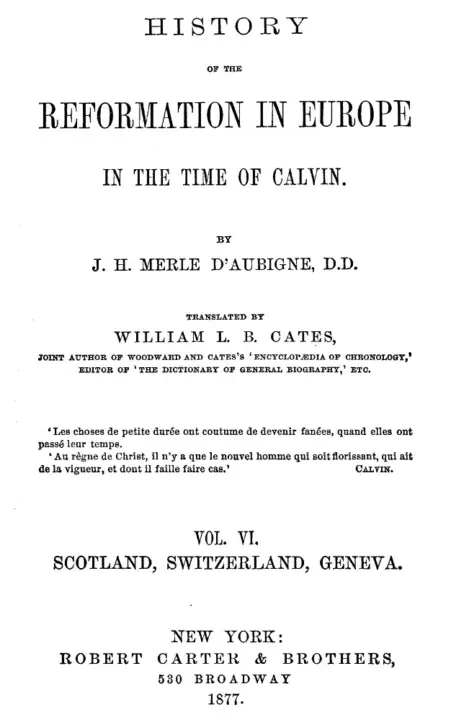
"History of the Reformation in Europe in the Time of Calvin, Vol. 6 (of 8)" by J. H. Merle D’Aubigné is a historical account written in the late 19th century. This volume focuses on the Reformation period in Scotland, Switzerland, and Geneva, emphasizing the theological and sociopolitical developments during Calvin's influence. It likely discusses the struggles for religious reformation and the impact of key figures such as John Knox and Patrick Hamilton on the Protestant movement in Scotland. The opening of the volume sets the stage for the narrative by outlining the historical background and key events leading to the Reformation in Scotland. It introduces the early influencers of the movement, touching on the historical significance of figures such as the Culdees, John Wycliffe's followers, and Patrick Hamilton. The text elegantly describes how the doctrines of the Reformation began to resonate throughout Scotland, highlighting the critical themes of faith, scripture, and the evolving relationship between the Church and Scottish society. It also begins to explore the tumultuous interplay of local nobility and religious authority, which would shape the Reformation's trajectory in the region.
Introduction adapted from the source catalogue; source summaries may be automatically generated.
Free to read · English · 180,014 words · No account needed
MAKE TIME FOR A GOOD BOOK
On by default. Untick to stop anonymous reading totals. Each page counts after 10 seconds in view. How this works.
Anonymous counting is on unless you have switched it off.
[121] ‘Insania conflictatus mortem obiit.’--Buchanan, lib. xiv. an. 1527.--‘Ut in phrenesin inciderit, et non longe post mortuus sit.’ Alesius, Lib. Psalm.
[122] The learned Mr. David Laing found a note of this in the Records of the Treasury.--See his appendix to Knox’s Hist. of the Ref., i. p. 515.
[123] ‘Commendat matrem amicis.’--Alesius, Liber Psalm.
[124] ‘Cum jam scissus per medium ignita catena ferrea.’--Ibid.
[125] ‘Erexit tres digitos, aliis duobus combustis.’--Alesius, Liber
Psalm.
[126] ‘In igne, ab hora xii. usque ad vi., vespere, sedit ustulatus magisquam combustus.’--Ibid.
[127] ‘Alesii responsio ad Cochlæum.’
[128] Théodore Beza, Icones.
[129] These verses relating to Hamilton occur in a poem, De Coronis Martyrum in Scotia, written by John Jonston, the manuscript of which is preserved in the Advocates’ Library, Edinburgh. [Note by Translator.]
[130] ‘Tunc incandescerunt,’ etc.--Alesius, Regi Scot.
[131] Knox, Hist. of the Ref., i. p. 36.
[132] Letters from the doctors of Louvain to the doctors of Scotland.--Fox, Acts, iv. p. 561. Knox, Hist., i. 512.
[133] ‘An epistil to the nobil lords of Scotland.’--Knox, Hist., i.
App. 3, p. 544.
[134] Ibid. p. 503.
[135] State Papers, iv p. 499.
[136] ‘A sacris libris arcetur.’--Alesius, Regi contra Cochlæum.
[137] ‘Vim religionis, inspectis fontibus, cognoscant.’--Ibid.
[138] Bayle, Dict. crit.; art. ‘Alesius.’
[139] ‘Stringit ferrum in me, meque confodisset, nisi duo canonici, eum vi retrahentes, ferrum a meo corpore avertissent.’--Alesius, Regi adv. Cochlæum.
[140] ‘Ita ut collapsus, aliquamdiu jacerem exanimis.’--Alesius, Regi
adv. Cochlæum.
[141] ‘Nisi locus fuisset infectus pestilentia.’--Ibid.
[142] ‘Ego in latrinam quamdam inducor.’--Ibid.
[143] ‘Post vigesimum diem extrahit me squalentem ex latrina illa.’--Alesius, Regi adv. Cochlæum.
[144] ‘Lavari et nitide vestiri.’--Ibid.
[145] ‘Jubet me ab ara avelli et in latrinam rapi.’--Alesius, Regi
adv. Cochlæum.
[146] ‘Certum exitium impendere, nisi fuga mihi consulam.’--Alesius,
Regi adv. Cochl.
[147] ‘Maximo dolore afficiebar cum cogitarem mihi e patria discedendum
esse.’--Ibid.
[148] ‘Patria qua nihil dulcius est bene institutis naturis.’--Ibid.
[149] ‘Ecclesia, cuilibet pio, verius est patria, quam ille locus qui nascentem excepit.’--Alesius, Regi adv. Cochlæum.
[150] ‘Cum lacrymantes inter nos vale dixissemus.’--Ibid.
[151] Comment. on Acts, xx. 37.
[152] ‘Media jam nocte in densissimis tenebris solus iter aggredior.’--Comment. on Acts, xx. 37.
[153] ‘Acerbissimum patriam et cognatos deserere.’--Ibid.
[154] ‘Fiducia Christi sustentabar.’--Ibid.
[155] ‘Equites missi a meo præposito.’--Ibid.
[156] ‘Me quidem homo germanus admodum excepit, meque sibi adjunxit’--Comment. on Acts, xx. 37. The word germanus in this passage doubtless means German, and not kinsman, as some have supposed.
[157] ‘Oleum misericordiæ, nisi in vase fiduciæ ponis.’--Comment. on
Acts, xx. 37.
[158] Alesius, De Traditionibus Apostolicis, in dedicatione.
[159] ‘Pervagatus sum quamdam Galliæ oram.’--Alesius, Regi adv.
Episcop.
Your reading position is saved on this browser. Take it to another device with a library code. Reading pages adapt to text, rather than matching a printed edition.
BEHIND THE BOOK
This eBook is for the use of anyone anywhere in the United States and most other parts of the world at no cost and with almost no restrictions whatsoever. You may copy it, give it away or re-use it under the terms of the Project Gutenberg License included with this eBook or online at www.gutenberg.org. If you are not located in the United States, you will have to check the laws of the country where you are located before using this eBook. Read the source licence.
The original source file, including credits and licence, is retained by this library. Request an original-format copy at no charge. Please include the book title and Project Gutenberg identifier #65984.
KEEP YOUR CURIOSITY GOING
Cécile Tormay

Moritz Busch
John L. Ransom
Frances Wright
Cécile Tormay

Mabel Potter Daggett