THE CLASSIC COLLECTION✦An outlaw’s diary: the CommuneCLASSIC FREE BOOKS
An outlaw’s diary: the Commune
Cécile Tormay
THE CLASSIC COLLECTION · 1879
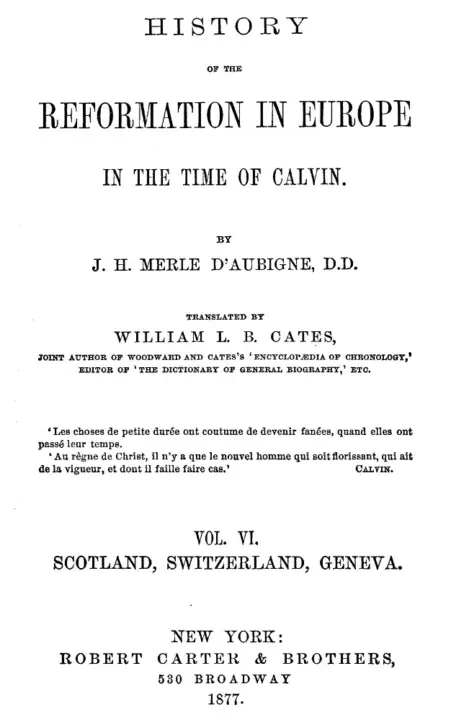
"History of the Reformation in Europe in the Time of Calvin, Vol. 6 (of 8)" by J. H. Merle D’Aubigné is a historical account written in the late 19th century. This volume focuses on the Reformation period in Scotland, Switzerland, and Geneva, emphasizing the theological and sociopolitical developments during Calvin's influence. It likely discusses the struggles for religious reformation and the impact of key figures such as John Knox and Patrick Hamilton on the Protestant movement in Scotland. The opening of the volume sets the stage for the narrative by outlining the historical background and key events leading to the Reformation in Scotland. It introduces the early influencers of the movement, touching on the historical significance of figures such as the Culdees, John Wycliffe's followers, and Patrick Hamilton. The text elegantly describes how the doctrines of the Reformation began to resonate throughout Scotland, highlighting the critical themes of faith, scripture, and the evolving relationship between the Church and Scottish society. It also begins to explore the tumultuous interplay of local nobility and religious authority, which would shape the Reformation's trajectory in the region.
Introduction adapted from the source catalogue; source summaries may be automatically generated.
Free to read · English · 180,014 words · No account needed
MAKE TIME FOR A GOOD BOOK
On by default. Untick to stop anonymous reading totals. Each page counts after 10 seconds in view. How this works.
Anonymous counting is on unless you have switched it off.
THE COUNTER-REFORMATION PREVAILS.--CALVIN AND FAREL REFUSE TO GIVE THE LORD’S SUPPER.--THE PULPIT IS CLOSED TO THEM.
[Sidenote: RESISTANCE OF CALVIN.]
The very circumstances which inspired the confidence of Berne were exactly those which roused the resistance of Calvin. Those powerful and magnificent lords could not believe that so dignified an intervention would fail to secure submission; and Calvin could not consent that the interests of the Church of Christ should be regulated by the magistrate, like those of the highways and the soldiery. Besides, in the present case, the question was about foreign magistrates. To their intervention the citizen and the Christian could not but be equally opposed. Calvin wished to maintain the principle of religious liberty, and he requested that time should be allowed him to come to an understanding with the other Churches. However, if the letter to the ministers was unsuccessful, that sent to the council had a success so abundant that it not only surpassed the hopes of the Bernese, but crossed their desires and threw an obstacle in the way of their projects. The syndics who had been named in a spirit hostile to the reformers, and all the citizens who had placed them in office, were delighted to see variance between Berne and Calvin and Farel. For them it was a piece of real good fortune, although for the ministers it was a grievous event. The two states, Berne and Geneva, acting in unison, would soon get the better of two poor ministers. Further, the council was at this time in a bad humor. The third preacher, the aged and energetic Courault, who had remained at Geneva, had blamed the syndics in one of his sermons, and it was resolved to reprimand him. It is safe to rely, in this matter, on what the Registers state. It is not right to receive, as some have done, the burlesque and lying imputations of the notorious slanderer Bolsec, who, ‘after the example of Herostratos, chose to pass down to posterity branded with infamy.’[597] The council forbade Courault to preach. This was the state of things when the letters from Berne arrived. The council immediately gave orders that Calvin and Farel should appear before them on Friday, April 19. It was the Holy week, and that day was the day of the Passion. This consideration caused no hesitation on the part of the enemies of the Reformation. As the holy supper was to be celebrated two days later on Easter Sunday, they were anxious to hurry forward the business. The ministers then found themselves between the anvil and the hammer; they must submit or fall, and do which they would, they would be weakened and lowered. The secretary having read the letter from Berne, the first syndic declared to the reformers that the council was determined to accede to the demand of that city, and to conform to the usages there established with respect to ceremonies. Then he asked them if they would themselves observe them, and requested them to answer Yes or No. Calvin and Farel demanded the time necessary, not merely, as has been asserted, for reflection on the subject, but also and especially, that the question might be settled by the competent authorities, the Swiss synod, which in ten days (April 29) was to be held at Zurich. Meanwhile they begged that no innovation should be made until the next supper. In making this request Calvin pledged himself to accept whatever should be decreed by that legitimate authority. This was on his part a large concession. To his Scriptural and just judgment it did not appear consistent, after separating from Roman Catholicism, still to retain any part of the system, even were it only a trifle, such as unleavened bread, baptisteries, and festivals. To one of the latter, especially, he felt great objection. He knew that small concessions lead on to large ones, and he feared that Rome would act according to the proverb, and if you gave an inch would take an ell. It is needless to repeat how decided and firm Calvin was, and yet, out of love for peace and for unity, he conceded to his adversaries what he might justly have refused them. All he asked was that they would wait for ten days the decision of the synodal authority. This, assuredly, was not saying No in an absolute manner.[598] It was quite the reverse; and the adversaries of Calvin ought rather to have wondered at his compliance than have blamed him for his inflexible obstinacy. His request was fair, and it ought to have been granted. But they would not listen to it. It was ordered that the supper should be celebrated conformably to the Bernese usage; and the council appointed the magistrates who were to take care that it was thus celebrated in the churches of St. Peter, St. Gervais, and Rive. It may be asked how it was that men who were by no means remarkable for their attachment to traditional observances should be so obstinate in sacrificing the ritual of Geneva to the ritual of Berne. Impartial judges have said, ‘The Council had taken this resolution in order to win over the Bernese and to implicate them in the opposition to the reformers.’[599] We confess that this explanation appears to us very probable.
Your reading position is saved on this browser. Take it to another device with a library code. Reading pages adapt to text, rather than matching a printed edition.
BEHIND THE BOOK
This eBook is for the use of anyone anywhere in the United States and most other parts of the world at no cost and with almost no restrictions whatsoever. You may copy it, give it away or re-use it under the terms of the Project Gutenberg License included with this eBook or online at www.gutenberg.org. If you are not located in the United States, you will have to check the laws of the country where you are located before using this eBook. Read the source licence.
The original source file, including credits and licence, is retained by this library. Request an original-format copy at no charge. Please include the book title and Project Gutenberg identifier #65984.
KEEP YOUR CURIOSITY GOING
Cécile Tormay

Moritz Busch
John L. Ransom
Frances Wright
Cécile Tormay

Mabel Potter Daggett