THE CLASSIC COLLECTION✦An outlaw’s diary: the CommuneCLASSIC FREE BOOKS
An outlaw’s diary: the Commune
Cécile Tormay
THE CLASSIC COLLECTION · 1879
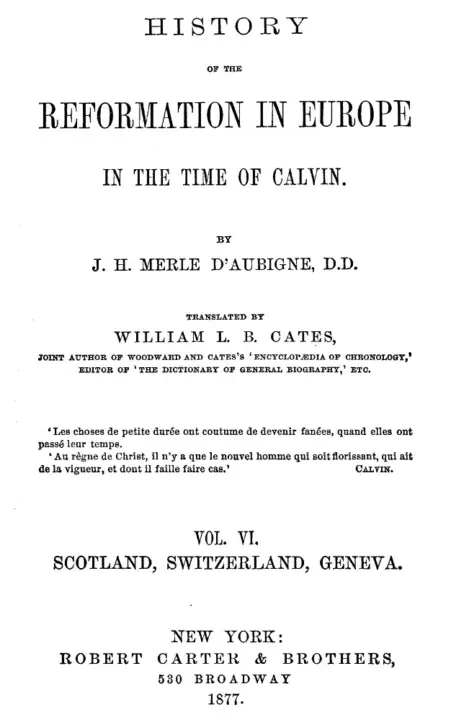
"History of the Reformation in Europe in the Time of Calvin, Vol. 6 (of 8)" by J. H. Merle D’Aubigné is a historical account written in the late 19th century. This volume focuses on the Reformation period in Scotland, Switzerland, and Geneva, emphasizing the theological and sociopolitical developments during Calvin's influence. It likely discusses the struggles for religious reformation and the impact of key figures such as John Knox and Patrick Hamilton on the Protestant movement in Scotland. The opening of the volume sets the stage for the narrative by outlining the historical background and key events leading to the Reformation in Scotland. It introduces the early influencers of the movement, touching on the historical significance of figures such as the Culdees, John Wycliffe's followers, and Patrick Hamilton. The text elegantly describes how the doctrines of the Reformation began to resonate throughout Scotland, highlighting the critical themes of faith, scripture, and the evolving relationship between the Church and Scottish society. It also begins to explore the tumultuous interplay of local nobility and religious authority, which would shape the Reformation's trajectory in the region.
Introduction adapted from the source catalogue; source summaries may be automatically generated.
Free to read · English · 180,014 words · No account needed
MAKE TIME FOR A GOOD BOOK
On by default. Untick to stop anonymous reading totals. Each page counts after 10 seconds in view. How this works.
Anonymous counting is on unless you have switched it off.
SYNOD OF ZURICH.--THE BERNESE AMBASSADORS CONDUCT CALVIN BACK TO GENEVA.--HE CANNOT ENTER THE TOWN.
[Sidenote: FAREL AND CALVIN AT ZURICH.]
Farel and Calvin did not allow themselves to hesitate by reason of the obduracy of their enemies. They were determined to do all they could to save the Church and likewise the town of Geneva from the calamities which, in the opinion of good men in Switzerland, must certainly fall upon them. The synod of the reformed Churches of this country, to the decision of which they had appealed, was now sitting at Zurich. They went thither without delay, to inform the assembly of the important events which had taken place at Geneva, and to claim its mediation. The deputies of Basel, Berne, Schaffhausen, St. Gall, Glaris, Mulhausen, and Bienne, in conjunction with the doctors of Zurich, constituted the assembly, which sat from April 29 to May 3. Bucer and Capito had also come from Strasburg to be present at it. The principal business of the synod was the union with Luther, who at that time showed a conciliatory disposition. All the members, except Kunz, the Bernese deputy, received the two exiles with true Christian cordiality. It appears that Farel and Calvin found relief and relaxation in this meeting of brethren. From their life at Geneva, constantly in the presence of violent adversaries, they had probably experienced a kind of moral tension. But the loyal affection of the Swiss allowed their minds to unbend, and their souls expanded in the sunshine of charity. After being engaged on matters relating to the Concordia of Wittenberg, the synod passed on to the subject of rites, and decided that with respect to them the Churches ought to retain full liberty--a resolution favorable to Calvin and Farel. After settling this point, the synod took into consideration the state of Geneva. Calvin laid before it the divisions and troubles which afflicted the Church, the forlorn condition to which the good Christians were reduced, and the dangers to which the Reformation was there exposed. He displayed no obstinacy with respect to subordinate points, but immovable firmness on those which he believed to be indispensable to the prosperity of Geneva. He readily assented to the use of baptismal fonts; and also, he added, the introduction ‘into our Church of unleavened bread; but,’ said he, ‘we desire to request of the Bernese that this bread should be broken.’[669] The act of breaking bread, according to the institution and the practice of the apostles, appeared to him essential to the symbol which was intended to commemorate the body of the Lord offered in sacrifice. He felt somewhat perplexed about the question of the festivals; but he gave his consent to four of them, on condition that any persons who might desire it should be at liberty to work after the service. He was anxious not to open the door to the uproar and licentiousness which characterize the Roman populations during the latter part of those festival days.[670] He continued: ‘If there be any thought of reëstablishing us at Geneva, we demand first of all that we should be allowed to clear ourselves of the calumnies which have been heaped on us. We have been condemned unheard, and that,’ said he, ‘is an inhuman, a barbarous proceeding, not to be tolerated.[671] Next, it will be essential to establish discipline, for want of which all that we may restore would soon be overthrown. We demand that the town should be divided into parishes, for no order is possible in the church unless the flock be near its pastor, and the pastor near his flock. We demand that a seasonable use of excommunication should be allowed; and that, for this purpose, the council should select in the several quarters of the town upright and wise men to whom, by common consent, its control should be intrusted. We demand that in the institution of pastors legitimate order should be maintained, and that the authority of the magistrate should not supersede the laying-on of hands, which ministers ought to receive. We demand a more frequent administration of the supper; that it should be celebrated, if not according to the custom of the early Church,[672] at least once a month. We demand that with the public preaching should be joined the singing of psalms. Finally, we demand that, as our own townsmen bring forward the example of the countries which are subject to Berne in justification of lascivious songs and dances,[673] the Bernese should be entreated to put an end to such profligacy in their own states, in order that our people may not take advantage of it to justify themselves in similar excesses.’
Your reading position is saved on this browser. Take it to another device with a library code. Reading pages adapt to text, rather than matching a printed edition.
BEHIND THE BOOK
This eBook is for the use of anyone anywhere in the United States and most other parts of the world at no cost and with almost no restrictions whatsoever. You may copy it, give it away or re-use it under the terms of the Project Gutenberg License included with this eBook or online at www.gutenberg.org. If you are not located in the United States, you will have to check the laws of the country where you are located before using this eBook. Read the source licence.
The original source file, including credits and licence, is retained by this library. Request an original-format copy at no charge. Please include the book title and Project Gutenberg identifier #65984.
KEEP YOUR CURIOSITY GOING
Cécile Tormay

Moritz Busch
John L. Ransom
Frances Wright
Cécile Tormay

Mabel Potter Daggett