THE CLASSIC COLLECTION✦An outlaw’s diary: the CommuneCLASSIC FREE BOOKS
An outlaw’s diary: the Commune
Cécile Tormay
THE CLASSIC COLLECTION · 1879
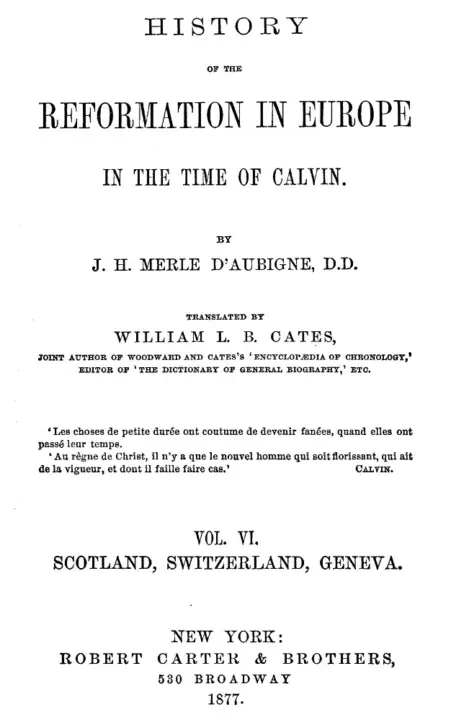
"History of the Reformation in Europe in the Time of Calvin, Vol. 6 (of 8)" by J. H. Merle D’Aubigné is a historical account written in the late 19th century. This volume focuses on the Reformation period in Scotland, Switzerland, and Geneva, emphasizing the theological and sociopolitical developments during Calvin's influence. It likely discusses the struggles for religious reformation and the impact of key figures such as John Knox and Patrick Hamilton on the Protestant movement in Scotland. The opening of the volume sets the stage for the narrative by outlining the historical background and key events leading to the Reformation in Scotland. It introduces the early influencers of the movement, touching on the historical significance of figures such as the Culdees, John Wycliffe's followers, and Patrick Hamilton. The text elegantly describes how the doctrines of the Reformation began to resonate throughout Scotland, highlighting the critical themes of faith, scripture, and the evolving relationship between the Church and Scottish society. It also begins to explore the tumultuous interplay of local nobility and religious authority, which would shape the Reformation's trajectory in the region.
Introduction adapted from the source catalogue; source summaries may be automatically generated.
Free to read · English · 180,014 words · No account needed
MAKE TIME FOR A GOOD BOOK
On by default. Untick to stop anonymous reading totals. Each page counts after 10 seconds in view. How this works.
Anonymous counting is on unless you have switched it off.
[88] ‘Adhortante rege ipso.’--Lesley, De Rebus Gestis, &c. p. 421.
[89] ‘They travailled with the king, that he should pass in pilgrimage to St. Duthac.’--Knox, Reform., i. p. 16.
[90] The fact of this journey has been disputed in spite of the testimonies of Knox, Spotswood, and others. But a letter of Angus to Wolsey, of March 30, 1528, states that the king was at that time in the north country, in the extreme parts of his realm. This evidence is decisive.
[91] ‘Cum frater Patricii duxisset exercitum.’--Lambert, Liber Psalm.
[92] ‘Ventis fuit impeditus.’--Ibid.
[93] ‘Aliquot millia conscripserunt equitum.’--Ibid. The number is
doubtless exaggerated.
[94] ‘Very early in the morning.’--Fox, Acts, iv. p. 559. The last of February.--Knox, Hist. of the Ref., i. 18 and 511. Pridie Cal. Martii.--Lambert, in Johan. Apocal. in Dedicat.
[95] Spotswood, Hist. of the Church of Scotland, p. 63.
[96] Spotswood, Hist. of the Church of Scotland, p. 63.
[97] M’Crie, Life of Melville, i. note D, p. 416.
[98] ‘Cum ii qui missi erant sub noctem ab episcopis hospitium ejus obsidissent.’--Alesius, Liber Psalm.
[99] ‘Processit ille obvius eis et petit quem quærerent.’--Alesius,
Liber Psalm.
[100] ‘Orans ut discedere permitteret suos.’--Ibid.
[101] The author, during a visit which he paid to St. Andrews in 1845, studied on the spot the places here referred to, having as his guide to the beautiful antiquities of St. Andrews the historian of the Scottish Church, Dr. Hetherington.
[102] ‘Affui ego, spectator tragediæ.’--Alesius, Liber Psalm.
[103] ‘After the manner of other courtiers in all kinds of licentious riotousness.’--Knox, Hist., i. App. p. 505.
[104] It is in reference to this verse (Ps. xxxvii. 3) that Alesius, in his Comm. des Psaumes, narrates the trial of Hamilton.
[105] ‘Jusserunt episcopi et theologi ut ei conviciaretur et vocaret eum hereticum.’--Alesius, Liber Psalm.
[106] Pitscottie, Hist. of Scotland, pp. 133, 134.
[107] ‘Mi frater, non ita sentis in animo.’--Alesius, Liber Psalm.
[108] ‘Hoc dicto ita conscientiam illius percutit.’--Ibid.
[109] ‘Domum rediens, inciderit in phrenesin.’--Ibid. Buchanan adds, lib. xiv. ad an. 1527, ‘Nunquam ex eo die compos mentis fuit.’
[110] The sentence is given at full length in Fox, Acts, iv. p. 560.
[111] ‘Conclusus inter aliquot millia armatorum.’--Alesius, Liber
Psalm.
[112] ‘Cum ipse adhuc in mensa sederet, jubet vocari præfectum et quærit utrum omnia parata sint.’--Alesius, Liber Psalm.
[113] ‘Apprehensa ejus dextera, properat ad locum supplicii.’--Ibid.
[114] ‘Christi cruce cunctis vitæ commodis anteposita.’--Bezæ Icones.
[115] ‘Viso palo, ad quam alligandus erat, aperit caput, suscipiensque in cœlum, orat.’--Alesius, Liber Psalm.
[116] Knox, Hist. of the Ref., p. 17. Spotswood, p. 63.
[117] Pittscottie, Lorimer.
[118] Pittscottie, Lorimer.
[119] ‘Tu, si vera doces, infer digitum huc, ubi totus
ardeo.’--Alesius, Liber Psalm.
[120] Knox, Hist., i. p. 18.
Your reading position is saved on this browser. Take it to another device with a library code. Reading pages adapt to text, rather than matching a printed edition.
BEHIND THE BOOK
This eBook is for the use of anyone anywhere in the United States and most other parts of the world at no cost and with almost no restrictions whatsoever. You may copy it, give it away or re-use it under the terms of the Project Gutenberg License included with this eBook or online at www.gutenberg.org. If you are not located in the United States, you will have to check the laws of the country where you are located before using this eBook. Read the source licence.
The original source file, including credits and licence, is retained by this library. Request an original-format copy at no charge. Please include the book title and Project Gutenberg identifier #65984.
KEEP YOUR CURIOSITY GOING
Cécile Tormay

Moritz Busch
John L. Ransom
Frances Wright
Cécile Tormay

Mabel Potter Daggett