THE CLASSIC COLLECTION✦An outlaw’s diary: the CommuneCLASSIC FREE BOOKS
An outlaw’s diary: the Commune
Cécile Tormay
THE CLASSIC COLLECTION · 1879
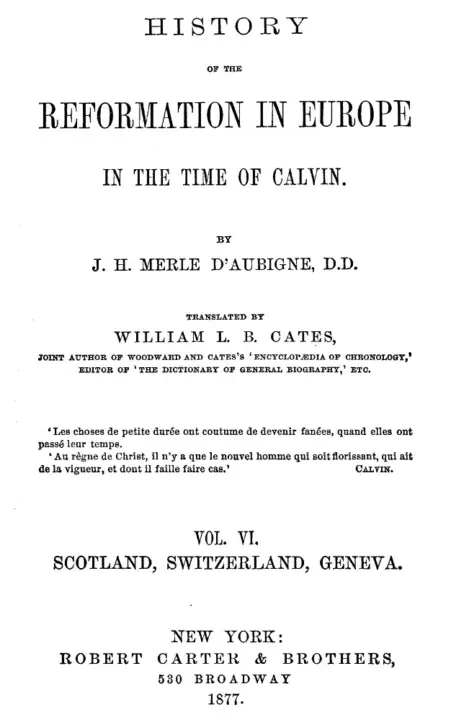
"History of the Reformation in Europe in the Time of Calvin, Vol. 6 (of 8)" by J. H. Merle D’Aubigné is a historical account written in the late 19th century. This volume focuses on the Reformation period in Scotland, Switzerland, and Geneva, emphasizing the theological and sociopolitical developments during Calvin's influence. It likely discusses the struggles for religious reformation and the impact of key figures such as John Knox and Patrick Hamilton on the Protestant movement in Scotland. The opening of the volume sets the stage for the narrative by outlining the historical background and key events leading to the Reformation in Scotland. It introduces the early influencers of the movement, touching on the historical significance of figures such as the Culdees, John Wycliffe's followers, and Patrick Hamilton. The text elegantly describes how the doctrines of the Reformation began to resonate throughout Scotland, highlighting the critical themes of faith, scripture, and the evolving relationship between the Church and Scottish society. It also begins to explore the tumultuous interplay of local nobility and religious authority, which would shape the Reformation's trajectory in the region.
Introduction adapted from the source catalogue; source summaries may be automatically generated.
Free to read · English · 180,014 words · No account needed
MAKE TIME FOR A GOOD BOOK
On by default. Untick to stop anonymous reading totals. Each page counts after 10 seconds in view. How this works.
Anonymous counting is on unless you have switched it off.
These were Calvin’s principles. His discourse has not been handed down to us, but it is impossible to suppose that he did not speak according to his deepest convictions; and if he did so, that would partly account for the calmness with which he was listened to. He was, however, mistaken on one point, and this we cannot too fully acknowledge. At that time the Church and the state were everywhere almost confounded, so that ‘the state did not hesitate to intermeddle in many subjects which were within the province of the Church.’[637] This was particularly the case at Geneva. Of all the reformers, Calvin was the one who had it most at heart to establish the autonomy of the Church, and thereby a certain independence of the two societies. But, like his contemporaries, he adhered to the opinions of his own age and of those which had preceded it. The elements of Judaic discipline had, from the first century, trenched on the ground of Christian discipline. The Reformation doubtless effected everywhere a great change in this state of things; but still the state was seen, even at Geneva, thrusting its iron arm into the midst of the Christian societies for the purpose of striking the guilty. That is a coarse and fatal error, one which every true Christian must energetically cast from him. Fortunately there could be no question on this point in the great conflict of Easter 1538. The state was then for the moment separated from the Church, and the reformers did not and would not make use of any other weapons than those of the Spirit.
[Sidenote: HIS EVENING SERMON.]
If the reformer had been able to preach with tranquillity in the morning, it was to be otherwise in the evening. The most furious of his adversaries thought that they owed him something, and in their wrath meant to discharge the debt. So long as they had had to do only with the good-natured Farel, matters had gone on pretty well, notwithstanding his lively sallies; but this young man from Noyon was a spirit of a different stamp, and since he came to Geneva everything had changed. He had a methodical intellect and the faculty for organization. Had he not prepared a fundamental law of the Church, to which they had been obliged to take the oath at St. Peter’s? He wanted to regulate everything, and this was not convenient. Since Farel had been attacked, it was not fair to let Calvin escape. An uproar had been made in the morning at St. Gervais; another shall be made in the evening at the church of St. Francis at Rive. It was in that convent that Farel had for the first time appeared in the pulpit, March 1, 1534; and there Calvin was to preach, April 21, 1538. The quarter in which this convent stood was situated in the lower part of the town, not far from the shores of the lake, and it was probably less quiet than the neighborhood of the cathedral. The church was speedily filled, and Calvin arrived. He began his sermon. Knowing that Farel had been treated worse than himself, it is possible that, to leave no ground for reproaching himself, he might think it his duty to put a stronger emphasis on his words, and to lay stress on certain things, in order to make them observed and felt. For the rest, had he spoken like an angel, he would not have escaped the tumult. Men’s minds were irritated; the thought of resisting this inflexible man had seized on many, and made them frantic; they had even taken their swords, and had come to church as to a military parade. Violence often remains at first smouldering, silent, and makes no sign. It appears to have been so in this case; but at some word uttered by the preacher, it revealed itself in a sudden explosion. One would have said that a stormy wind passed over that crowd, and impressed on it a passionate movement. In the church of Rive there were violent speeches and threatening gestures. This was not all. In sight of that orator, whose dignity and power irritated them, the most furious drew their swords, and the flash of steel was seen in the sanctuary of peace. No one, it is true, directed the fatal edge at the throat of the orator. It appears, however, that a struggle took place between the friends and the enemies of the Reformation, and that arms were crossed; for the great magistrate of Geneva in the sixteenth century, Michel Rozet, felt bound to say in his chronicle that the affair passed off without bloodshed.[638] The syndic Gautier, too, looks on this fortunate circumstance as a kind of miracle. Thus, after having heard the firing of arquebuses, fifty or sixty times in the course of the evening, against his own house, the reformer at this hour saw glittering swords brandished against him in the very house of God. Luther and other reformers were also tried by such tribulations, but in their case they came from the pope and his adherents, not from people of their own Church. Was Calvin agitated, or did he remain calm in the presence of this outbreak? We do not know. It is probable that, while inwardly agitated, he preserved an outward calmness. While some of his friends gathered around the pulpit to defend him, there were happily found a few moderate men, belonging to both sides, who exerted themselves to restore peace, to check the outbursts of passion, and to bring to reason those excited men who were dishonoring by their violence the temple of the Lord. Gradually feeling calmed down, speech became less violent, swords were returned to their scabbards, and the storm was laid. The friends of Calvin accompanied and conducted him safe and sound to his abode, which was not far off. ‘And in the evening, at Rive,’ says the syndic Rozet, ‘a disturbance broke out against Calvin. Swords were drawn; but it was all quelled.’
Your reading position is saved on this browser. Take it to another device with a library code. Reading pages adapt to text, rather than matching a printed edition.
BEHIND THE BOOK
This eBook is for the use of anyone anywhere in the United States and most other parts of the world at no cost and with almost no restrictions whatsoever. You may copy it, give it away or re-use it under the terms of the Project Gutenberg License included with this eBook or online at www.gutenberg.org. If you are not located in the United States, you will have to check the laws of the country where you are located before using this eBook. Read the source licence.
The original source file, including credits and licence, is retained by this library. Request an original-format copy at no charge. Please include the book title and Project Gutenberg identifier #65984.
KEEP YOUR CURIOSITY GOING
Cécile Tormay

Moritz Busch
John L. Ransom
Frances Wright
Cécile Tormay

Mabel Potter Daggett