THE CLASSIC COLLECTION✦An outlaw’s diary: the CommuneCLASSIC FREE BOOKS
An outlaw’s diary: the Commune
Cécile Tormay
THE CLASSIC COLLECTION · 1879
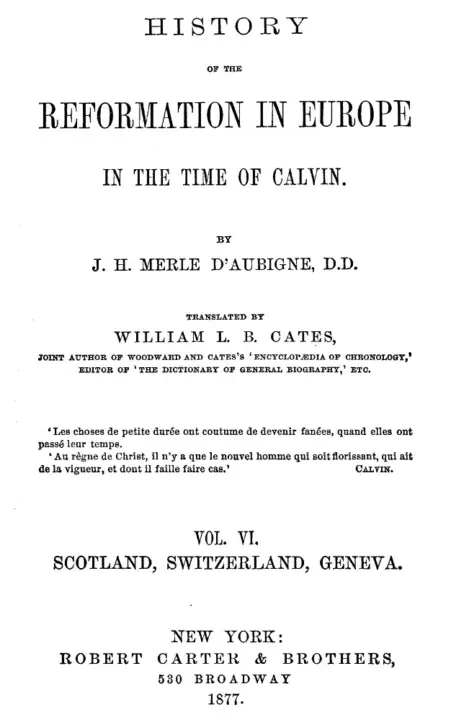
"History of the Reformation in Europe in the Time of Calvin, Vol. 6 (of 8)" by J. H. Merle D’Aubigné is a historical account written in the late 19th century. This volume focuses on the Reformation period in Scotland, Switzerland, and Geneva, emphasizing the theological and sociopolitical developments during Calvin's influence. It likely discusses the struggles for religious reformation and the impact of key figures such as John Knox and Patrick Hamilton on the Protestant movement in Scotland. The opening of the volume sets the stage for the narrative by outlining the historical background and key events leading to the Reformation in Scotland. It introduces the early influencers of the movement, touching on the historical significance of figures such as the Culdees, John Wycliffe's followers, and Patrick Hamilton. The text elegantly describes how the doctrines of the Reformation began to resonate throughout Scotland, highlighting the critical themes of faith, scripture, and the evolving relationship between the Church and Scottish society. It also begins to explore the tumultuous interplay of local nobility and religious authority, which would shape the Reformation's trajectory in the region.
Introduction adapted from the source catalogue; source summaries may be automatically generated.
Free to read · English · 180,014 words · No account needed
MAKE TIME FOR A GOOD BOOK
On by default. Untick to stop anonymous reading totals. Each page counts after 10 seconds in view. How this works.
Anonymous counting is on unless you have switched it off.
Voulaient du Dieu vivant braver la majesté.
[Sidenote: DISTURBANCE AT ST. GERVAIS.]
He therefore went on. His popular eloquence, his animated movements, his imagery so well adapted to make his ideas more lively and more obvious, his energetic gestures, his voice like thunder, the resounding of which, according to Theodore Beza, made his hearers tremble, made him the most captivating of the orators of France and Switzerland. Farel, who generally spoke extempore, could not but be struck at the spectacle which presented itself to him, for the congregation in such circumstances always reacts on the preacher. He was standing in the presence of a stormy sea, the surging waves of which appeared about to engulf him. But he felt that he stood on a rock, and he had learnt long ago to brave the tempest. He then courageously unfolded the act of accusation. He set forth those things which would profane the supper. He enumerated ‘those divisions, those bands, those blasphemies, those profligacies which were multiplying, and which made it impossible for the ministers to administer it.’[634] For a long time people could not listen to him without being charmed, but it was quite otherwise at this moment. Men’s minds were more and more agitated, hearts were rebellious, the opposition burst forth, voices changed by passion were heard, and the disturbance of which the chronicler tells filled the church of St. Gervais. Farel, however, kept the upper hand. His character and his action awed the rebels. His friends protected his departure, and he succeeded in reaching his own house unharmed.
Meanwhile Calvin was preaching at St. Peter’s. What was passing there?
[Sidenote: CALVIN’S MORNING SERMON.]
The worship appears to have been quiet and dignified; the scenes of St. Gervais, at any rate, were not repeated here. The quarter in which the cathedral stood, its imposing and solemn aspect, the composition of the congregation, the magistrates, who doubtless were present in large numbers, the grave countenance of the reformer, partly explain this decorum. But the character of his speech, calm, simple, rich in thought, luminous, and illuminating all the subjects of which he treated, concise, awe-inspiring, and convincing, without the vivid and popular flashes of Farel, doubtless contributed thereto to a great extent. Nevertheless Calvin kept back nothing. ‘We protest before you all,’ he said, ‘that we are not obstinate on the question about bread, leavened or unleavened; that is a matter of indifference which is left to the discretion of the Church. If we decline to administer the supper, it is because we are in a great difficulty which prompts us to this course.’ Then he spoke of the divisions, the bands of men, the blasphemies, the profligacies, disorders, abominations, mockery of God and his Gospel, the troubles and the sects which prevailed in the town. ‘For,’ he said, ‘in public, and without any kind of punishment being inflicted for it, a thousand derisive speeches have been uttered against the Word of God and likewise against the supper.’[635] He then stated unreservedly the motives which deterred him from celebrating the communion. But he does not appear to have gone further. He had doubtless more than once in his discourses transgressed the limits of moderation; but it seems that the solemnity of the occasion and the dignity of the pulpit led him to suppress those violent phrases with which his speech sometimes bristled. He had a difficult task to accomplish. He was bound to make these people understand the obligations imposed on them by the profession of Christianity. Every member of a society has, in fact, certain duties to discharge, which are essential to the very existence of the community; in the same way, every member of the Church owes to it an edifying and blameless life. Christians form but one body, and it is a matter of concern to each of its members that God should be honored in them all. Evident hypocrisy and shameless depravity, in any man making profession of being a Christian, are an injury to the whole Christian society. Union with God is incompatible with a state of sin; vice and virtue are two things which never go together. To regard as a trifle and a matter of indifference the implacable opposition which exists between truth and falsehood, between holiness and licentiousness, so that the one or the other may be pursued without any ground for preference, is the degradation of humanity and the scandal of scandals. If this mode of thought prevail, the Christian Church is in a state of suffering; it must be defended, it must be saved; and a Church unwilling to be defended would be in a very unhealthy condition. More than that, and Calvin frequently called it to mind, to maintain the necessity of a life conformed to the Word of God is of importance even to the man whose conduct is in opposition to his commandments. This necessity is insisted on not to destroy but to save him. ‘It is maintained in such a manner,’ said Calvin, ‘as to bring him back into the way of salvation, and the Church is quite ready to receive him as a friend. She must not exercise a too rigorous severity; she must not proceed strictly to extremities and show herself inexorable, but must rather come forward with gentleness. If this moderation be not carefully adhered to, there is danger that from correctors we should become executioners.’[636]
Your reading position is saved on this browser. Take it to another device with a library code. Reading pages adapt to text, rather than matching a printed edition.
BEHIND THE BOOK
This eBook is for the use of anyone anywhere in the United States and most other parts of the world at no cost and with almost no restrictions whatsoever. You may copy it, give it away or re-use it under the terms of the Project Gutenberg License included with this eBook or online at www.gutenberg.org. If you are not located in the United States, you will have to check the laws of the country where you are located before using this eBook. Read the source licence.
The original source file, including credits and licence, is retained by this library. Request an original-format copy at no charge. Please include the book title and Project Gutenberg identifier #65984.
KEEP YOUR CURIOSITY GOING
Cécile Tormay

Moritz Busch
John L. Ransom
Frances Wright
Cécile Tormay

Mabel Potter Daggett