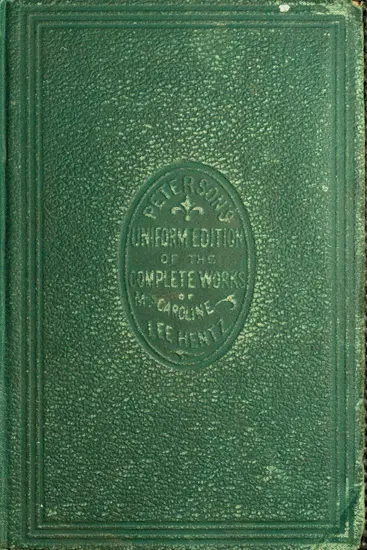
Love After Marriage; and Other Stories of the Heart
Caroline Lee Hentz
THE CLASSIC COLLECTION · 1853
"Helen and Arthur; or, Miss Thusa's Spinning Wheel" by Caroline Lee Hentz is a novel written in the mid-19th century. The story centers on young Helen, a child characterized by her vivid imagination and deep emotions, who finds herself in the care of Miss Thusa, an eccentric spinner and storyteller. As Helen navigates her fears and curious fantasies, the narrative explores themes of childhood innocence, the supernatural, and the contrast between life and death, particularly in the backdrop of Southern domestic life. The opening of the novel introduces Helen and Miss Thusa on a blustery night, where Miss Thusa, spinning by the fire, captivates Helen with her tales, blending elements of horror with comfort. Helen's fascination with these stories, particularly those that send shivers down her spine, fosters a rich inner world filled with contrasting joys and terrors. Soon, the narrative hints at deeper emotional challenges, particularly as Helen's mother struggles with illness, framing a poignant exploration of grief and childhood vulnerability. This initial setup promises a blend of whimsical yet dark storytelling, inviting readers into a soulful reflection on the complexities of growing up.
Introduction adapted from the source catalogue; source summaries may be automatically generated.
Free to read · English · 98,161 words · No account needed
MAKE TIME FOR A GOOD BOOK
On by default. Untick to stop anonymous reading totals. Each page counts after 10 seconds in view. How this works.
Anonymous counting is on unless you have switched it off.
They were now close to the water, which, just where they stood, was as still and smooth as glass. Helen saw herself in the clear, blue mirror, and laughed aloud--then she blushed to think how strange and ugly she looked. Eagerly scooping up the water in the hollow of her hand, she bathed her face, and removed the disfiguring stains.
"You have no napkin," said the young doctor, taking a snowy linen handkerchief from his pocket, which emitted a sweet, faint, rose-like perfume. "Will this do?"
He wiped her face, which looked fairer than ever after the ablution, and then first one and then the other of her trembling hands, for they still trembled from nervous agitation.
"How kind, how good he is!" thought Helen, as his hand passed gently over her brow, smoothing back the moist and tangled hair, then glided against her cheek, while he arranged the twisted bonnet and untied the dangling strings, which had tightened into a hard and obstinate knot. "I wonder what makes him so kind and good to me?"
When they came to the fence, surrounding the strawberry-field, Helen's steps involuntarily grew slower, and she hung back heavily on the hand of her companion. Her old fears came rushing over her, drowning her new-born courage.
Arthur laid his hand on the top rail, and vaulted over as lightly as a bird, then held out his arms towards her.
"Climb, and I will catch you," said he, with an encouraging smile. Poor little Helen felt constrained to obey him, though she turned white as snow--and when he took her in his arms, he felt her heart beating and fluttering like the wings of a caged humming-bird.
"Ah, I see the silver bucket," he cried, "all filled with strawberries. The enemy is fled; the coast is clear."
He still held her in his arms, while he stooped and lifted the bucket,
then again vaulted over the fence, as if no burden impeded his
movements.
"You are safe," said he, "and you can now gladden your mother's heart by this sweet offering. Are you sorry you came?"
"Oh! no," she replied, "I feel happy now." She insisted upon his eating part of the strawberries, but he refused, and as they walked home, he gathered green leaves and flowers, and made a garland round them.
"What makes you so good to me?" she exclaimed, with an irresistible impulse, looking gratefully in his face.
"Because I like you," he replied; "you remind me, too, of a dear little sister of mine, whom I love very tenderly. Poor unfortunate Alice! Your lot is happier than hers."
Your reading position is saved on this browser. Take it to another device with a library code. Reading pages adapt to text, rather than matching a printed edition.
BEHIND THE BOOK
This eBook is for the use of anyone anywhere in the United States and most other parts of the world at no cost and with almost no restrictions whatsoever. You may copy it, give it away or re-use it under the terms of the Project Gutenberg License included with this eBook or online at www.gutenberg.org. If you are not located in the United States, you will have to check the laws of the country where you are located before using this eBook. Read the source licence.
The original source file, including credits and licence, is retained by this library. Request an original-format copy at no charge. Please include the book title and Project Gutenberg identifier #23106.
KEEP YOUR CURIOSITY GOING
Coulson Kernahan

Maurice Baring
Frances Wright
Cécile Tormay

Frederic Jesup Stimson

W. H. P. (William Henry Pope) Jarvis