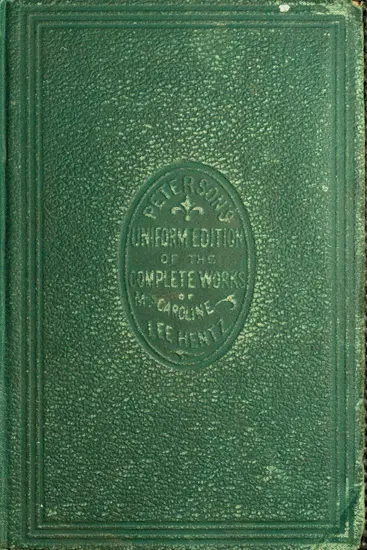
Love After Marriage; and Other Stories of the Heart
Caroline Lee Hentz
THE CLASSIC COLLECTION · 1853
"Helen and Arthur; or, Miss Thusa's Spinning Wheel" by Caroline Lee Hentz is a novel written in the mid-19th century. The story centers on young Helen, a child characterized by her vivid imagination and deep emotions, who finds herself in the care of Miss Thusa, an eccentric spinner and storyteller. As Helen navigates her fears and curious fantasies, the narrative explores themes of childhood innocence, the supernatural, and the contrast between life and death, particularly in the backdrop of Southern domestic life. The opening of the novel introduces Helen and Miss Thusa on a blustery night, where Miss Thusa, spinning by the fire, captivates Helen with her tales, blending elements of horror with comfort. Helen's fascination with these stories, particularly those that send shivers down her spine, fosters a rich inner world filled with contrasting joys and terrors. Soon, the narrative hints at deeper emotional challenges, particularly as Helen's mother struggles with illness, framing a poignant exploration of grief and childhood vulnerability. This initial setup promises a blend of whimsical yet dark storytelling, inviting readers into a soulful reflection on the complexities of growing up.
Introduction adapted from the source catalogue; source summaries may be automatically generated.
Free to read · English · 98,161 words · No account needed
MAKE TIME FOR A GOOD BOOK
On by default. Untick to stop anonymous reading totals. Each page counts after 10 seconds in view. How this works.
Anonymous counting is on unless you have switched it off.
Helen was too breathless to speak, but he knew, by her clinging hold, that she sought protection from some real or imaginary danger. While he pitied her evident fright, he could not help smiling at her grotesque appearance. The perspiration, dripping from her forehead, had made channels through the crimson dye on her cheeks, and her chin, which had been buried in the ground when she fell, was all covered with mud. Her frock was soiled and torn, her bonnet twisted so that the strings hung dangling over her shoulder. A more forlorn, wild-looking little figure, can scarcely be imagined, and it is not strange that the young doctor found it difficult to suppress a laugh.
"And so you left your strawberries behind," said he, after hearing the history of her fright and flight. "It seems to me I would not have treated the snake so daintily. Suppose we go back and cheat him of his nice supper, after all."
"Oh! no--no--no," exclaimed Helen, emphatically. "I wouldn't go for all the strawberries in the whole world."
"Not when they would do your sick mother good?" said he, gravely.
"But the snake!" cried she, with a shudder.
"It is perfectly harmless. If you took it in your hand and played with it, it would not hurt you. Those beautiful, bright-striped creatures have no venom in them. Come, let us step down to the edge of the stream and wash the stains from your face and hands, and then you shall show me where your strawberries are waiting for us in the long grass."
He took her hand and attempted to draw her along, but she resisted with astonishing strength, planting her back against the railing that divided the lane from the corn-field.
"Helen, you will come with me," said he, in the same tone, and with the same magnetic glance, with which he had once before subdued her. She remained still a few moments, then the rigid muscles began to relax, and hanging down her head, she sobbed aloud.
"You will come," repeated he, leading her gently along towards the bank of the stream, "because you know I would not lead you into danger, and because if you do not try to conquer such fears, they will make you very unhappy through life. Don't you wish to be useful and do good to others, when you grow older?"
"Oh, yes," replied Helen, with animation--"but," added she,
despondingly, "I never shall."
"It depends upon yourself," replied her friend; "some of the greatest men that ever lived, were once timid little children. They made themselves great by overcoming their fears, by having a strong will."
Your reading position is saved on this browser. Take it to another device with a library code. Reading pages adapt to text, rather than matching a printed edition.
BEHIND THE BOOK
This eBook is for the use of anyone anywhere in the United States and most other parts of the world at no cost and with almost no restrictions whatsoever. You may copy it, give it away or re-use it under the terms of the Project Gutenberg License included with this eBook or online at www.gutenberg.org. If you are not located in the United States, you will have to check the laws of the country where you are located before using this eBook. Read the source licence.
The original source file, including credits and licence, is retained by this library. Request an original-format copy at no charge. Please include the book title and Project Gutenberg identifier #23106.
KEEP YOUR CURIOSITY GOING
Coulson Kernahan

Maurice Baring
Frances Wright
Cécile Tormay

Frederic Jesup Stimson

W. H. P. (William Henry Pope) Jarvis