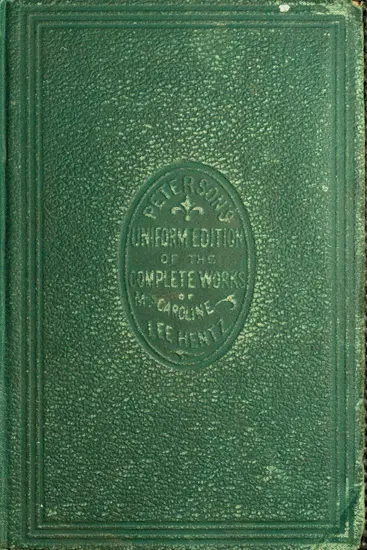
Love After Marriage; and Other Stories of the Heart
Caroline Lee Hentz
THE CLASSIC COLLECTION · 1853
"Helen and Arthur; or, Miss Thusa's Spinning Wheel" by Caroline Lee Hentz is a novel written in the mid-19th century. The story centers on young Helen, a child characterized by her vivid imagination and deep emotions, who finds herself in the care of Miss Thusa, an eccentric spinner and storyteller. As Helen navigates her fears and curious fantasies, the narrative explores themes of childhood innocence, the supernatural, and the contrast between life and death, particularly in the backdrop of Southern domestic life. The opening of the novel introduces Helen and Miss Thusa on a blustery night, where Miss Thusa, spinning by the fire, captivates Helen with her tales, blending elements of horror with comfort. Helen's fascination with these stories, particularly those that send shivers down her spine, fosters a rich inner world filled with contrasting joys and terrors. Soon, the narrative hints at deeper emotional challenges, particularly as Helen's mother struggles with illness, framing a poignant exploration of grief and childhood vulnerability. This initial setup promises a blend of whimsical yet dark storytelling, inviting readers into a soulful reflection on the complexities of growing up.
Introduction adapted from the source catalogue; source summaries may be automatically generated.
Free to read · English · 98,161 words · No account needed
MAKE TIME FOR A GOOD BOOK
On by default. Untick to stop anonymous reading totals. Each page counts after 10 seconds in view. How this works.
Anonymous counting is on unless you have switched it off.
"First Fear his hand its skill to try,
Amid the chords bewildered laid--
And back recoiled, he knew not why,
E'en at the sound himself had made."--Collins.
Little Helen sat in her long flannel night-dress, by the side of Miss Thusa, watching the rapid turning of her wheel, and the formation of the flaxen thread, as it glided out, a more and more attenuated filament, betwixt the dexterous fingers of the spinner.
It was a blustering, windy night, and the window-panes rattled every now and then, as if the glass were about to shiver in twain, while the stars sparkled and winked coldly without, and the fire glowed warmly, and crackled within.
Helen was seated on a low stool, so near the wheel, that several times her short, curly hair mingled with the flax of the distaff, and came within a hair's breadth of being twisted into thread.
"Get a little farther off, child, or I'll spin you into a spider's web, as sure as you're alive," said Miss Thusa, dipping her fingers into the gourd, which hung at the side of the distaff, while at the same time she stooped down and moistened the fibres, by slipping them through her mouth, as it glided over the dwindling flax.
Helen, wrapped in yellow flannel from head to feet, with her little white face peeping above, looked not unlike a pearl in golden setting. A muslin night-cap perched on the top of her head, below which her hair frisked about in defiance of comb or ribbon. The cheek next to the fire was of a burning red, the other perfectly colorless. Her eyes, which always looked larger and darker by night than by day, were fixed on Miss Thusa's face with a mixture of reverence and admiration, which its external lineaments did not seem to justify. The outline of that face was grim, and the hair, profusely sprinkled with the ashes of age, was combed back from the brow, in the fashion of the Shakers, adding much to the rigid expression of the features. A pair of dark-rimmed spectacles bestrided her forehead midway, appearing more for ornament than use. Never did Nature provide a more convenient resting-place for twin-glasses, than the ridge of Miss Thusa's nose, which rose with a sudden, majestic elevation, suggesting the idea of unexpectedness in the mind of the beholder. Every thing was harsh about her face, except the eyes, which had a soft, solemn, misty look, a look of prophecy, mingled with kindness and compassion, as if she pitied the evils her far-reaching vision beheld, but which she had not the power to avert. Those soft, solemn, prophetic eyes had the power of fascination on the imagination of the young Helen, and night after night she would creep to her side, after her mother had prepared her for bed, heard her little Protestant pater noster, and left her, as she supposed, just ready to sink into the deep slumbers of childhood. She did not know the strange influence which was acting so powerfully on the mind of her child, or rather she did not seem to be aware that her child was old enough to receive impressions, deep and lasting as life itself.
Your reading position is saved on this browser. Take it to another device with a library code. Reading pages adapt to text, rather than matching a printed edition.
BEHIND THE BOOK
This eBook is for the use of anyone anywhere in the United States and most other parts of the world at no cost and with almost no restrictions whatsoever. You may copy it, give it away or re-use it under the terms of the Project Gutenberg License included with this eBook or online at www.gutenberg.org. If you are not located in the United States, you will have to check the laws of the country where you are located before using this eBook. Read the source licence.
The original source file, including credits and licence, is retained by this library. Request an original-format copy at no charge. Please include the book title and Project Gutenberg identifier #23106.
KEEP YOUR CURIOSITY GOING
Coulson Kernahan

Maurice Baring
Frances Wright
Cécile Tormay

Frederic Jesup Stimson

W. H. P. (William Henry Pope) Jarvis