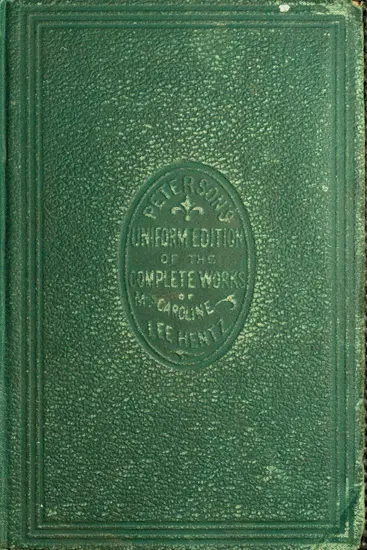
Love After Marriage; and Other Stories of the Heart
Caroline Lee Hentz
THE CLASSIC COLLECTION · 1853
"Helen and Arthur; or, Miss Thusa's Spinning Wheel" by Caroline Lee Hentz is a novel written in the mid-19th century. The story centers on young Helen, a child characterized by her vivid imagination and deep emotions, who finds herself in the care of Miss Thusa, an eccentric spinner and storyteller. As Helen navigates her fears and curious fantasies, the narrative explores themes of childhood innocence, the supernatural, and the contrast between life and death, particularly in the backdrop of Southern domestic life. The opening of the novel introduces Helen and Miss Thusa on a blustery night, where Miss Thusa, spinning by the fire, captivates Helen with her tales, blending elements of horror with comfort. Helen's fascination with these stories, particularly those that send shivers down her spine, fosters a rich inner world filled with contrasting joys and terrors. Soon, the narrative hints at deeper emotional challenges, particularly as Helen's mother struggles with illness, framing a poignant exploration of grief and childhood vulnerability. This initial setup promises a blend of whimsical yet dark storytelling, inviting readers into a soulful reflection on the complexities of growing up.
Introduction adapted from the source catalogue; source summaries may be automatically generated.
Free to read · English · 98,161 words · No account needed
MAKE TIME FOR A GOOD BOOK
On by default. Untick to stop anonymous reading totals. Each page counts after 10 seconds in view. How this works.
Anonymous counting is on unless you have switched it off.
"Pale as the corse o'er which she leaned,
As cold, with stifling breath,
Her spirit sunk before the might,
The majesty of death."
"A man severe he was, and stern to view,
I knew him well, and every truant knew--
Yet he was kind, or if severe in aught,
The love he bore for learning was in fault."
Goldsmith.
The darkened room, the stilly tread, the muffled knocker and slowly closing door, announced the presence of that kingly guest, who presides over the empire of terror and the grave. The long-expected hour was arrived, and Mrs. Gleason lay supported by pillows, whose soft down would never more sink under the pressure of her weary head. The wasting fires of consumption had burned and burned, till nothing but the ashes of life were left, save a few smouldering embers, from which flashed occasionally a transient spark. Mr. Gleason sat at the bed's head, with that grave, stern, yet bitter grief on his countenance which bids defiance to tears. She had been a gentle and devoted wife, and her quiet, home-born virtues, not always fully appreciated, rose before his remembrance, like the angels in Jacob's dream, climbing up to Heaven. Louis stood behind him, his head bowed upon his shoulder, sobbing as if his heart would break. Helen was nestled in her father's arms, with the most profound and unutterable expression of grief and awe and dread, on her young face. She was told that her mother was dying, going away from her, never to return, and the anguish this conviction imparted would have found vent in shrieks, had not the awe with which she beheld the cold, gray shadows of death, slowly, solemnly rolling over the face she loved best on earth, the face which had always seemed to her the perfection of mortal beauty, paralyzed her tongue, and frozen the fountain of her tears. Mittie stood at the foot of the bed, looking at her mother through the opening of the curtain, partly veiled by the long, white fringe that hung heavily from the folds, and which the wind blew to and fro, with something like the sweep of the willow. The windows were all open to admit the air to the faintly heaving lungs of the sufferer, and gradually one curtain after another was lifted, as the struggle for breath and air increased, and the light of departing day streamed in on the sunken and altered features it was never more to illuminate. Mittie was awe struck, but she manifested no tenderness or sensibility. It was astonishing how so young a child could see anyone die, and above all a mother--a mother, so kind and affectionate, with so little emotion. She was far more oppressed by the realization of her own mortality, for the first time pressed home upon her, than by her impending bereavement. What were the feelings of that speechless, expiring, but fully conscious mother, as she gazed earnestly, wistfully, thrillingly on the group that surrounded her? There was the husband, whom she had so much loved, he, who often, when weary with business, and perplexed with anxiety, had seemed careless and indifferent, but who, as life waned away, had shown the tenderness of love's early day, and who she knew would mourn her deeply and long. There was her noble, handsome, warm-hearted, high-souled boy--the object of her pride, as well as her affection--he, who had never willfully given her a moment's pain--and though his irrepressive sighs and suffocating sobs she would have hushed, at the expense of all that remained of life to her--there was still a music in them to her dying ear, that told of love that would not forget, that would twine in perennial garlands round her grave. Poor little Helen, as she looked at her pale, agonized face, and saw the terror imprinted there, she remembered what she had once said to Miss Thusa, of being after death an object of terror to her child, and she felt a sting that no language could express. She longed to stretch out her feeble arms, to fold them round this child of her prayers and fears, to carry her with her down the dark valley her feet were treading, to save her from trials a nature like hers was so ill-fitted to sustain. She looked from her to Mittie, the cold, insensible Mittie, whose large, black eyes, serious, but not sad, were riveted upon her through the white fringe of the curtain, and another sting sharper still went through her heart.
Your reading position is saved on this browser. Take it to another device with a library code. Reading pages adapt to text, rather than matching a printed edition.
BEHIND THE BOOK
This eBook is for the use of anyone anywhere in the United States and most other parts of the world at no cost and with almost no restrictions whatsoever. You may copy it, give it away or re-use it under the terms of the Project Gutenberg License included with this eBook or online at www.gutenberg.org. If you are not located in the United States, you will have to check the laws of the country where you are located before using this eBook. Read the source licence.
The original source file, including credits and licence, is retained by this library. Request an original-format copy at no charge. Please include the book title and Project Gutenberg identifier #23106.
KEEP YOUR CURIOSITY GOING
Coulson Kernahan

Maurice Baring
Frances Wright
Cécile Tormay

Frederic Jesup Stimson

W. H. P. (William Henry Pope) Jarvis