
The Writing of News A Handbook with Chapters on Newspaper Correspondence and Copy Reading
Charles G. (Charles Griffith) Ross
THE CLASSIC COLLECTION · 1910
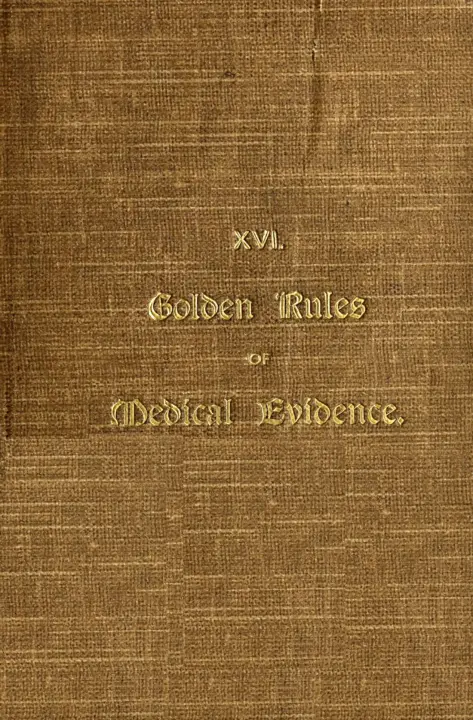
"Golden Rules of Medical Evidence" by Stanley B. Atkinson is a scientific publication written in the early 20th century. The book serves as a guide for medical practitioners on how to prepare and present medical evidence in legal settings, specifically in the context of inquests and other judicial proceedings. It emphasizes the importance of accurate observation, clear communication, and the ethical responsibilities of medical witnesses. The content of the book outlines various aspects of giving medical evidence, including the roles of different types of witnesses, the importance of post-mortem examinations, and the proper protocols to follow before and during court appearances. Atkinson discusses the preparation of evidence, the nuances of courtroom testimony, and the necessary precautions in cases of suspicious deaths, including chronic poisoning and suicide. The text also delves into the limitations of medico-legal evidence, helping practitioners navigate the complexities of the legal system while adhering to medical ethical standards. Overall, this book serves as an essential resource for medical professionals involved in forensic medicine, equipping them with the knowledge to effectively contribute to legal proceedings.
Introduction adapted from the source catalogue; source summaries may be automatically generated.
Free to read · English · 6,647 words · No account needed
MAKE TIME FOR A GOOD BOOK
On by default. Untick to stop anonymous reading totals. Each page counts after 10 seconds in view. How this works.
Anonymous counting is on unless you have switched it off.
3. The result of an exhaustive external and internal post-mortem
examination.
a. The Manner of the Report:
Reports should be =short= and =distinct=; all unnecessary words
should be omitted.
The paragraphs should be numbered: this facilitates reference.
Names and figures must be written plainly, and underlined.
=Technical terms= should be used only if the report is intended for
the use of a public authority; if used otherwise they should be
explained.
=Beware= of writing “There is no ...” when you intend to report “I
can find no....”
Exclude uncalled-for reasons, opinions, and comments.
“Science is measurement.” Everything that can be, should be
=measured=. Anatomical and chronological order and exactness should
be aimed at.
For immediate comparison, quote easily recognized English standards.
“The sometimes of the cautious is the often of the sanguine, the always of the empiric, the never of the sceptic: but the numbers 1, 10, 100, 1000 have but one meaning for all mankind.”
In important cases the report should be type-written in duplicate and signed, one copy being handed to the Court.
b. The Matter of the Report:
The date and time of day of each examination, and the names of all persons present thereat, should be stated.
There must be a very sharp division made between:
(a) =Information= received and from whom—this is hearsay.
“Never believe what a patient says another doctor said.”
Never sign a certificate to oblige another practitioner, without personally examining the patient.
(b) =Facts= found by personal examination or under personal
supervision.
The results of a complete methodical external (anterior and posterior) and internal investigation must be detailed; the condition of the =diseased organs= may be recorded first, the =healthy organs= being mentioned after, exhaustively.
After entering all the pertinent facts, summarize the =main points=, and conclude with the =probable cause= of the pathological conditions found.
=Sign= the report, affixing your medical qualifications and the date; secure the signature of other medical men who may be present. While in your care, keep the report under lock and key.
Append any =sketches= or =photographs=, carefully numbered, which
elucidate the case.
Retain an identical copy of the report for reference.
All testimony given at this stage is null and void, and may render the speaker liable to an action for defamation. Do not omit to be “sworn” before speaking.
Should you wish to object to giving evidence on the grounds:
a. That your fee (for expenses and loss of time) has not been paid by the solicitor calling you.
b. That you are unwilling to pose as able to give “expert
opinions.”
c. That you may possibly incriminate yourself:—
this is the stage at which you should say so.
Your reading position is saved on this browser. Take it to another device with a library code. Reading pages adapt to text, rather than matching a printed edition.
BEHIND THE BOOK
This eBook is for the use of anyone anywhere in the United States and most other parts of the world at no cost and with almost no restrictions whatsoever. You may copy it, give it away or re-use it under the terms of the Project Gutenberg License included with this eBook or online at www.gutenberg.org. If you are not located in the United States, you will have to check the laws of the country where you are located before using this eBook. Read the source licence.
The original source file, including credits and licence, is retained by this library. Request an original-format copy at no charge. Please include the book title and Project Gutenberg identifier #69556.
KEEP YOUR CURIOSITY GOING
Charles G. (Charles Griffith) Ross
Hannah Webster Foster

Emily Lawless
Edwin Hamlin Carr

Charles De Lano Hine
Andrew Ure