
The Writing of News A Handbook with Chapters on Newspaper Correspondence and Copy Reading
Charles G. (Charles Griffith) Ross
THE CLASSIC COLLECTION · 1910
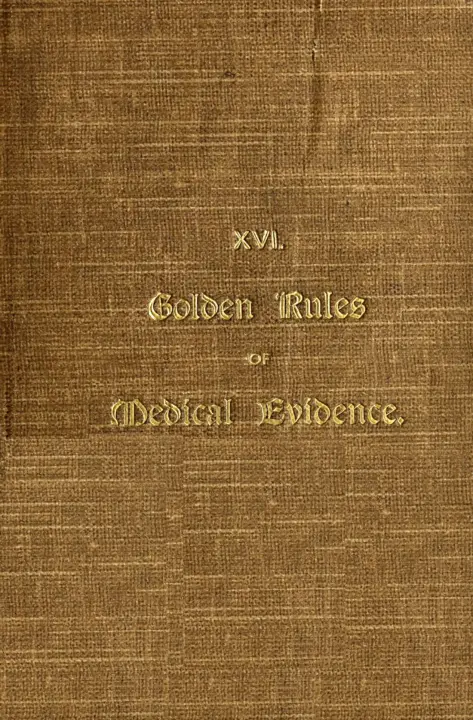
"Golden Rules of Medical Evidence" by Stanley B. Atkinson is a scientific publication written in the early 20th century. The book serves as a guide for medical practitioners on how to prepare and present medical evidence in legal settings, specifically in the context of inquests and other judicial proceedings. It emphasizes the importance of accurate observation, clear communication, and the ethical responsibilities of medical witnesses. The content of the book outlines various aspects of giving medical evidence, including the roles of different types of witnesses, the importance of post-mortem examinations, and the proper protocols to follow before and during court appearances. Atkinson discusses the preparation of evidence, the nuances of courtroom testimony, and the necessary precautions in cases of suspicious deaths, including chronic poisoning and suicide. The text also delves into the limitations of medico-legal evidence, helping practitioners navigate the complexities of the legal system while adhering to medical ethical standards. Overall, this book serves as an essential resource for medical professionals involved in forensic medicine, equipping them with the knowledge to effectively contribute to legal proceedings.
Introduction adapted from the source catalogue; source summaries may be automatically generated.
Free to read · English · 6,647 words · No account needed
MAKE TIME FOR A GOOD BOOK
On by default. Untick to stop anonymous reading totals. Each page counts after 10 seconds in view. How this works.
Anonymous counting is on unless you have switched it off.
There is now complete emancipation from “the insanitary oath.” For the sake of public example you should decline to “kiss the Book” unless you have brought a Testament with you. Insist on your right either to affirm or to swear by the Scots method.[1]
Whatever you say in giving evidence will not render you open to an
action for slander.
The privilege of a witness under examination is extended to a witness making statements to a solicitor preparing his “proof.”
State your full name and address. Then say, “I am a registered medical practitioner”; your exact qualifications are immaterial.
(Cf. Reports, p. 24.)
“There is matter in manner.” “Tell the truth, and make the truth tell.” “Be the plainest man in the world in the witness box.” “All trifles are not trifling.” “Pathology creates the doctor, as distinct from the nurse.”
The Manner.
Listen to the =whole question= before you attempt to reply: then answer only what is asked. Make yourself understood.
Don’t assume that the jury know all about the case.
Speak audibly, slowly, deliberately, with an eye on the recording
clerk’s pen.
Say =exactly= what you mean.
Cultivate the power of expression and of repression.
Be candid, courteous, dignified, and withal good humoured; =avoid=
appearing to be suspicious.
Your =personal= disposition will count more with a jury than your professional position; they will note looks, doubts, hesitations, confidence, calmness, consideration, or precipitancy.
Use =simple= and popular =terms=, otherwise you may be regarded as speaking “either oracles or jargon.” Reserve technicalities for cross-examination. The jury will think they understand “alcoholic disease of the ...,” “bad disorder,” “black and blue,” “black-eye,” “blood clot,” “blood poisoning,” “bowel,” “brain fever,” “bruise,” “buoyant lungs,” “cancer,” “consumptive spots,” “coverings of the brain,” “death stiffening,” “great vessel of the heart,” “gullet,” “gut,” “hardened liver,” “hardening of valves,” “inflammation or congestion of the ...,” “overloaded with fat,” “shrunken kidneys,” “skull-cap,” “stroke,” “swallow,” “sweet-bread,” “windpipes.”
Don’t worry about the =technical rules= of evidence; in the Coroner’s Court they are seldom applied strictly.
Insist on answering double-barrelled questions “=Yes= AND =No=” if
necessary.
Do not argue with Counsel; “disagree without being disagreeable.” “A large experience is not all experience,” and what you call “a rare case” may reflect upon your limited experience.
An early “I =don’t= know” is better than a late “I =did not= know.” If you “don’t know,” do not be trapped into guessing. Beware of “argumentative figures.”
The Matter.
Your reading position is saved on this browser. Take it to another device with a library code. Reading pages adapt to text, rather than matching a printed edition.
BEHIND THE BOOK
This eBook is for the use of anyone anywhere in the United States and most other parts of the world at no cost and with almost no restrictions whatsoever. You may copy it, give it away or re-use it under the terms of the Project Gutenberg License included with this eBook or online at www.gutenberg.org. If you are not located in the United States, you will have to check the laws of the country where you are located before using this eBook. Read the source licence.
The original source file, including credits and licence, is retained by this library. Request an original-format copy at no charge. Please include the book title and Project Gutenberg identifier #69556.
KEEP YOUR CURIOSITY GOING
Charles G. (Charles Griffith) Ross
Hannah Webster Foster

Emily Lawless
Edwin Hamlin Carr

Charles De Lano Hine
Andrew Ure