
The Writing of News A Handbook with Chapters on Newspaper Correspondence and Copy Reading
Charles G. (Charles Griffith) Ross
THE CLASSIC COLLECTION · 1910
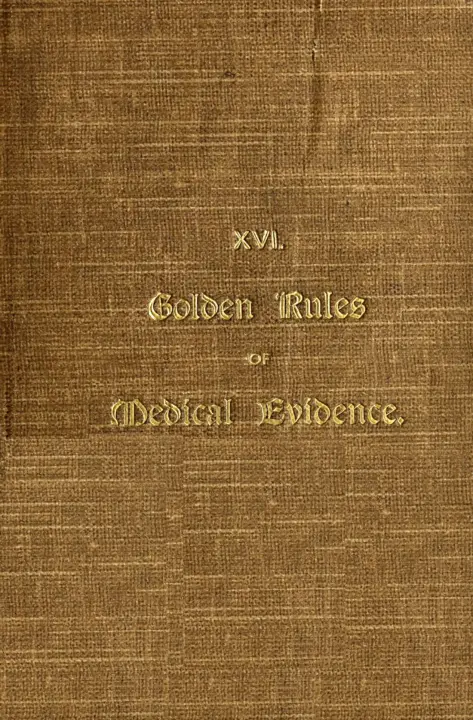
"Golden Rules of Medical Evidence" by Stanley B. Atkinson is a scientific publication written in the early 20th century. The book serves as a guide for medical practitioners on how to prepare and present medical evidence in legal settings, specifically in the context of inquests and other judicial proceedings. It emphasizes the importance of accurate observation, clear communication, and the ethical responsibilities of medical witnesses. The content of the book outlines various aspects of giving medical evidence, including the roles of different types of witnesses, the importance of post-mortem examinations, and the proper protocols to follow before and during court appearances. Atkinson discusses the preparation of evidence, the nuances of courtroom testimony, and the necessary precautions in cases of suspicious deaths, including chronic poisoning and suicide. The text also delves into the limitations of medico-legal evidence, helping practitioners navigate the complexities of the legal system while adhering to medical ethical standards. Overall, this book serves as an essential resource for medical professionals involved in forensic medicine, equipping them with the knowledge to effectively contribute to legal proceedings.
Introduction adapted from the source catalogue; source summaries may be automatically generated.
Free to read · English · 6,647 words · No account needed
MAKE TIME FOR A GOOD BOOK
On by default. Untick to stop anonymous reading totals. Each page counts after 10 seconds in view. How this works.
Anonymous counting is on unless you have switched it off.
1200 Pledge to answer truly appears.
1215 Trial by Ordeal abolished.
1275 The Coroner’s Ordinance. The inquest jury were the witnesses also; inspection of external appearances was alone necessary for the jury’s post-mortem examination.
1290 The Court, after being advised by physicians, direct the jury as to the legitimacy of a posthumous child.
1345 The Sheriff is directed to summon the foremost London medical men to consider the severity of a recently inflicted wound.
1354 A charge of surgical malpraxis narrated in the City Records.
1450 Common witnesses are summoned to appear before the jury.
1506 Dispute as to the province of the Court or the surgeon to decide upon the severity of a wound.
Anatomical post-mortem examinations occur, though pathology is primitive. “Searchers.”
1542 Thomas Vicary advises the Lord Mayor in a case of battery.
1562 Witnesses summoned sub-pœna.
1575 Ambrose Paré publishes typical “medico-legal reports.”
1632 College of Physicians report in full on a corrosive poisoning
case.
1665 Sir Thomas Browne affirmed in Court his belief in witches.
1699 Baron Hatsell objects to Dr. Crell quoting “Ambros Parey’s”
opinions.
1723 Mr. Justice Tracey enunciates “the wild beast” theory of responsibility in lunacy cases.
1767 Slater v. Baker & Stapleton—a case of surgical malpraxis;
damages £500.
1781 John Hunter gives expert evidence in an alleged poisoning case: “I can give nothing definite.”
1788 Samuel Farr’s Elements of Medical Jurisprudence.
1795 Matthew Baillie exposes the fallacy of “Death from polyp of the
heart.”
1807 Chair of Medical Jurisprudence established in Edinburgh.
1823 Last “cross-road” burial of suicides in England.
1827 Orfila doubts detection of blood-stain with the microscope.
1830 The first Medical Coroner elected. “A medical Crowner’s a queer sort of thing.”
1831 Sir Thos. Watson lectures at King’s College Hospital, and Swaine Taylor at Guy’s.
1832 The Anatomy Act, after Burke and Hare scandals. “Burke Hare
too!”
1836 Registration of “the cause of death” introduced.
Sir Dominic Corrigan’s clause as to fact of death: “As I am
informed” (1874).
1837 The Medical Witnesses Remuneration Act allows fees for medical evidence at inquests; inquests and autopsies increase, pathology advances.
1843 Swaine Taylor’s Manual of Medical Jurisprudence (Principles
and Practice, 1865).
Rules as to the test of criminal responsibility of the insane
(McNaughten’s case).
1844 Rudolph Virchow’s Die Sections-Tecknik commenced.
1845 Telegraph first used for arrest of a prisoner (Tawell).
1846 Anæsthetics introduced. “Gentlemen! Here is no humbug!”
1848 The first Public Health Act.
1851 Stas devises his process to detect poisoning by alkaloids
(nicotine).
1857 Lord Chief Justice Cockburn discredits microscopical evidence.
1858 “Railway shock” appears.
The Medical Act registers medical practitioners.
1862 Hoppe-Seyler suggests medico-legal use of the spectroscope
(Muller’s case, 1864).
1863 Photography applied to surgery. (1871, criminals photographed).
1864 Listerism introduced.
1868 Crown Office (Scotland) memorandum for medico-legal examination of dead bodies (revised 1897).
1883 Bertillonage employed (France).
1879 The first Inebriates Act.
1886 The triple qualification necessary.
1887 Retford ptomaine poisoning.
Your reading position is saved on this browser. Take it to another device with a library code. Reading pages adapt to text, rather than matching a printed edition.
BEHIND THE BOOK
This eBook is for the use of anyone anywhere in the United States and most other parts of the world at no cost and with almost no restrictions whatsoever. You may copy it, give it away or re-use it under the terms of the Project Gutenberg License included with this eBook or online at www.gutenberg.org. If you are not located in the United States, you will have to check the laws of the country where you are located before using this eBook. Read the source licence.
The original source file, including credits and licence, is retained by this library. Request an original-format copy at no charge. Please include the book title and Project Gutenberg identifier #69556.
KEEP YOUR CURIOSITY GOING
Charles G. (Charles Griffith) Ross
Hannah Webster Foster

Emily Lawless
Edwin Hamlin Carr

Charles De Lano Hine
Andrew Ure