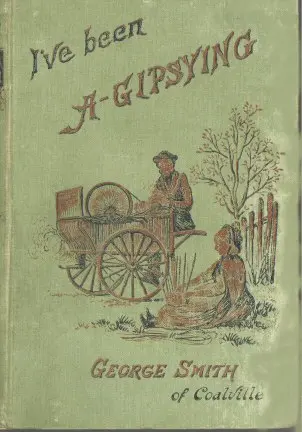
I’ve been a Gipsying or, Rambles among our Gipsies and their children in their tents and vans
George Smith
THE CLASSIC COLLECTION · 1880
"Gipsy Life" by George Smith is an account written in the late 19th century that examines the lives, origins, and social conditions of the Gipsy population in England. The book delves into the challenges faced by Gipsies, particularly women and children, highlighting themes of neglect and societal misunderstanding. The opening reveals the author's dedication to raising awareness about the plight of Gipsies and the need for educational intervention in their lives. Smith outlines the historical treatment of Gipsies across Europe, touching on their origins and the stigma associated with their lifestyle. He paints a vivid picture of the struggles they have endured, from persecution in various countries to their current state in England, emphasizing the importance of understanding their story to foster compassion and potential improvement in their circumstances.
Introduction adapted from the source catalogue; source summaries may be automatically generated.
Free to read · English · 108,927 words · No account needed
MAKE TIME FOR A GOOD BOOK
On by default. Untick to stop anonymous reading totals. Each page counts after 10 seconds in view. How this works.
Anonymous counting is on unless you have switched it off.
Straggling Gipsies no doubt found their way westward prior to the wars of Timur Beg, and in this view I am supported by the fact that two of our own countrymen--Fitz-Simeon and Hugh the Illuminator, holy friars--on their pilgrimage to the Holy Land in 1322, called at Crete, and there found some Gipsies--I am inclined to think only a few sent out as a kind of advance-guard or feeler, adopting the plan they have done subsequently in peopling Europe and England during the fifteenth and sixteenth centuries.
Brand, in his observations in "Popular Antiquities," is of opinion also that the Gipsies fled from Hindustan when Timur Beg ravaged India with a view of making Mohammedans of the heathens, and it is calculated that during his deeds of blood he butchered 500,000 Indians. Some writers suppose that the Gipsies, in order to escape the sword of this human monster, came into Europe through Egypt, and on this account were called English Gipsies.
In a paper read by Colonel Herriot before the Royal Asiatic Society, he says that the Gipsies, or Indians--called by some Suders, by others Naths or Benia, the first signifying rogue, the second dancer or tumbler--are to be met in large numbers in that part of Hindustan which is watered by the Ganges, as well as the Malwa, Gujerat, and the Deccan.
The religious crusades to the Holy Land commenced in the year 1095 and lasted to 1270. It was during the latter part of the time of the Crusades, and prior to the commencement of the wars by Timur Beg, that the Gipsies flocked by hundreds of thousands to Asiatic Turkey. While the rich merchants and princes were trying to outvie each other in their costly equipages, grandeur, and display of gold in their pilgrimage to the Holy Land, and the tremendous death-struggles between Christianity, Idolatry, and Mohammedism, the Gipsies were busily engaged in singing songs and plundering, and in this work they were encouraged by the Persians as they passed through their territory. The Persians have always been friendly to these wandering, loafing Indians, for we find that during the wars of India by Timur Beg, and other monsters previous, they were harbouring 20,000 of these poor low-caste and outcast Indians; and, in fact, the same thing may be said of the other countries they passed through on their way westward, for we do not read of their being persecuted in these countries to anything like the extent they have been in Europe. This, no doubt, arises from the affinity there is between the Indian, Persian, and Gipsy races, and the dislike the Europeans have towards idlers, loafers, liars, and thieves; and especially is this so in England. Gipsy life may find favour in the East, but in the West the system cannot thrive. A real Englishman hates the man who will not work, scorns the man who would tell him a lie, and would give the thief who puts his hands into his pocket the cat-o'-nine-tails most unmercifully. The persecutions of the Gipsies in this country from time to time has been brought about, to a great extent, by themselves. John Bull dislikes keeping the idle, bastard children of other nations. He readily protects all those who tread upon English soil, but in return for this kindness he expects them, like bees, to be all workers. Drones, ragamuffins, and rodneys cannot grumble if they get kicked out of the hive. If 20,000 Englishmen were to tramp all over India, Turkey, Persia, Hungary, Spain, America, Egypt, Greece, Cyprus, South Africa, Germany, or France, in bands of from, say two to fifty men, women, and children, in a most wretched; miserable condition, doing little else but fiddling upon the national conscience and sympathies, blood-sucking the hardworking population, and frittering their time away in idleness, pilfering, and filth, I expect, and justly so, the inhabitants would begin to "kick," and the place would no doubt get rather warm for Mr. John Bull and his motley flock. If the Gipsies, and others of the same class in this country, will begin to "buckle-to," and set themselves out for real hard work, instead of cadging from door to door, they will find, notwithstanding they are called Gipsies, John Bull extending to them the hand of brotherhood and sympathy, and the days of persecution passed.
Your reading position is saved on this browser. Take it to another device with a library code. Reading pages adapt to text, rather than matching a printed edition.
George Smith
George Smith
BEHIND THE BOOK
This eBook is for the use of anyone anywhere in the United States and most other parts of the world at no cost and with almost no restrictions whatsoever. You may copy it, give it away or re-use it under the terms of the Project Gutenberg License included with this eBook or online at www.gutenberg.org. If you are not located in the United States, you will have to check the laws of the country where you are located before using this eBook. Read the source licence.
The original source file, including credits and licence, is retained by this library. Request an original-format copy at no charge. Please include the book title and Project Gutenberg identifier #28548.
KEEP YOUR CURIOSITY GOING
Cécile Tormay

Moritz Busch
John L. Ransom
Frances Wright
Cécile Tormay

Mabel Potter Daggett