
Life of Edwin Forrest, the American Tragedian. Volume 2 (of 2)
William Rounseville Alger & Horatio, Jr. Alger
THE CLASSIC COLLECTION · 1896
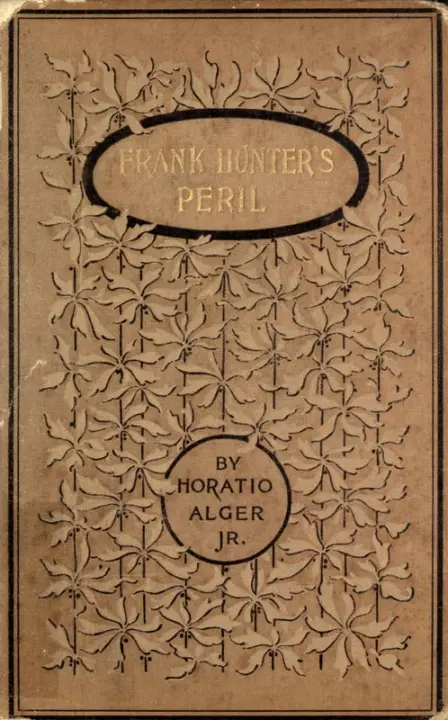
"Frank Hunter's Peril" by Horatio Alger, Jr. is a novel written in the late 19th century. The story centers around Frank Hunter, a young boy grappling with insecurity about his mother's intentions to marry Mr. Craven, a man he does not trust. As tension builds surrounding the perceived threat from Craven, Frank's loyalty and love for his mother are tested, leading to a conflict where he must navigate the complexities of family, trust, and emerging adulthood. The opening portion of the book introduces Frank Hunter, who is initially enjoying a carefree moment on the lawn when his friend Ben Cameron brings up the subject of his mother’s growing relationship with Mr. Craven. Frank's palpable discomfort with the idea of Craven becoming his stepfather surfaces as he expresses concern over Craven’s frequent visits. A scene between Frank's mother and Mr. Craven reveals Craven’s intentions to propose marriage, leading to a troubling acceptance on her part despite her lack of affection for him. Through Frank's lens, we see the dynamics of this impending family change, laying the groundwork for future tensions and foreshadowing the peril that awaits Frank and his dog, Pompey, at the hands of the predatory Mr. Craven.
Introduction adapted from the source catalogue; source summaries may be automatically generated.
Free to read · English · 50,788 words · No account needed
MAKE TIME FOR A GOOD BOOK
On by default. Untick to stop anonymous reading totals. Each page counts after 10 seconds in view. How this works.
Anonymous counting is on unless you have switched it off.
"I don't know as I have a right to."
"Pooh, man, get over your ridiculous scruples. I know your real reason. You look upon her money as yours, and don't like to part with any of it. But just consider, if things turn out as we expect, you will shortly get possession of the boy's forty thousand dollars, and can then pay yourself. Don't you see it?"
"Perhaps the boy may return in safety," suggested Craven. "In that case our plans are all dished."
"Don't be afraid of that," said Sharpley, with wicked significance. "I
will take care of that."
"It shall be as you say, then," said Craven. "You shall have two hundred dollars for the purchase of tickets and a bill of exchange for a thousand."
"You may as well say three hundred, Craven, as there will be some extra preliminary expenses, and you had better give me the money now, as I am going up to the city this morning to procure tickets."
"Very well, three hundred let it be."
"And there's another point to be settled, a very important one, and we may as well settle it now."
"What is it?"
"How much am I to receive in case our plans work well?"
"How much?" repeated Craven, hesitatingly.
"Yes, how much?"
"Well, say two thousand dollars."
"Two thousand devils!" exclaimed Sharpley, indignantly. "Why, Craven, you must take me for a fool."
Mr. Craven hastily disclaimed this imputation.
"You expect me to do your dirty work for any such paltry sum as that! No! I don't sell myself so cheap."
"Two thousand dollars is a good deal of money."
"Not for such services as that, especially as it leaves you nineteen times as much. Craven, it won't do!"
"Say five thousand dollars, then!" said Craven, reluctantly.
"That's a little more like the figure, but it isn't enough."
"What will satisfy you, then?"
"Ten thousand."
"Ten thousand!" repeated Craven, in dismay.
"Yes, ten thousand," said Sharpley, firmly. "Not a cent less."
Mr. Craven expostulated, but his expostulations were all in vain. His companion felt that he had him in his power, and was not disposed to abate his demands. Finally the agreement was made.
"Shall it be in writing, Craven?" asked Sharpley, jocosely.
"No, no."
"I didn't know but you might want to bind me. When does the train leave
for New York?"
"In an hour."
"Then I'll trouble you to look up three hundred dollars for me, and
I'll take it."
By the ten o'clock train Colonel Sharpley was a passenger. Mr. Craven saw him off, and then returned thoughtfully to his office.
Your reading position is saved on this browser. Take it to another device with a library code. Reading pages adapt to text, rather than matching a printed edition.
William Rounseville Alger & Horatio, Jr. Alger

William Rounseville Alger & Horatio, Jr. Alger

Horatio, Jr. Alger

Horatio, Jr. Alger
BEHIND THE BOOK
This eBook is for the use of anyone anywhere in the United States and most other parts of the world at no cost and with almost no restrictions whatsoever. You may copy it, give it away or re-use it under the terms of the Project Gutenberg License included with this eBook or online at www.gutenberg.org. If you are not located in the United States, you will have to check the laws of the country where you are located before using this eBook. Read the source licence.
The original source file, including credits and licence, is retained by this library. Request an original-format copy at no charge. Please include the book title and Project Gutenberg identifier #56602.
KEEP YOUR CURIOSITY GOING
Wilfrid Scawen Blunt
Wilfrid Scawen Blunt

E. W. (Edgar Watson) Howe
Coulson Kernahan

Maurice Baring
Frances Wright