
Life of Edwin Forrest, the American Tragedian. Volume 2 (of 2)
William Rounseville Alger & Horatio, Jr. Alger
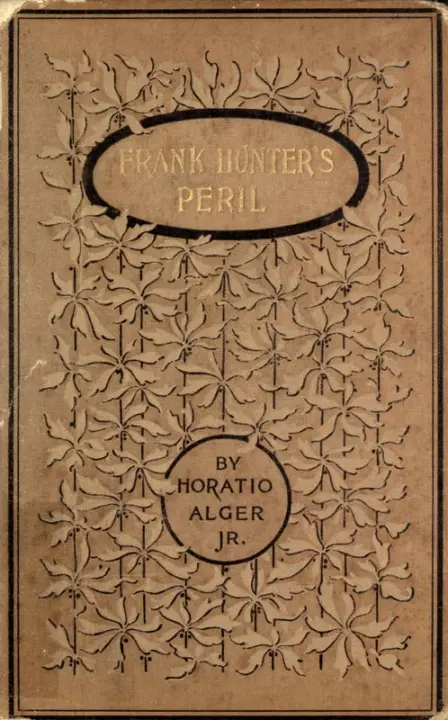
THE CLASSIC COLLECTION · 1896
"Frank Hunter's Peril" by Horatio Alger, Jr. is a novel written in the late 19th century. The story centers around Frank Hunter, a young boy grappling with insecurity about his mother's intentions to marry Mr. Craven, a man he does not trust. As tension builds surrounding the perceived threat from Craven, Frank's loyalty and love for his mother are tested, leading to a conflict where he must navigate the complexities of family, trust, and emerging adulthood. The opening portion of the book introduces Frank Hunter, who is initially enjoying a carefree moment on the lawn when his friend Ben Cameron brings up the subject of his mother’s growing relationship with Mr. Craven. Frank's palpable discomfort with the idea of Craven becoming his stepfather surfaces as he expresses concern over Craven’s frequent visits. A scene between Frank's mother and Mr. Craven reveals Craven’s intentions to propose marriage, leading to a troubling acceptance on her part despite her lack of affection for him. Through Frank's lens, we see the dynamics of this impending family change, laying the groundwork for future tensions and foreshadowing the peril that awaits Frank and his dog, Pompey, at the hands of the predatory Mr. Craven.
Introduction adapted from the source catalogue; source summaries may be automatically generated.
Free to read · English · 50,788 words · No account needed
MAKE TIME FOR A GOOD BOOK
On by default. Untick to stop anonymous reading totals. Each page counts after 10 seconds in view. How this works.
Anonymous counting is on unless you have switched it off.
They started on their walk provided with alpenstocks, for just above them was the snow-line, and they could not go far without encountering ice also. The Hotel du Glacier stood thousands of feet above the sea-level, and was a favorite resort with those who enjoyed the sublimity of mountain scenery.
Though Sharpley was by no means the companion he would have best liked, Frank was in high spirits, as he realized that he was really four thousand miles from home, surrounded by the famous mountains of which he had so often read.
"Have you ever been up this mountain before, Colonel Sharpley?" asked
Frank.
"Not up this mountain. I have ascended others, however. I once crossed over Mount Cenis to Italy."
"How? Did you walk?"
"No. I went in a diligence."
"It must have been fine. Shall we go into Italy?"
"Perhaps so."
"I should like it very much. I have read so much about Italy."
"How I wish Ben Cameron were here!" said Frank, after a pause.
He did not so much mean to say this to Sharpley, but the thought entered his mind, and he unconsciously uttered it aloud.
"Who is Ben Cameron?"
"He is a friend of mine at home. We were a great deal together."
"Was he the boy that was with you when I first met you?"
"Yes, sir."
"Humph! I have no desire for his company," thought Sharpley.
"Have you a glass with you, Colonel Sharpley?" asked Frank.
"Yes. Would you like to use it?"
"If you please."
It was a small spy-glass, not powerful, but serviceable. Frank adjusted it to his eye, and looked earnestly in a certain direction.
"What do you see?" asked his companion.
"Wait a minute. I am not certain. Yes, it is they."
"Who?" demanded Sharpley, impatiently.
"The Abercrombies. They are higher up than we, over there, but not very much out of our way. Shall we join them?" asked Frank, hopefully.
"Where are they? Let me see," said Sharpley, seizing the glass.
He thought Frank might be mistaken, but a glance through the glass satisfied him that he was right. There was Mr. Abercrombie, toiling up a steep ascent, with his son following, the latter assisted by the guide.
"Do you see them?"
"Yes."
"Don't you think we can overtake them?"
"Perhaps we might, but I for one don't intend to try."
Frank looked at him inquiringly.
"Why not?"
"I thought you heard me decline to join them at the hotel. I have no
fancy for company to-day."
"Excuse me," said Frank, politely. "I might have remembered it."
"You can join them to-morrow if you feel like it," said Sharpley,
emphasizing the last clause.
Your reading position is saved on this browser. Take it to another device with a library code. Reading pages adapt to text, rather than matching a printed edition.
William Rounseville Alger & Horatio, Jr. Alger

William Rounseville Alger & Horatio, Jr. Alger

Horatio, Jr. Alger

Horatio, Jr. Alger
BEHIND THE BOOK
This eBook is for the use of anyone anywhere in the United States and most other parts of the world at no cost and with almost no restrictions whatsoever. You may copy it, give it away or re-use it under the terms of the Project Gutenberg License included with this eBook or online at www.gutenberg.org. If you are not located in the United States, you will have to check the laws of the country where you are located before using this eBook. Read the source licence.
The original source file, including credits and licence, is retained by this library. Request an original-format copy at no charge. Please include the book title and Project Gutenberg identifier #56602.
KEEP YOUR CURIOSITY GOING
Wilfrid Scawen Blunt
Wilfrid Scawen Blunt

E. W. (Edgar Watson) Howe
Coulson Kernahan

Maurice Baring
Frances Wright