
Life of Edwin Forrest, the American Tragedian. Volume 2 (of 2)
William Rounseville Alger & Horatio, Jr. Alger
THE CLASSIC COLLECTION · 1896
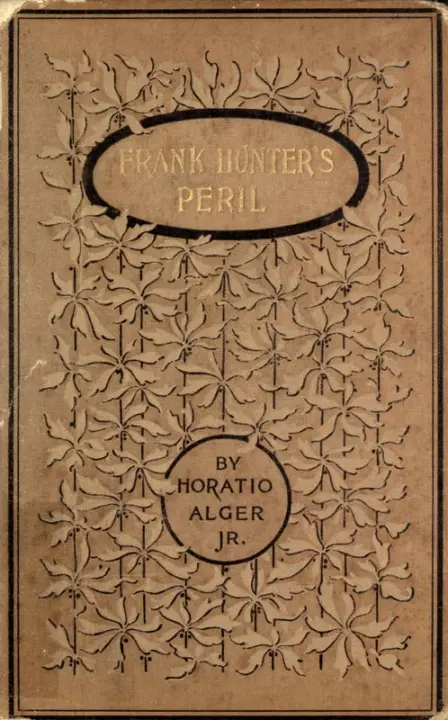
"Frank Hunter's Peril" by Horatio Alger, Jr. is a novel written in the late 19th century. The story centers around Frank Hunter, a young boy grappling with insecurity about his mother's intentions to marry Mr. Craven, a man he does not trust. As tension builds surrounding the perceived threat from Craven, Frank's loyalty and love for his mother are tested, leading to a conflict where he must navigate the complexities of family, trust, and emerging adulthood. The opening portion of the book introduces Frank Hunter, who is initially enjoying a carefree moment on the lawn when his friend Ben Cameron brings up the subject of his mother’s growing relationship with Mr. Craven. Frank's palpable discomfort with the idea of Craven becoming his stepfather surfaces as he expresses concern over Craven’s frequent visits. A scene between Frank's mother and Mr. Craven reveals Craven’s intentions to propose marriage, leading to a troubling acceptance on her part despite her lack of affection for him. Through Frank's lens, we see the dynamics of this impending family change, laying the groundwork for future tensions and foreshadowing the peril that awaits Frank and his dog, Pompey, at the hands of the predatory Mr. Craven.
Introduction adapted from the source catalogue; source summaries may be automatically generated.
Free to read · English · 50,788 words · No account needed
MAKE TIME FOR A GOOD BOOK
On by default. Untick to stop anonymous reading totals. Each page counts after 10 seconds in view. How this works.
Anonymous counting is on unless you have switched it off.
"That while I am gone you will call round often and see mother. She will miss me a great deal, for I have always been with her, and it will be a pleasure to her to see you, whom she knows to be my dearest friend, and talk with you about me. Will you go?"
"Certainly I will, Frank, if you think she would like to have me."
"I know she would. You see, Ben, though Mr. Craven and my mother get along well enough, I am sure she doesn't love him. He may be a fair sort of man, and I am bound to say that I have no fault to find with him, but I don't think she finds a great deal of pleasure in his society. Of course, Ben, you won't repeat this?"
"Certainly not."
"And you will call often?"
"Yes, Frank."
"I will tell mother so. Then I shall leave home with a light heart. Just think of it, Ben--it's now the sixth of the month, and on the nineteenth I sail. I wish it were to-morrow."
"It will soon be here, Frank."
"Yes, I know it. I am afraid I can't fix my mind on my studies much for the next week or so. I shall be thinking of Europe all the time."
Meanwhile, Mr. Craven and Colonel Sharpley, in the office of the former, were discussing the same subject.
"So we have succeeded, Craven," said Sharpley, taking out a cigar and
beginning to smoke.
"Yes, you managed it quite cleverly."
"Neither Mrs. Craven nor the boy will suspect that you are particularly interested in getting him out of the country."
"No," said Craven, complacently; "I believe I scored a point in my favor with the boy by favoring the project. Had I opposed it, his mother would not have consented, and he knows it."
"Yes, that is well. It will avert suspicion hereafter. Now there is an important point to be considered. What funds are you going to place in my hands to start with?"
"How much shall you need?"
"Well, you must supply me with money at once to pay for tickets--say two hundred and fifty dollars, and a bill of exchange for a thousand dollars, to begin with. More can be sent afterward."
"I hope you won't be too extravagant, Sharpley," said Mr. Craven, a
little uneasily.
"Extravagant! Why, zounds, man, two persons can't travel for nothing. Besides, the money doesn't come out of your purse; it comes out of the boy's fortune."
"If I draw too much, his mother, who is his guardian, will be startled."
"Then draw part from her funds. You have the control of those."
Your reading position is saved on this browser. Take it to another device with a library code. Reading pages adapt to text, rather than matching a printed edition.
William Rounseville Alger & Horatio, Jr. Alger

William Rounseville Alger & Horatio, Jr. Alger

Horatio, Jr. Alger

Horatio, Jr. Alger
BEHIND THE BOOK
This eBook is for the use of anyone anywhere in the United States and most other parts of the world at no cost and with almost no restrictions whatsoever. You may copy it, give it away or re-use it under the terms of the Project Gutenberg License included with this eBook or online at www.gutenberg.org. If you are not located in the United States, you will have to check the laws of the country where you are located before using this eBook. Read the source licence.
The original source file, including credits and licence, is retained by this library. Request an original-format copy at no charge. Please include the book title and Project Gutenberg identifier #56602.
KEEP YOUR CURIOSITY GOING
Wilfrid Scawen Blunt
Wilfrid Scawen Blunt

E. W. (Edgar Watson) Howe
Coulson Kernahan

Maurice Baring
Frances Wright