
Life of Edwin Forrest, the American Tragedian. Volume 2 (of 2)
William Rounseville Alger & Horatio, Jr. Alger
THE CLASSIC COLLECTION · 1896
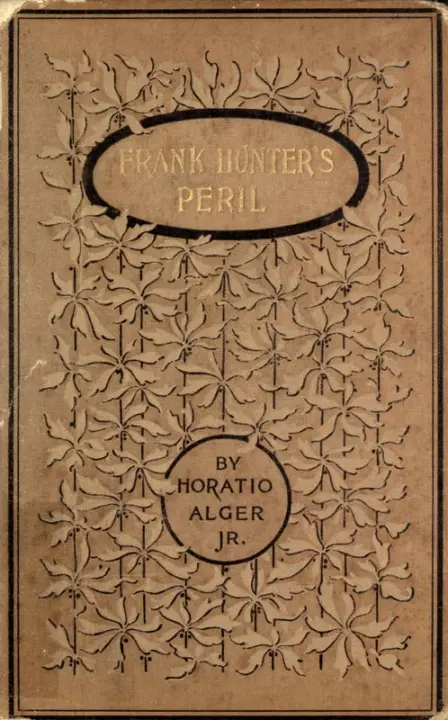
"Frank Hunter's Peril" by Horatio Alger, Jr. is a novel written in the late 19th century. The story centers around Frank Hunter, a young boy grappling with insecurity about his mother's intentions to marry Mr. Craven, a man he does not trust. As tension builds surrounding the perceived threat from Craven, Frank's loyalty and love for his mother are tested, leading to a conflict where he must navigate the complexities of family, trust, and emerging adulthood. The opening portion of the book introduces Frank Hunter, who is initially enjoying a carefree moment on the lawn when his friend Ben Cameron brings up the subject of his mother’s growing relationship with Mr. Craven. Frank's palpable discomfort with the idea of Craven becoming his stepfather surfaces as he expresses concern over Craven’s frequent visits. A scene between Frank's mother and Mr. Craven reveals Craven’s intentions to propose marriage, leading to a troubling acceptance on her part despite her lack of affection for him. Through Frank's lens, we see the dynamics of this impending family change, laying the groundwork for future tensions and foreshadowing the peril that awaits Frank and his dog, Pompey, at the hands of the predatory Mr. Craven.
Introduction adapted from the source catalogue; source summaries may be automatically generated.
Free to read · English · 50,788 words · No account needed
MAKE TIME FOR A GOOD BOOK
On by default. Untick to stop anonymous reading totals. Each page counts after 10 seconds in view. How this works.
Anonymous counting is on unless you have switched it off.
Crouching behind the stone wall, Katy enjoyed the effect of what she had done. She particularly enjoyed the bewildered look, of Mr. Craven, who, bare-headed, looked on this side and on that, unable to conjecture who had thrown the missile.
Pompey, unconscious of the danger he had escaped, walked up to the tumbler and smelt of it. This attracted the attention of Mr. Craven, who stooped and picked it up. His bewilderment increased. If it had been a stone, he would have understood better, but how a tumbler should have found its way here as a missile was incomprehensible.
It slowly dawned upon him that the person who threw it must be somewhere near. Then again, on examining it further, he began to suspect that it was one of his wife's tumblers, and he jumped to the conclusion that it was Frank who threw it.
"If it is he, I'll wring his neck!" he murmured, revengefully. "I mean
to find out."
"Pompey," he said, calling the dog, "do you see this tumbler?"
Pompey wagged his tail.
"Who threw it?"
Pompey looked up, as if for instructions.
"Go find him!" said Mr. Craven, in a tone of command.
The dog seemed to understand, for he put his nose to the ground and began to run along, as if in search.
"Oh, murther! What if he finds me?" thought Katy, crouching a little lower. "Won't he be mad, jist?"
Katy might have crawled away unobserved, very possibly, if she had started as soon as the missile was thrown. Now, that dog and man were both on the lookout, escape was cut off.
"Will he find me?" Katy asked herself, with some anxiety.
The question was soon answered.
Pompey jumped over the wall, and a joyous bark announced his discovery. He knew Katy, and seemed to fancy that she had concealed herself in joke. He jumped upon her, and wagged his tail intelligently, as if to say:
"You see, I've found you out, after all."
Mr. Craven hurried to the wall, eagerly expecting to detect Frank in the person concealed. He started back in astonishment as Katy O'Grady rose and faced him. Then he became wrathful, as he realized that his own hired servant had had the audacity to fling a tumbler at his hat.
"What brings you out here, Katy?" he demanded, with a frown.
"Shure, sir," said Katy, nonchalantly, "I was tired wid stayin' in the hot kitchen, and I thought I'd come out and take the air jist."
"And so you neglected the work."
"The worruk will be done; niver you mind about that."
"Did you fling this tumbler at my head?" demanded Mr. Craven, sternly.
Your reading position is saved on this browser. Take it to another device with a library code. Reading pages adapt to text, rather than matching a printed edition.
William Rounseville Alger & Horatio, Jr. Alger

William Rounseville Alger & Horatio, Jr. Alger

Horatio, Jr. Alger

Horatio, Jr. Alger
BEHIND THE BOOK
This eBook is for the use of anyone anywhere in the United States and most other parts of the world at no cost and with almost no restrictions whatsoever. You may copy it, give it away or re-use it under the terms of the Project Gutenberg License included with this eBook or online at www.gutenberg.org. If you are not located in the United States, you will have to check the laws of the country where you are located before using this eBook. Read the source licence.
The original source file, including credits and licence, is retained by this library. Request an original-format copy at no charge. Please include the book title and Project Gutenberg identifier #56602.
KEEP YOUR CURIOSITY GOING
Wilfrid Scawen Blunt
Wilfrid Scawen Blunt

E. W. (Edgar Watson) Howe
Coulson Kernahan

Maurice Baring
Frances Wright