THE CLASSIC COLLECTION✦An outlaw’s diary: the CommuneCLASSIC FREE BOOKS
An outlaw’s diary: the Commune
Cécile Tormay
THE CLASSIC COLLECTION · 1885
"Fabiola; Or, The Church of the Catacombs" by Nicholas Patrick Wiseman is a novel first published in 1854. Set in early fourth-century Rome during Diocletian's persecution of Christians, the story follows Fabiola, a spoiled noblewoman whose encounter with her Christian slave girl Syra sparks an unexpected transformation. Meanwhile, young Pancratius prepares for martyrdom while facing betrayal from his nemesis Corvinus. The novel weaves real martyrdom accounts with fictional drama, exploring themes of faith, forgiveness, and community among Rome's underground Christians.
Introduction adapted from the source catalogue; source summaries may be automatically generated.
Free to read · English · 141,871 words · No account needed
MAKE TIME FOR A GOOD BOOK
On by default. Untick to stop anonymous reading totals. Each page counts after 10 seconds in view. How this works.
Anonymous counting is on unless you have switched it off.
“With her relics gathered here,
The altar o’er them placed revere,
She beneath God’s feet reposes,
Nor to us her soft eye closes,
Nor her gracious ear.”
The idea that the martyr lies “beneath the feet of God” is an allusion to the Real Presence in the Blessed Eucharist.
[103] The arched tombs were so called. A homely illustration would be an arched fireplace, walled up to the height of three feet. The paintings would be inside, above the wall.
[104] The word is usually given in Greek, and Christ is familiarly called the ιχθυς, ichthys.
[105] This is the interpretation of St. Optatus (adv. Parm. lib. iii.) and St. Augustine (de C. D. lib. xviii. c. 23).
[106] This is Tertullian’s explanation (de Baptismo, lib. ii. c. 2).
[107] In the same cemetery is another interesting painting. On a table lie a loaf and a fish; a priest is stretching his hands over them; and opposite is a female figure in adoration. The priest is the same as, in a picture close by, is represented administering baptism. In another chamber just cleared out, are very ancient decorations, such as masks, &c., and fishes bearing baskets of bread and flasks of wine, on their backs as they swim.
[108] The type of the figure is that of St. Peter, as he is represented to us in the cemeteries. On a glass, bearing a picture of this scene, the person striking the rock has written over his head PETRVS.
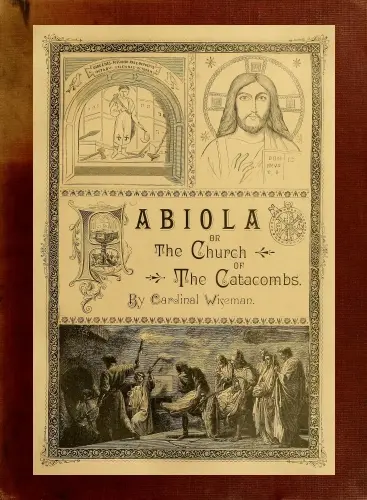
[109] There are several repetitions of this painting. One has been lately found, if we remember right, in the cemetery of Nereus and Achilleus. It is long anterior to the Council of Chalcedon, whence this mode of representing our Lord is usually dated. It is given in our title-page.
[110] The Lateran house or palace.
[111] Inscription on the front, and medals, of the Lateran Basilica.
[112] These are the very words of Decius, on the election of St. Cornelius to the See of St. Peter: “Cum multo patientius audiret levari adversum se æmulum principem, quam constitui Romæ Dei sacerdotem.” S. Cypr. Ep. lii. ad Antonianum, p. 69, ed. Maur. Could there be a stronger proof, that under the heathen empire, the papal power was sensible and external, even to the extent of exciting imperial jealousy?
[113] “As a sated guest.”
[114] A fashionable watering-place near Naples.
[115] A large earthenware vessel, in which wine was kept in the cellar.
[116] These instruments of cruelty are mentioned in the Acts of the Martyrs, and in ecclesiastical historians.
[117] “Sopra l’antichissimo altare di legno, rinchiuso nell’ altare papale,” &c. “On the most ancient wooden altar, enclosed in the papal altar of the most holy Lateran basilica.” By Monsig. D. Bartolini. Rome, 1852.
[118] Acts x.
[119] 2 Tim. iv. 21.
Your reading position is saved on this browser. Take it to another device with a library code. Reading pages adapt to text, rather than matching a printed edition.
BEHIND THE BOOK
This eBook is for the use of anyone anywhere in the United States and most other parts of the world at no cost and with almost no restrictions whatsoever. You may copy it, give it away or re-use it under the terms of the Project Gutenberg License included with this eBook or online at www.gutenberg.org. If you are not located in the United States, you will have to check the laws of the country where you are located before using this eBook. Read the source licence.
The original source file, including credits and licence, is retained by this library. Request an original-format copy at no charge. Please include the book title and Project Gutenberg identifier #62254.
KEEP YOUR CURIOSITY GOING
Cécile Tormay

Moritz Busch
Coulson Kernahan
John L. Ransom

Maurice Baring
Frances Wright