THE CLASSIC COLLECTION✦An outlaw’s diary: the CommuneCLASSIC FREE BOOKS
An outlaw’s diary: the Commune
Cécile Tormay
THE CLASSIC COLLECTION · 1885
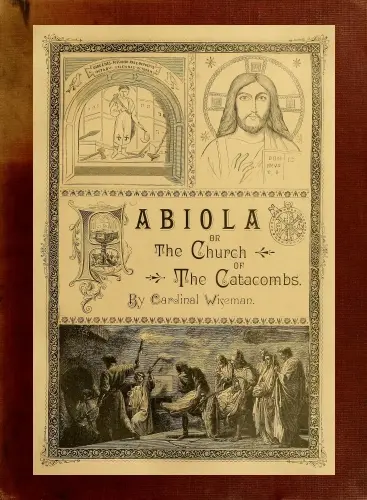
"Fabiola; Or, The Church of the Catacombs" by Nicholas Patrick Wiseman is a novel first published in 1854. Set in early fourth-century Rome during Diocletian's persecution of Christians, the story follows Fabiola, a spoiled noblewoman whose encounter with her Christian slave girl Syra sparks an unexpected transformation. Meanwhile, young Pancratius prepares for martyrdom while facing betrayal from his nemesis Corvinus. The novel weaves real martyrdom accounts with fictional drama, exploring themes of faith, forgiveness, and community among Rome's underground Christians.
Introduction adapted from the source catalogue; source summaries may be automatically generated.
Free to read · English · 141,871 words · No account needed
MAKE TIME FOR A GOOD BOOK
On by default. Untick to stop anonymous reading totals. Each page counts after 10 seconds in view. How this works.
Anonymous counting is on unless you have switched it off.
“As any one can be,” struck in Fabiola, “who, in offering his hand, expresses himself equally ready, in three hours, to espouse or to murder the object of his affection. And she prefers the latter, and he keeps his word. Begone from my presence; you taint the very atmosphere in which you move.”
“I will leave when I have accomplished my task, and you will have little reason to rejoice when I do. You have then purposely, and unprovoked, blighted and destroyed in me every honorable purpose of life, withered my only hope, cut me off from rank, society, respectable ease, and domestic happiness.
“That was not enough. After acting in that character, with which you summed up my condemnation, of a spy, and listened to my conversation, you this morning threw off all sense of female propriety, and stood forward prominently in the Forum, to complete in public what you had begun in private, excite against me the supreme tribunal, and through it the emperor, and arouse an unjust popular outcry and vengeance; such as, but for a feeling stronger than fear, which brings me hither, would make me now skulk, like a hunted wolf, till I could steal out of the nearest gate.”
“And, Fulvius, I tell you,” interposed Fabiola, “that the moment you cross its threshold, the average of virtue will be raised in this wicked city. Again I bid you depart from my house, at least; or at any rate I will withdraw from this offensive intrusion.”
“We part not yet, lady,” said Fulvius, whose countenance had been growing every moment more flushed, as his lips had been becoming more deadly pale. He rudely grasped her arm, and pushed her back to her seat; “and beware,” he added, “how you attempt again either to escape or to bring aid; your first cry will be your last, cost me what it may.
“You have made me, then, an outcast, not only from society but from Rome, an exile, a houseless wanderer on a friendless earth; was not that enough to satisfy your vengeance? No: you must needs rob me of my gold, of my rightfully, though painfully earned wealth; peace, reputation, my means of subsistence, all you have stolen from me, a youthful stranger.”
“Wicked and insolent man!” exclaimed now the indignant Roman lady, reckless of consequences, “you shall answer heavily for your temerity. Dare you, in my own house, call me a thief?”
Your reading position is saved on this browser. Take it to another device with a library code. Reading pages adapt to text, rather than matching a printed edition.
BEHIND THE BOOK
This eBook is for the use of anyone anywhere in the United States and most other parts of the world at no cost and with almost no restrictions whatsoever. You may copy it, give it away or re-use it under the terms of the Project Gutenberg License included with this eBook or online at www.gutenberg.org. If you are not located in the United States, you will have to check the laws of the country where you are located before using this eBook. Read the source licence.
The original source file, including credits and licence, is retained by this library. Request an original-format copy at no charge. Please include the book title and Project Gutenberg identifier #62254.
KEEP YOUR CURIOSITY GOING
Cécile Tormay

Moritz Busch
Coulson Kernahan
John L. Ransom

Maurice Baring
Frances Wright