THE CLASSIC COLLECTION✦An outlaw’s diary: the CommuneCLASSIC FREE BOOKS
An outlaw’s diary: the Commune
Cécile Tormay
THE CLASSIC COLLECTION · 1885
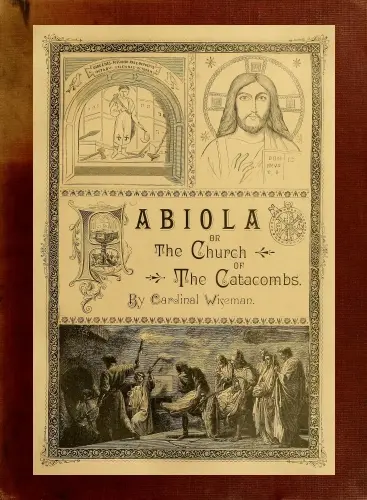
"Fabiola; Or, The Church of the Catacombs" by Nicholas Patrick Wiseman is a novel first published in 1854. Set in early fourth-century Rome during Diocletian's persecution of Christians, the story follows Fabiola, a spoiled noblewoman whose encounter with her Christian slave girl Syra sparks an unexpected transformation. Meanwhile, young Pancratius prepares for martyrdom while facing betrayal from his nemesis Corvinus. The novel weaves real martyrdom accounts with fictional drama, exploring themes of faith, forgiveness, and community among Rome's underground Christians.
Introduction adapted from the source catalogue; source summaries may be automatically generated.
Free to read · English · 141,871 words · No account needed
MAKE TIME FOR A GOOD BOOK
On by default. Untick to stop anonymous reading totals. Each page counts after 10 seconds in view. How this works.
Anonymous counting is on unless you have switched it off.
“And you, Syra,” interposed the mistress, with a contemptuous smile, “what would you desire? and what have you to praise of your own doing?”
“Nothing to desire, noble lady, but that you may be ever happy; nothing to praise of my own doing, for I am not conscious of having done more than my duty,” was the modest and sincere reply.
It did not please the haughty lady, who said, “Methinks, slave, that you are not over given to praise. One seldom hears a soft word from your mouth.”
“And what worth would it be from me,” answered Syra; “from a poor servant to a noble dame, accustomed to hear it all day long from eloquent and polished lips? Do you believe it when you hear it from them? Do you not despise it when you receive it from us?”
A look of spite was darted at her from her two companions. Fabiola, too, was angry at what she thought a reproof. A lofty sentiment in a slave!
“Have you yet to learn, then,” she answered haughtily, “that you are mine, and have been bought by me at a high price, that you might serve me as I please? I have as good a right to the service of your tongue as of your arms; and if it please me to be praised, and flattered, and sung to, by you, do it you shall, whether you like it or not. A new idea, indeed, that a slave has to have any will but that of her mistress, when her very life belongs to her!”
“True,” replied the handmaid, calmly but with dignity, “my life belongs to you, and so does all else that ends with life,--time, health, vigor, body, and breath. All this you have bought with your gold, and it has become your property. But I still hold as my own what no emperor’s wealth can purchase, no chains of slavery fetter, no limit of life contain.”
“And pray what is that?”
“A soul.”
“A soul!” re-echoed the astonished Fabiola, who had never before heard a slave claim ownership of such a property. “And pray, let me ask you, what you mean by the word?”
“I cannot speak philosophical sentences,” answered the servant, “but I mean that inward living consciousness within me, which makes me feel to have an existence with, and among, better things than surround me, which shrinks sensitively from destruction, and instinctively from what is allied to it, as disease is to death. And therefore it abhors all flattery, and it detests a lie. While I possess that unseen gift, and die it cannot, either is impossible to me.”
Your reading position is saved on this browser. Take it to another device with a library code. Reading pages adapt to text, rather than matching a printed edition.
BEHIND THE BOOK
This eBook is for the use of anyone anywhere in the United States and most other parts of the world at no cost and with almost no restrictions whatsoever. You may copy it, give it away or re-use it under the terms of the Project Gutenberg License included with this eBook or online at www.gutenberg.org. If you are not located in the United States, you will have to check the laws of the country where you are located before using this eBook. Read the source licence.
The original source file, including credits and licence, is retained by this library. Request an original-format copy at no charge. Please include the book title and Project Gutenberg identifier #62254.
KEEP YOUR CURIOSITY GOING
Cécile Tormay

Moritz Busch
Coulson Kernahan
John L. Ransom

Maurice Baring
Frances Wright