THE CLASSIC COLLECTION✦An outlaw’s diary: the CommuneCLASSIC FREE BOOKS
An outlaw’s diary: the Commune
Cécile Tormay
THE CLASSIC COLLECTION · 1885
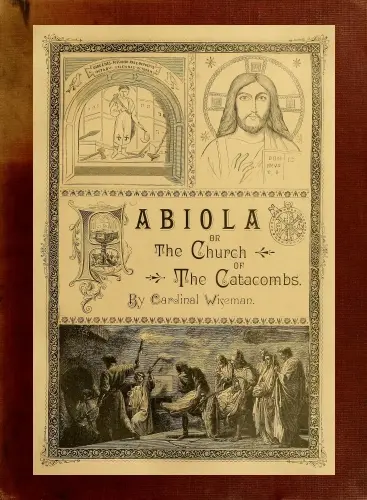
"Fabiola; Or, The Church of the Catacombs" by Nicholas Patrick Wiseman is a novel first published in 1854. Set in early fourth-century Rome during Diocletian's persecution of Christians, the story follows Fabiola, a spoiled noblewoman whose encounter with her Christian slave girl Syra sparks an unexpected transformation. Meanwhile, young Pancratius prepares for martyrdom while facing betrayal from his nemesis Corvinus. The novel weaves real martyrdom accounts with fictional drama, exploring themes of faith, forgiveness, and community among Rome's underground Christians.
Introduction adapted from the source catalogue; source summaries may be automatically generated.
Free to read · English · 141,871 words · No account needed
MAKE TIME FOR A GOOD BOOK
On by default. Untick to stop anonymous reading totals. Each page counts after 10 seconds in view. How this works.
Anonymous counting is on unless you have switched it off.
“None whatever. Fulvius, of course, will apply for his share; and the probability is, that the emperor will declare he intends to take it all for himself. For he hates Fulvius. But if I propose a more popular and palpably reasonable plan, of giving the property to the nearest relation, who worships the gods--this Fabiola does, don’t she?”
“Certainly, father.”
“I think he will embrace it: while I am sure there is no chance of his making a free gift to me. The proposal from a judge would enrage him.”
“Then how will you manage it, father?”
“I will have an imperial rescript prepared during the night, ready for signature; and I will proceed immediately after the execution to the palace, magnify the unpopularity which is sure to follow it, lay it all on Fulvius, and show the emperor how his granting the property to the next in the settlement of it, will redound greatly to his credit and glory. He is as vain as he is cruel and rapacious; and one vice must be made to fight another.”
“Nothing could be better, my dear father; I shall retire to rest with an easy mind. To-morrow will be the critical day of my life. All my future depends upon whether I am accepted or rejected.”
“I only wish,” added Tertullus, rising, “that I could have seen this peerless lady, and sounded the depths of her philosophy, before your final bargain was struck.”
“Fear not, father: she is well worthy of being your daughter-in-law. Yes, to-morrow is indeed the turning-point of my fortunes.”
Even Corvinus can have his critical day. Why not Fabiola?
While this domestic interview was going on, a conference was taking place between Fulvius and his amiable uncle. The latter, entering late, found his nephew sitting sullen and alone in the house, and thus accosted him:
“Well, Fulvius, is she secured?”
“She is, uncle, as fast as bars and walls can make her; but her spirit is free and independent as ever.”
“Never mind that: sharp steel makes short work of spirit. Is her fate certain? and are its consequences sure?”
“Why, if nothing else happens, the first is safe; the second have still to encounter imperial caprice. But I own I feel pain and remorse at sacrificing so young a life, and for an insecure result.”
“Come, Fulvius,” said the old man sternly, looking as cold as a grey rock in the morning mist; “no softness, I hope, in this matter. Do you remember what day is to-morrow?”
“Yes, the twelfth before the calends of February.”[195]
“The critical day always for you. It was on this day that to gain another’s wealth, you committed----”
Your reading position is saved on this browser. Take it to another device with a library code. Reading pages adapt to text, rather than matching a printed edition.
BEHIND THE BOOK
This eBook is for the use of anyone anywhere in the United States and most other parts of the world at no cost and with almost no restrictions whatsoever. You may copy it, give it away or re-use it under the terms of the Project Gutenberg License included with this eBook or online at www.gutenberg.org. If you are not located in the United States, you will have to check the laws of the country where you are located before using this eBook. Read the source licence.
The original source file, including credits and licence, is retained by this library. Request an original-format copy at no charge. Please include the book title and Project Gutenberg identifier #62254.
KEEP YOUR CURIOSITY GOING
Cécile Tormay

Moritz Busch
Coulson Kernahan
John L. Ransom

Maurice Baring
Frances Wright