THE CLASSIC COLLECTION✦An outlaw’s diary: the CommuneCLASSIC FREE BOOKS
An outlaw’s diary: the Commune
Cécile Tormay
THE CLASSIC COLLECTION · 1885
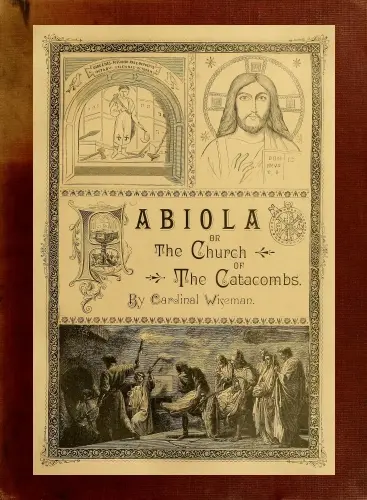
"Fabiola; Or, The Church of the Catacombs" by Nicholas Patrick Wiseman is a novel first published in 1854. Set in early fourth-century Rome during Diocletian's persecution of Christians, the story follows Fabiola, a spoiled noblewoman whose encounter with her Christian slave girl Syra sparks an unexpected transformation. Meanwhile, young Pancratius prepares for martyrdom while facing betrayal from his nemesis Corvinus. The novel weaves real martyrdom accounts with fictional drama, exploring themes of faith, forgiveness, and community among Rome's underground Christians.
Introduction adapted from the source catalogue; source summaries may be automatically generated.
Free to read · English · 141,871 words · No account needed
MAKE TIME FOR A GOOD BOOK
On by default. Untick to stop anonymous reading totals. Each page counts after 10 seconds in view. How this works.
Anonymous counting is on unless you have switched it off.
She sat alone at home, and tried to read; she took up volume after volume of favorite works on Death, on Fortitude, on Friendship, on Virtue; and every one of them seemed insipid, unsound, and insincere. She plunged into a deeper and a deeper melancholy, which lasted till towards evening, when she was disturbed by a letter being put into her hand. The Greek slave, Graja, who brought it in, retired to the other end of the room, alarmed and perplexed by what she witnessed. For her mistress had scarcely glanced over the note, than she leaped up wildly from her seat, threw her hair into disorder with her hands, which she pressed, as in agony, on her temples, stood thus for a moment, looking up with an unnatural stare in her eyes, and then sank heavily down again on her chair with a deep groan. Thus she remained for some minutes, holding the letter in both her hands, with her arms relaxed, apparently unconscious.
“Who brought this letter?” she then asked, quite collected.
“A soldier, madam,” answered the maid.
“Ask him to come here.”
While her errand was being delivered, she composed herself, and gathered up her hair. As soon as the soldier appeared she held this brief dialogue:
“Whence do you come?”
“I am on guard at the Tullian prison.”
“Who gave you the letter?”
“The Lady Agnes herself.”
“On what cause is the poor child there?”
“On the accusation of a man named Fulvius, for being a Christian.”
“For nothing else?”
“For nothing, I am sure.”
“Then we shall soon set that matter right. I can give witness to the contrary. Tell her I will come presently; and take this for your trouble.”
The soldier retired, and Fabiola was left alone. When there was something to do her mind was at once energetic and concentrated, though afterwards the tenderness of womanhood might display itself the more painfully. She wrapped herself close up, proceeded alone to the prison, and was at once conducted to the separate cell, which Agnes had obtained in consideration of her rank, backed by her parents’ handsome largitions.
“What is the meaning of this, Agnes?” eagerly inquired Fabiola, after a
warm embrace.
“I was arrested a few hours ago, and brought hither.”
“And is Fulvius fool enough, as well as scoundrel, to trump up an accusation against you, which five minutes will confute? I will go to Tertullus myself, and contradict his absurd charge at once.”
“What charge, dearest?”
“Why, that you are a Christian.”
“And so I am, thank God!” replied Agnes, making on herself the sign of
the cross.
Your reading position is saved on this browser. Take it to another device with a library code. Reading pages adapt to text, rather than matching a printed edition.
BEHIND THE BOOK
This eBook is for the use of anyone anywhere in the United States and most other parts of the world at no cost and with almost no restrictions whatsoever. You may copy it, give it away or re-use it under the terms of the Project Gutenberg License included with this eBook or online at www.gutenberg.org. If you are not located in the United States, you will have to check the laws of the country where you are located before using this eBook. Read the source licence.
The original source file, including credits and licence, is retained by this library. Request an original-format copy at no charge. Please include the book title and Project Gutenberg identifier #62254.
KEEP YOUR CURIOSITY GOING
Cécile Tormay

Moritz Busch
Coulson Kernahan
John L. Ransom

Maurice Baring
Frances Wright