THE CLASSIC COLLECTION✦An outlaw’s diary: the CommuneCLASSIC FREE BOOKS
An outlaw’s diary: the Commune
Cécile Tormay
THE CLASSIC COLLECTION · 1885
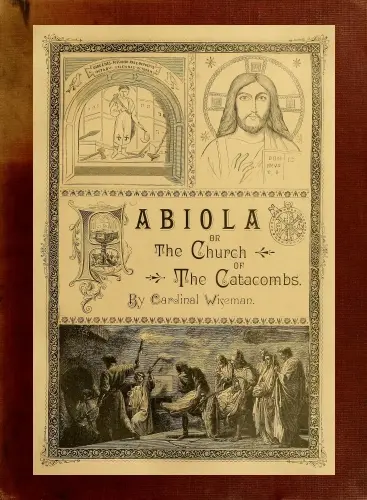
"Fabiola; Or, The Church of the Catacombs" by Nicholas Patrick Wiseman is a novel first published in 1854. Set in early fourth-century Rome during Diocletian's persecution of Christians, the story follows Fabiola, a spoiled noblewoman whose encounter with her Christian slave girl Syra sparks an unexpected transformation. Meanwhile, young Pancratius prepares for martyrdom while facing betrayal from his nemesis Corvinus. The novel weaves real martyrdom accounts with fictional drama, exploring themes of faith, forgiveness, and community among Rome's underground Christians.
Introduction adapted from the source catalogue; source summaries may be automatically generated.
Free to read · English · 141,871 words · No account needed
MAKE TIME FOR A GOOD BOOK
On by default. Untick to stop anonymous reading totals. Each page counts after 10 seconds in view. How this works.
Anonymous counting is on unless you have switched it off.
“Surely, Eurotas, you would prefer my trying to get this wealth by honorable,” (Eurotas smiled at the idea coming into either of their minds) “rather than by foul, means.”
“Get it, get it any way, provided it be the surest and the speediest. You know our compact. Either the family is restored to wealth and splendor, or it ends in and with you. It shall never linger on in disgrace, that is, in poverty.”
“I know, I know, without your every day reminding me of the bitter condition,” said Fulvius, wringing his hands, and writhing in all his body. “Give me time enough, and all will be well.”
“I give you time, till all is hopeless. Things do not look bright at present. But, Fulvius, it is time that I tell you who I am.”
“Why, were you not my father’s faithful dependant, to whose care he
intrusted me?”
“I was your father’s elder brother, Fulvius, and am the head of the family. I have had but one thought, but one aim in life, the restoring of our house to that greatness and splendor, from which my father’s negligence and prodigality had brought it down. Thinking that your father, my brother, had greater ability than myself for this work, I resigned my rights and gains to him upon certain terms; one of which was your guardianship, and the exclusive forming of your mind. You know how I have trained you, to care nothing about the means, so that our great ends be carried.”
Fulvius, who had been riveted with amazement and deep attention on the speaker, shrunk into himself with shame, at this baring of both their hearts. The dark old man fixed his eyes more intently than ever, and went on:
“You remember the black and complicated crime by which we concentrated in your hands the divided remnant of family wealth.”
Fulvius covered his face with his hands and shuddered, then said entreatingly, “Oh, spare me that, Eurotas; for heaven’s sake spare me!”
“Well, then,” resumed the other, unmoved as ever, “I will be brief. Remember, nephew, that he who does not recoil from a brilliant future, to be gained by guilt, must not shrink from a past that prepared it by crime. For the future will one day be the past. Let our compact, therefore, be straightforward and honest, for there is an honesty even in sin. Nature has given you abundance of selfishness and cunning, and she has given me boldness and remorselessness in directing and applying them. Our lot is cast by the same throw,--we become rich, or die, together.”
Your reading position is saved on this browser. Take it to another device with a library code. Reading pages adapt to text, rather than matching a printed edition.
BEHIND THE BOOK
This eBook is for the use of anyone anywhere in the United States and most other parts of the world at no cost and with almost no restrictions whatsoever. You may copy it, give it away or re-use it under the terms of the Project Gutenberg License included with this eBook or online at www.gutenberg.org. If you are not located in the United States, you will have to check the laws of the country where you are located before using this eBook. Read the source licence.
The original source file, including credits and licence, is retained by this library. Request an original-format copy at no charge. Please include the book title and Project Gutenberg identifier #62254.
KEEP YOUR CURIOSITY GOING
Cécile Tormay

Moritz Busch
Coulson Kernahan
John L. Ransom

Maurice Baring
Frances Wright