THE CLASSIC COLLECTION✦An outlaw’s diary: the CommuneCLASSIC FREE BOOKS
An outlaw’s diary: the Commune
Cécile Tormay
THE CLASSIC COLLECTION · 1885
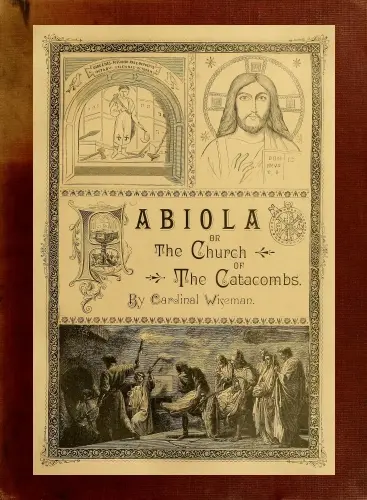
"Fabiola; Or, The Church of the Catacombs" by Nicholas Patrick Wiseman is a novel first published in 1854. Set in early fourth-century Rome during Diocletian's persecution of Christians, the story follows Fabiola, a spoiled noblewoman whose encounter with her Christian slave girl Syra sparks an unexpected transformation. Meanwhile, young Pancratius prepares for martyrdom while facing betrayal from his nemesis Corvinus. The novel weaves real martyrdom accounts with fictional drama, exploring themes of faith, forgiveness, and community among Rome's underground Christians.
Introduction adapted from the source catalogue; source summaries may be automatically generated.
Free to read · English · 141,871 words · No account needed
MAKE TIME FOR A GOOD BOOK
On by default. Untick to stop anonymous reading totals. Each page counts after 10 seconds in view. How this works.
Anonymous counting is on unless you have switched it off.
She blushed and remained silent. Could he have seen her put into the poor old man’s purse her own share of the alms?
“You have owned yourself a Christian?” he asked negligently.
“Oh, yes! how could I deny it?”
“Then that meeting was a Christian meeting?”
“Certainly; what else could it be?”
He wanted no more; his suspicions were verified. Agnes, about whom Torquatus had been able or willing to tell him nothing, was certainly a Christian. His game was made. She must yield, or he would be avenged.
After a pause, looking at her steadfastly, he said, “Do you know whither
you are going?”
“Before the judge of earth, I suppose, who will send me to my Spouse in
heaven.”
“And so calmly?” he asked in surprise; for he could see no token from the soul to the countenance, but a smile.
“So joyfully rather,” was her brief reply.
Having got all that he desired, he consigned his prisoner to Corvinus at the gates of the Æmilian basilica, and left her to her fate. It had been a cold and drizzling day like the preceding evening. The weather, and the incident of the night, had kept down all enthusiasm; and while the prefect had been compelled to sit in-doors, where no great crowd could collect, as hours had passed away without any arrest, trial, or tidings, most of the curious had left, and only a few more persevering remained, past the hour of afternoon recreation in the public gardens. But just before the captive arrived, a fresh knot of spectators came in, and stood near one of the side-doors, from which they could see all.
As Corvinus had prepared his father for what he was to expect, Tertullus, moved with some compassion, and imagining there could be little difficulty in overcoming the obstinacy of a poor, ignorant, blind beggar, requested the spectators to remain perfectly still, that he might try his persuasion on her, alone, as she would imagine, with him; and he threatened heavy penalties on any one who should presume to break the silence.
It was as he had calculated. Cæcilia knew not that any one else was there, as the prefect thus kindly addressed her:
“What is thy name, child?”
“Cæcilia.”
“It is a noble name; hast thou it from thy family?”
“No; I am not noble; except because my parents, though poor, died for Christ. As I am blind, those who took care of me called me Cæca,[153] and then, out of kindness, softened it into Cæcilia.”
Your reading position is saved on this browser. Take it to another device with a library code. Reading pages adapt to text, rather than matching a printed edition.
BEHIND THE BOOK
This eBook is for the use of anyone anywhere in the United States and most other parts of the world at no cost and with almost no restrictions whatsoever. You may copy it, give it away or re-use it under the terms of the Project Gutenberg License included with this eBook or online at www.gutenberg.org. If you are not located in the United States, you will have to check the laws of the country where you are located before using this eBook. Read the source licence.
The original source file, including credits and licence, is retained by this library. Request an original-format copy at no charge. Please include the book title and Project Gutenberg identifier #62254.
KEEP YOUR CURIOSITY GOING
Cécile Tormay

Moritz Busch
Coulson Kernahan
John L. Ransom

Maurice Baring
Frances Wright