THE CLASSIC COLLECTION✦An outlaw’s diary: the CommuneCLASSIC FREE BOOKS
An outlaw’s diary: the Commune
Cécile Tormay
THE CLASSIC COLLECTION · 1885
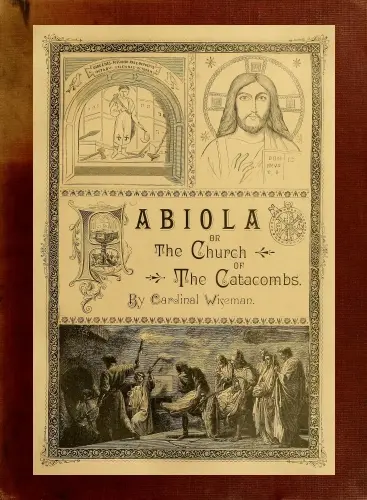
"Fabiola; Or, The Church of the Catacombs" by Nicholas Patrick Wiseman is a novel first published in 1854. Set in early fourth-century Rome during Diocletian's persecution of Christians, the story follows Fabiola, a spoiled noblewoman whose encounter with her Christian slave girl Syra sparks an unexpected transformation. Meanwhile, young Pancratius prepares for martyrdom while facing betrayal from his nemesis Corvinus. The novel weaves real martyrdom accounts with fictional drama, exploring themes of faith, forgiveness, and community among Rome's underground Christians.
Introduction adapted from the source catalogue; source summaries may be automatically generated.
Free to read · English · 141,871 words · No account needed
MAKE TIME FOR A GOOD BOOK
On by default. Untick to stop anonymous reading totals. Each page counts after 10 seconds in view. How this works.
Anonymous counting is on unless you have switched it off.
“I feel,” she said at last to Sebastian, “how very kind it is of you, to come thus to put me on my guard; and I admire the delicacy with which you have unfolded so disagreeable a matter, and the tenderness with which you have treated every one concerned.”
“I have only done in this instance,” replied the soldier, “what I should have done for any human being,--save him, if possible, from pain or danger.”
“Your friends, I hope you mean,” said Fabiola, smiling; “otherwise I fear your whole life would go, in works of unrequited benevolence.”
“And so let it go; it could not be better spent.”
“Surely, you are not in earnest, Sebastian. If you saw one who had ever hated you, and sought your destruction, threatened with a calamity, which would make him harmless, would you stretch out your hand to save, or succor, him?”
“Certainly I would. While God sends His sunshine and His rain equally upon His enemies, as upon His friends, shall weak man frame another rule of justice?”
At these words Fabiola wondered; they were so like those of her mysterious parchment, identical with the moral theories of her slave.
“You have been in the East, I believe, Sebastian,” she asked him, rather abruptly; “was it there that you learnt these principles? For I have one near me, who is yet, by her own choice, a servant, a woman of rare moral perceptions, who has propounded to me the same ideas; and she is an Asiatic.”
“It is not in any distant country that I learnt them; for here I sucked them in with my mother’s milk; though, originally, they doubtless came from the East.”
“They are certainly beautiful in the abstract,” remarked Fabiola; “but death would overtake us before we could half carry them out, were we to make them our principles of conduct.”
“And how better could death find us, though not surprise us, than in thus doing our duty, even if not to its completion?”
“For my part,” resumed the lady, “I am of the old Epicurean poet’s mind. This world is a banquet, from which I shall be ready to depart when I have had my fill--ut conviva satur[113]--and not till then. I wish to read life’s book through, and close it calmly, only when I have finished its last page.”
Sebastian shook his head, smiling, and said, “The last page of this world’s book comes but in the middle of the volume, wherever ‘death’ may happen to be written. But on the next page begins the illuminated book of a new life--without a last page.”
Your reading position is saved on this browser. Take it to another device with a library code. Reading pages adapt to text, rather than matching a printed edition.
BEHIND THE BOOK
This eBook is for the use of anyone anywhere in the United States and most other parts of the world at no cost and with almost no restrictions whatsoever. You may copy it, give it away or re-use it under the terms of the Project Gutenberg License included with this eBook or online at www.gutenberg.org. If you are not located in the United States, you will have to check the laws of the country where you are located before using this eBook. Read the source licence.
The original source file, including credits and licence, is retained by this library. Request an original-format copy at no charge. Please include the book title and Project Gutenberg identifier #62254.
KEEP YOUR CURIOSITY GOING
Cécile Tormay

Moritz Busch
Coulson Kernahan
John L. Ransom

Maurice Baring
Frances Wright