THE CLASSIC COLLECTION✦An outlaw’s diary: the CommuneCLASSIC FREE BOOKS
An outlaw’s diary: the Commune
Cécile Tormay
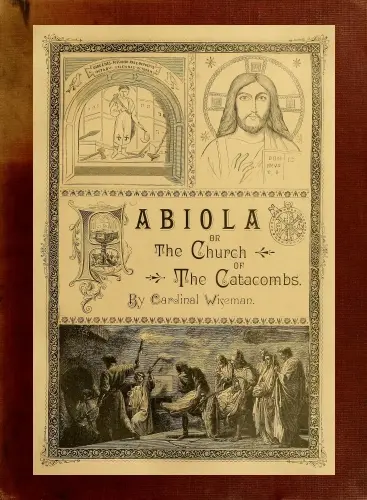
THE CLASSIC COLLECTION · 1885
"Fabiola; Or, The Church of the Catacombs" by Nicholas Patrick Wiseman is a novel first published in 1854. Set in early fourth-century Rome during Diocletian's persecution of Christians, the story follows Fabiola, a spoiled noblewoman whose encounter with her Christian slave girl Syra sparks an unexpected transformation. Meanwhile, young Pancratius prepares for martyrdom while facing betrayal from his nemesis Corvinus. The novel weaves real martyrdom accounts with fictional drama, exploring themes of faith, forgiveness, and community among Rome's underground Christians.
Introduction adapted from the source catalogue; source summaries may be automatically generated.
Free to read · English · 141,871 words · No account needed
MAKE TIME FOR A GOOD BOOK
On by default. Untick to stop anonymous reading totals. Each page counts after 10 seconds in view. How this works.
Anonymous counting is on unless you have switched it off.
“Oh, do not talk of me, my dear mistress; but look at the simple principle; you honor it in others, too. Do you despise, or do you respect, Aristides, for obliging a boorish enemy, by writing, when asked, his own name on the shell that voted his banishment? Do you, as a Roman lady, contemn or honor the name of Coriolanus, for his generous forbearance to your city?”
“I venerate both, most truly, Syra; but then you know those were heroes, and not every-day men.”
“And why should we not all be heroes?” asked Syra, laughing.
“Bless me, child! what a world we should live in, if we were. It is very pleasant reading about the feats of such wonderful people; but one would be very sorry to see them performed by common men, every day.”
“Why so?” pressed the servant.
“Why so? who would like to find a baby she was nursing, playing with, or strangling, serpents in the cradle? I should be very sorry to have a gentleman, whom I invited to dinner, telling me coolly he had that morning killed a minotaur, or strangled a hydra; or to have a friend offering to send the Tiber through my stables, to cleanse them. Preserve us from a generation of heroes, say I.” And Fabiola laughed heartily at the conceit. In the same good humor Syra continued:
“But suppose we had the misfortune to live in a country where such monsters existed, centaurs and minotaurs, hydras and dragons. Would it not be better that common men should be heroes enough to conquer them, than that we should have to send off to the other side of the world for a Theseus, or a Hercules, to destroy them? In fact, in that case, a man would be no more a hero if he fought them, than a lion-slayer is in my country.”
“Quite true, Syra; but I do not see the application of your idea.”
“It is this: anger, hatred, revenge, ambition, avarice, are to my mind as complete monsters as serpents or dragons; and they attack common men as much as great ones. Why should not I try to be as able to conquer them as Aristides, or Coriolanus, or Cincinnatus? Why leave it to heroes only, to do what we can do as well?”
“And do you really hold this as a common moral principle? If so, I fear you will soar too high.”
“No, dear lady. You were startled when I ventured to maintain that inward and unseen virtue was as necessary as the outward and visible: I fear I must surprise you still more.”
“Go on, and do not fear to tell me all.”
Your reading position is saved on this browser. Take it to another device with a library code. Reading pages adapt to text, rather than matching a printed edition.
BEHIND THE BOOK
This eBook is for the use of anyone anywhere in the United States and most other parts of the world at no cost and with almost no restrictions whatsoever. You may copy it, give it away or re-use it under the terms of the Project Gutenberg License included with this eBook or online at www.gutenberg.org. If you are not located in the United States, you will have to check the laws of the country where you are located before using this eBook. Read the source licence.
The original source file, including credits and licence, is retained by this library. Request an original-format copy at no charge. Please include the book title and Project Gutenberg identifier #62254.
KEEP YOUR CURIOSITY GOING
Cécile Tormay

Moritz Busch
Coulson Kernahan
John L. Ransom

Maurice Baring
Frances Wright