THE CLASSIC COLLECTION✦An outlaw’s diary: the CommuneCLASSIC FREE BOOKS
An outlaw’s diary: the Commune
Cécile Tormay
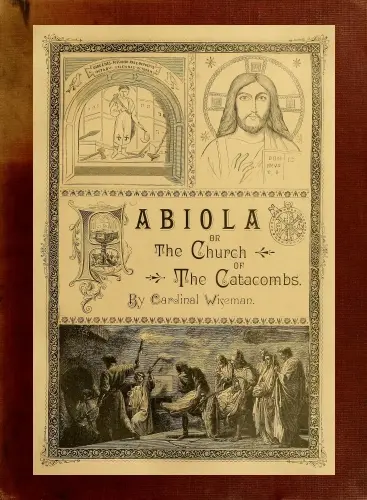
THE CLASSIC COLLECTION · 1885
"Fabiola; Or, The Church of the Catacombs" by Nicholas Patrick Wiseman is a novel first published in 1854. Set in early fourth-century Rome during Diocletian's persecution of Christians, the story follows Fabiola, a spoiled noblewoman whose encounter with her Christian slave girl Syra sparks an unexpected transformation. Meanwhile, young Pancratius prepares for martyrdom while facing betrayal from his nemesis Corvinus. The novel weaves real martyrdom accounts with fictional drama, exploring themes of faith, forgiveness, and community among Rome's underground Christians.
Introduction adapted from the source catalogue; source summaries may be automatically generated.
Free to read · English · 141,871 words · No account needed
MAKE TIME FOR A GOOD BOOK
On by default. Untick to stop anonymous reading totals. Each page counts after 10 seconds in view. How this works.
Anonymous counting is on unless you have switched it off.
Her passion of tears was long and tender. Her heart was getting above her intellect; and this can only be by its increasing softness. At length she grew calm; and as she withdrew her embrace she said:
“One thing more, Syra: dare one address, by worship, this Being whom you have described to me? Is He not too great, too lofty, too distant for this?”
“Oh, no! far from it, noble lady,” answered the servant. “He is not distant from any of us; for as much as in the light of the sun, so in the very splendor of His might, His kindness, and His wisdom, we live and move and have our being. Hence, one may address Him, not as far off, but as around us and within us, while we are in Him; and He hears us not with ears, but our words drop at once into His very bosom, and the desires of our hearts pass directly into the divine abyss of His.”
“But,” pursued Fabiola, somewhat timidly, “is there no great act of acknowledgment, such as sacrifice is supposed to be, whereby He may be formally recognized and adored?”
Syra hesitated, for the conversation seemed to be trenching upon mysterious and sacred ground, never opened by the Church to profane foot. She, however, answered in a simple and general affirmative.
“And could not I,” still more humbly asked her mistress, “be so far instructed in your school as to be able to perform this sublimer act of homage?”
“I fear not, noble Fabiola; one must needs obtain a Victim worthy of the
Deity.”
“Ah, yes! to be sure,” answered Fabiola. “A bull may be good enough for Jupiter, or a goat for Bacchus; but where can be found a sacrifice worthy of Him whom you have brought me to know?”
“It must indeed be one every way worthy of Him, spotless in purity, matchless in greatness, unbounded in acceptableness.”
“And what can that be, Syra?”
“Only Himself.”
Fabiola shrouded her face with her hands, and then looking up earnestly into Syra’s face, said to her:
“I am sure that, after having so clearly described to me the deep sense of responsibility under which you must habitually speak, as well as act, you have a real meaning in this awful saying, though I understand you not.”
“As surely as every word of mine is heard, as every thought of mine is seen, it is a truth which I have spoken.”
“I have not strength to carry the subject further at present; my mind
has need of rest.”
Your reading position is saved on this browser. Take it to another device with a library code. Reading pages adapt to text, rather than matching a printed edition.
BEHIND THE BOOK
This eBook is for the use of anyone anywhere in the United States and most other parts of the world at no cost and with almost no restrictions whatsoever. You may copy it, give it away or re-use it under the terms of the Project Gutenberg License included with this eBook or online at www.gutenberg.org. If you are not located in the United States, you will have to check the laws of the country where you are located before using this eBook. Read the source licence.
The original source file, including credits and licence, is retained by this library. Request an original-format copy at no charge. Please include the book title and Project Gutenberg identifier #62254.
KEEP YOUR CURIOSITY GOING
Cécile Tormay

Moritz Busch
Coulson Kernahan
John L. Ransom

Maurice Baring
Frances Wright