THE CLASSIC COLLECTION✦An outlaw’s diary: the CommuneCLASSIC FREE BOOKS
An outlaw’s diary: the Commune
Cécile Tormay
THE CLASSIC COLLECTION · 1885
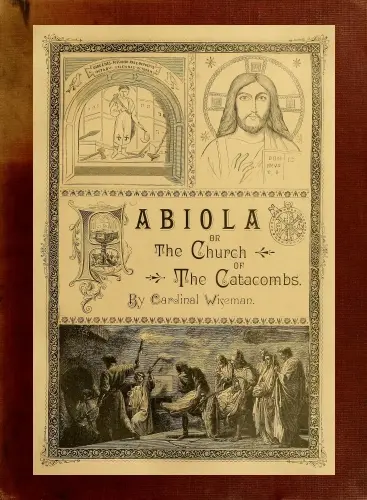
"Fabiola; Or, The Church of the Catacombs" by Nicholas Patrick Wiseman is a novel first published in 1854. Set in early fourth-century Rome during Diocletian's persecution of Christians, the story follows Fabiola, a spoiled noblewoman whose encounter with her Christian slave girl Syra sparks an unexpected transformation. Meanwhile, young Pancratius prepares for martyrdom while facing betrayal from his nemesis Corvinus. The novel weaves real martyrdom accounts with fictional drama, exploring themes of faith, forgiveness, and community among Rome's underground Christians.
Introduction adapted from the source catalogue; source summaries may be automatically generated.
Free to read · English · 141,871 words · No account needed
MAKE TIME FOR A GOOD BOOK
On by default. Untick to stop anonymous reading totals. Each page counts after 10 seconds in view. How this works.
Anonymous counting is on unless you have switched it off.
“True, my mistress; and what is the action of the mind, or as I call it the soul, but thought? A passion which wishes death, is the action of this invisible power, like it, unseen; the blow which inflicts it is but the mechanical action of the body, discernible like its origin. But which power commands, and which obeys? In which resides the responsibility of the final effect?”
“I understand you,” said Fabiola, after a pause of some little mortification. “But one difficulty remains. There is responsibility, you maintain, for the inward, as well as the outward act. To whom? If the second follow, there is joint responsibility for both, to society, to the laws, to principles of justice, to self; for painful results will ensue. But if only the inward action exist, to whom can there be responsibility? Who sees it? Who can presume to judge it? Who to control it?”
“God,” answered Syra, with simple earnestness.
Fabiola was disappointed. She expected some new theory, some striking principle, to come out. Instead, they had sunk down into what she feared was mere superstition, though not so much as she once had deemed it. “What, Syra, do you then really believe in Jupiter, and Juno, or perhaps Minerva, who is about the most respectable of the Olympian family? Do you think they have any thing to do with our affairs?”
“Far indeed from it; I loathe their very names, and I detest the wickedness which their histories or fables symbolize on earth. No, I spoke not of gods and goddesses, but of one only God.”
“And what do you call Him, Syra, in your system?”
“He has no name but GOD; and that only men have given Him, that they may speak of Him. It describes not His nature, His origin, His attributes.”
“And what are these?” asked the mistress, with awakened curiosity.
“Simple as light is His nature, one and the same every where, indivisible, undefilable, penetrating yet diffusive, ubiquitous and unlimited. He existed before there was any beginning; He will exist after all ending has ceased. Power, wisdom, goodness, love, justice too, and unerring judgment belong to Him by His nature, and are as unlimited and unrestrained as it. He alone can create, He alone preserve, and He alone destroy.”
Fabiola had often read of the inspired looks which animated a sibyl, or the priestess of an oracle; but she had never witnessed them till now. The slave’s countenance glowed, her eyes shone with a calm brilliancy, her frame was immovable, the words flowed from her lips, as if these were but the opening of a musical reed, made vocal by another’s breath.
Your reading position is saved on this browser. Take it to another device with a library code. Reading pages adapt to text, rather than matching a printed edition.
BEHIND THE BOOK
This eBook is for the use of anyone anywhere in the United States and most other parts of the world at no cost and with almost no restrictions whatsoever. You may copy it, give it away or re-use it under the terms of the Project Gutenberg License included with this eBook or online at www.gutenberg.org. If you are not located in the United States, you will have to check the laws of the country where you are located before using this eBook. Read the source licence.
The original source file, including credits and licence, is retained by this library. Request an original-format copy at no charge. Please include the book title and Project Gutenberg identifier #62254.
KEEP YOUR CURIOSITY GOING
Cécile Tormay

Moritz Busch
Coulson Kernahan
John L. Ransom

Maurice Baring
Frances Wright