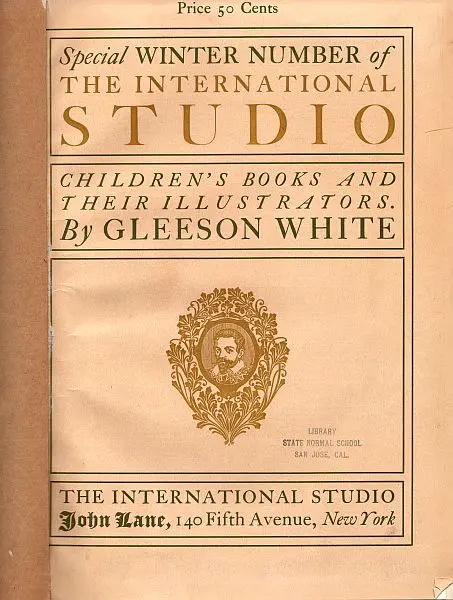
Children’s Books and Their Illustrators
Gleeson White
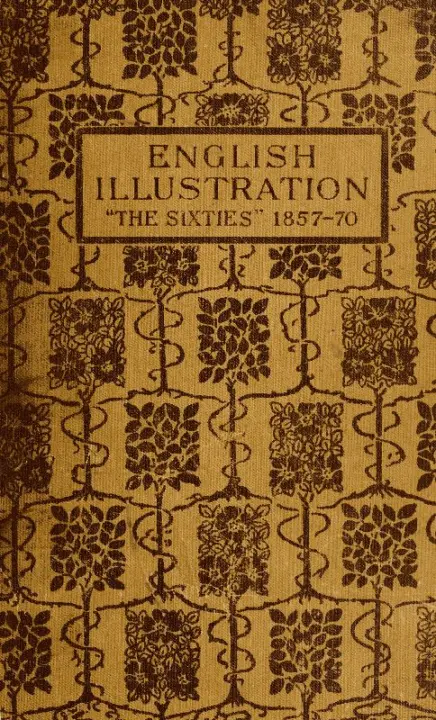
THE CLASSIC COLLECTION · 1903
"English Illustration 'The Sixties': 1855-70" by Gleeson White is a collection of critical essays and analyses written in the late 19th century. The work primarily focuses on the art and significance of various illustrators and illustrated periodicals from the 1860s, assessing their contributions to English literature and visual culture during this time. White reflects on how societal and aesthetic changes in this period influenced public perception of illustration and the artist's role. The opening of the volume sets the stage for a deep exploration of mid-Victorian illustration. Gleeson White expresses the need to reevaluate and appreciate the artists of the 1860s, who had once been overshadowed by painters but are now recognized for their merit in visual storytelling. He discusses the evolution of public interest in illustrations, linking it to a broader cultural shift that has made past styles and artists more appealing. This introduction suggests a rich examination of the art of the period and how it intermingled with societal trends, setting the groundwork for comprehensive discussions in subsequent chapters.
Introduction adapted from the source catalogue; source summaries may be automatically generated.
Free to read · English · 83,355 words · No account needed
MAKE TIME FOR A GOOD BOOK
On by default. Untick to stop anonymous reading totals. Each page counts after 10 seconds in view. How this works.
Anonymous counting is on unless you have switched it off.
In vol. iii. 1863 there is a drawing, The Confession (p. 37), engraved by Dalziel, that is possibly by Pinwell. Three by T. Morten, After the Opera (p. 39), A Struggle in the Clouds (p. 287), and Ruth Grey's Trial (p. 59), are good, if not the best of this artist's work. Two by George Du Maurier (pp. 209, 216) employ, after the manner of the time, a sort of pictured parable entitled On the Bridge and Under the Bridge. Our Honeymoon, by Marcus Stone, is interesting. Struck Down (p. 106) and The Heiress of Elkington (p. 345), both by J. D. Watson, are as good as his work is usually. A May Morning (p. 428), by George H. Thomas, is also worthy of mention, but the rest, by E. K. Johnson, E. H. Corbould, W. Brunton, W. Cave Thomas, Louis Huard, etc., are not peculiarly attractive.
The concluding volume for 1863 has a very dainty figure, Honey-Dew, by M. J. Lawless (p. 554). The three Du Mauriers are A Little Hop in Harley St. (p. 469), Lords: University Cricket Match (p. 161), and the Worship of Bacchus (p. 192) at first sight so curiously like a Charles Keene that, were it not for the signature, one would distrust the index. Nine drawings by T. Morten to The First Time are good, especially those on p. 180, and A First Attempt, Charles Green (p. 205), is also worth notice. Two drawings by G. J. Pinwell, Wolsey (p. 311) and another (p. 319), are characteristic. For the rest, C. H. Bennett, Louis Huard, Felix Darley, W. M'Connell, W. Brunton, Matt Morgan, Florence Claxton, T. Godwin, Waldo Sargent, George Thomas, and C. A. Doyle, provide entrées and sweets a little flavourless to-day, although palatable enough, no doubt, at the time.
In 1864, M. J. Lawless's Not for You (p. 85); a fine J. D. Watson, The Duet (p. 268); Charley Blake, by G. Du Maurier (p. 385); At Swindon (p. 41), M. E. Edwards, and Little Golden Hair, by R. Barnes, are the only others above the average. Adelaide Claxton, W. M'Connell, H. Sanderson, and J. B. Zwecker provide most of the rest. The second half of the year (vol. vi.) is far better, contains some good work by the 'talented young lady,' M. E. E. (to quote contemporary praise); that her work was talented all students of the 'sixties' will agree. A Holocaust (p. 433), Dangerous (p. 353), Gone (p. 185), Magdalen (p. 553), Milly's Success (p. 269), and Unto this Last (p. 252) are all by Miss Edwards. A fine Millais, Knightly Worth (p. 247), and a good J. D. Watson, Blankton Weir (p. 416), would alone make the volume memorable. C. A. Doyle has some of his best drawings to A Shy Man, and G. H. Thomas and others maintain a good average. Rebecca Solomon has a good full page (p. 541). In the extra Christmas number you will find E. J. Poynter's A Sprig of Holly (p. 28), J. D. Watson's Story of a Christmas Fairy (p. 24), a notable design, besides capital illustrations by Du Maurier, R. Dudley (The Blue Boy), R. Barnes, and Marcus Stone.
Your reading position is saved on this browser. Take it to another device with a library code. Reading pages adapt to text, rather than matching a printed edition.
Gleeson White
BEHIND THE BOOK
This eBook is for the use of anyone anywhere in the United States and most other parts of the world at no cost and with almost no restrictions whatsoever. You may copy it, give it away or re-use it under the terms of the Project Gutenberg License included with this eBook or online at www.gutenberg.org. If you are not located in the United States, you will have to check the laws of the country where you are located before using this eBook. Read the source licence.
The original source file, including credits and licence, is retained by this library. Request an original-format copy at no charge. Please include the book title and Project Gutenberg identifier #45426.
KEEP YOUR CURIOSITY GOING

David Patterson (Spirit) Hatch

David Patterson (Spirit) Hatch

David Patterson (Spirit) Hatch
Cécile Tormay

Moritz Busch
John L. Ransom