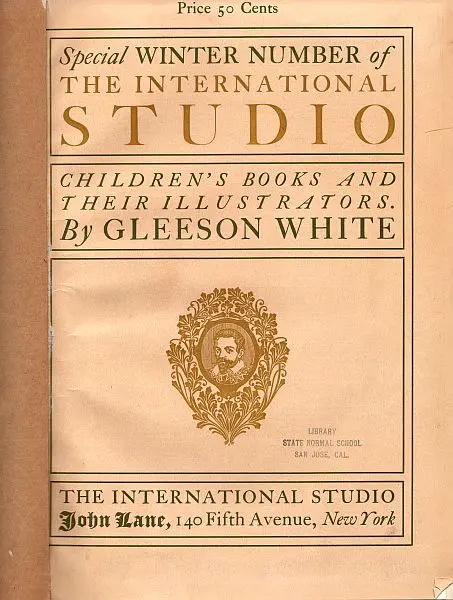
Children’s Books and Their Illustrators
Gleeson White
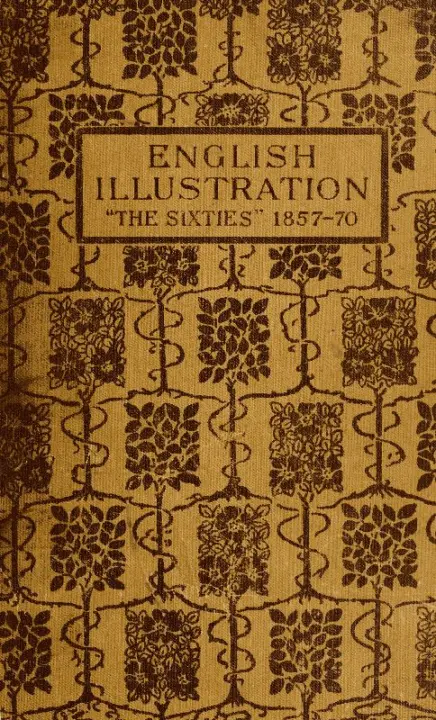
THE CLASSIC COLLECTION · 1903
"English Illustration 'The Sixties': 1855-70" by Gleeson White is a collection of critical essays and analyses written in the late 19th century. The work primarily focuses on the art and significance of various illustrators and illustrated periodicals from the 1860s, assessing their contributions to English literature and visual culture during this time. White reflects on how societal and aesthetic changes in this period influenced public perception of illustration and the artist's role. The opening of the volume sets the stage for a deep exploration of mid-Victorian illustration. Gleeson White expresses the need to reevaluate and appreciate the artists of the 1860s, who had once been overshadowed by painters but are now recognized for their merit in visual storytelling. He discusses the evolution of public interest in illustrations, linking it to a broader cultural shift that has made past styles and artists more appealing. This introduction suggests a rich examination of the art of the period and how it intermingled with societal trends, setting the groundwork for comprehensive discussions in subsequent chapters.
Introduction adapted from the source catalogue; source summaries may be automatically generated.
Free to read · English · 83,355 words · No account needed
MAKE TIME FOR A GOOD BOOK
On by default. Untick to stop anonymous reading totals. Each page counts after 10 seconds in view. How this works.
Anonymous counting is on unless you have switched it off.
T. Morten has a finely-engraved night-piece, Pictures in the Fire (p. 200), besides The Christmas Child (p. 56) and The Carrier Pigeon (p. 121). The Holman Hunt, Go and Come (p. 32), a weeping figure, is not particularly interesting. Honesty (p. 736), by T. Graham, gives evidence of the power of an artist who has yet to be 'discovered' so far as his illustrations are concerned. H. H. Armstead's Seaweeds (p. 568), and eight by J. D. Watson (pp. 9, 81, 144, 201, 209, 302, 400, 433) need no special comment, nor do the ten by J. Pettie (pp. 264-713). Fred Walker is represented by The Summer Woods, a typical pastoral (p. 368), Love in Death, a careworn woman in the snow (p. 185), and Out among the wild flowers (p. 657), the latter an excellent example of the grace he imparted to rustic figures. These, with a few diagrams and engravings from photographs, complete the record of a memorable, if not the most memorable, year of the magazine.
In 1863 we find less variety in the artists and subjects, which is due to the presence of the superb series of drawings by Millais, The Parables, wherein the great illustrator touched his highest level. To call these twelve pictures masterpieces is for once to apply consistently a term often misused. For, though one ransacked the portfolios of Europe, not many sets of drawings could be found to equal, and very few to excel them. The twelve subjects appeared in the following order: The Leaven (p. 1), The Ten Virgins (p. 81), The Prodigal Son (p. 161), The Good Samaritan (p. 241), The Unjust Judge (p. 313), The Pharisee and Publican (p. 385), The Hid Treasure (p. 461), The Pearl of Great Price (p. 533), The Lost Piece of Money[1] (p. 605), The Sower (p. 677), The Unmerciful Servant (p. 749), and The Labourers in the Vineyard (p. 821). To F. Sandys two drawings are attributed; one is obviously from another hand, but Sleep (p. 589) undoubtedly marks his final appearance in this magazine. T. Morten is represented by Cousin Winnie (p. 257), Hester Durham (p. 492), The Spirit of Eld (p. 629, unsigned), a powerful composition that at first glance might almost be taken for a Sandys, and An Orphan Family's Christmas (p. 844). In Autumn Thoughts (p. 743) we have an example of J. W. North, more akin to those he contributed to the Dalziel table-books, a landscape, with a fine sense of space, despite the fact that it is enclosed by trees. John Tenniel, in The Norse Princess (p. 201) and Queen Dagmar (p. 344), finds subjects that suit him peculiarly well. The Summer Snow (p. 380), attributed to 'Christopher' Jones, is by Sir Edward Burne-Jones of course, and the final contribution of the artist to these pages. H. J. Lucas, a name rarely encountered, has one drawing, The Sangreal (p. 454). A. Boyd Houghton, in St. Elmo (p. 64), A Missionary Cheer (p. 547), and Childhood (p. 636), is showing the more mature style of his best period. G. J. Pinwell has but a single drawing, Martin Ware's Temptation (p. 573), and that not peculiarly individual; John Pettie appears with six, The Monks and the Heathen (p. 14), The Passion Flowers of Life (p. 141), a study of an old man seated in a creeper-covered porch with a child on his lap, The Night Walk over the Mill Stream (p. 185), and Not above his Business (p. 272), A Touch of Nature (p. 417), and The Negro (p. 476). To a later generation, who only know the pictures of the Royal Academician, these come as a surprise, and prove the versatility of an artist whose painting was somewhat mannered. Walter Crane's--a fine group of oriental sailors--Treasure-trove (p. 795), and J. D. Watson's six drawings are all capable and accomplished; A Pastoral (p. 32), a very elaborate composition which looks like a copy of an oil-painting, Fallen in the Night (p. 97), The Curate of Suverdsio (p. 333), The Aspen (p. 401), Rhoda (p. 520), and Olive Shand's Partner (p. 774), with the not very important Sheep and Goats wrongly attributed to Sandys, two decorated pages by John Leighton, one drawing by E. W. Cooke and five by T. Graham, complete the year's record.
Your reading position is saved on this browser. Take it to another device with a library code. Reading pages adapt to text, rather than matching a printed edition.
Gleeson White
BEHIND THE BOOK
This eBook is for the use of anyone anywhere in the United States and most other parts of the world at no cost and with almost no restrictions whatsoever. You may copy it, give it away or re-use it under the terms of the Project Gutenberg License included with this eBook or online at www.gutenberg.org. If you are not located in the United States, you will have to check the laws of the country where you are located before using this eBook. Read the source licence.
The original source file, including credits and licence, is retained by this library. Request an original-format copy at no charge. Please include the book title and Project Gutenberg identifier #45426.
KEEP YOUR CURIOSITY GOING

David Patterson (Spirit) Hatch

David Patterson (Spirit) Hatch

David Patterson (Spirit) Hatch
Cécile Tormay

Moritz Busch
John L. Ransom